
Thank you for your patience, whilst there was a short delay. Sadly this was not caused by my relocation to a new abode, because the house I viewed first, and set my heart on, went to someone else. Instead it was caused by the website needing to be remastered to counteract the effects of what is referred to in the press as "the php problem" - and that ended in a much happier way, with a greatly updated site and the addition of green ink to the palette, which you will see popping up all over the place. Some things may be out of kilter though, so if you find anything that does not look quite right do let me know, at the same email as always, which is webmaster@card-world.co.uk
This week we are going to continue with the theme of firsts, and discover the first set ever to have been mentioned by name in a card magazine. That was a very long time ago, almost a hundred years, and the magazine was the first ever edition of the London Cigarette Card Company`s "Cigarette Card News", published as Volume One, Number One, and dated for October 1933, retailed at a cost of just two pence.
The article in question comes right on page one,
HOW AND WHY,
In our belief, the principal tests are accuracy, readability and informativeness; everything published should be of interest and service to either the specialist or general collector. Now, the heaven-sent writer on specialized subjects is not easy to find anywhere. In the case of our hobby, where the written word has up to now been singularly lacking, he "(or she) is about as rare a bird as a complete set of Wills' 1895 Cricketers.
Now some of us are already scurrying to our reference books, but there is no need, as this is a bit of a cartophilic "in joke" - for there was actually no set by that name, the first set of Wills` "Cricketers" definitely not being issued until 1896. Therefore the 1895 set was "as rare a bird" to have never existed at all. To discover the first actual set we must continue reading the very same paragraph, which continues with :
We felt, therefore, a certain amount of the explorer's pride of discovery when we first read the contributions of Lady Margaret MacRae, C. H. Matthews, C. T. Gregory, R. H. Malcolm and the rest of our galaxy. Seriously, they know what they are writing about, and they can write about it, and that was what we wanted. You may have a very sketchy knowledge of your subject if you write for the "Daily Snippet," provided you can converse in the current jargon. But someone who would not know the difference between "Wills' "Railway Locos" and Phillips' "Railway Engines," and would care less, is no good to us, even if he contrived, as he doubtless would if he knew* the tricks of the trade, to grind out a chatty article....
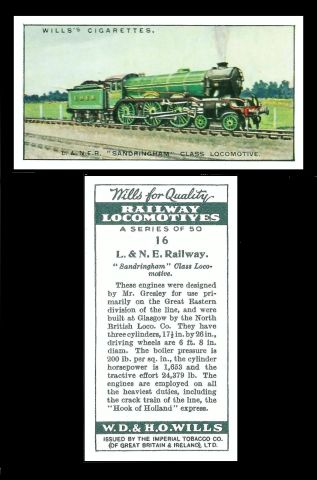
Now at first you may think that this is another "in joke", because another trip to your reference books will not find any Wills set called "Railway Locos" either, but it is but a shortening, of their 1930 set "Railway Locomotives", which, rather thrillingly, is a set we have not featured before on this website.
Its actually one of nine sets with "Railway" in the title issued by Wills in the nineteen twenties and thirties, namely :
- 50 Railway Engines - home issue - January 1924
- 50 Railway Engines - New Zealand issue - October 1925
- 50 Railway Working - with "Wills" at back - 1925?, month not recorded
- 50 Railway Working - anonymous backs - 1925?, month not recorded
- 50 Railway Locomotives - home issue - December 1930
- 50 Railway Engines - home issue - May 1936
- 50 Railway Engines - Irish issue - 1936?, month not recorded
- 50 Railway Equipment - home issue - April 1939
- 50 Railway Equipment - Channel Islands issue - 1939?, month not recorded
Perhaps that plethora accounts for the way as to why our set has a rather scant description in our original Wills booklet part four (which, coincidentally, is where you will find all the sets listed above) - which reads just :
- 306. RAILWAY LOCOMOTIVES. Fronts printed by letterpress in colour. Backs in grey, with descriptive text. Home issue, 1930.
By the time of our original World Tobacco Issues Index this had dropped still more, to :
- RAILWAY LOCOMOTIVES. Sm. Nd. (50) ... W62-171
However, don`t think that this set is a boring one, because it is definitely not, and it is also not confined to trains within the British Isles, for the full line up is as follows.
- 1. G.W.R. "King George V"
2. G.W.R. "Launceston Castle"
3. L.M. & S.R. High Pressure Locomotive
4. L.M. & S.R. Compound Express Locomotive
5. L.M. & S.R. "Garratt" Mineral Locomotive
6. L.M. & S.R. L.&Y. Type Express Locomotive
7. L.M. & S.R. "Mogul" Type
8. L.M. & S.R. "Royal Scot"
9. L.N.E.R. "Cock O'The North"
10. L.N.E.R. "County" Class
11. L.N.E.R. "Director" Class
12. L.N.E.R. "Enterprise"
13. L.N.E.R. G.C. Type Express Locomotive
14. L. & N.E.R. High Pressure Compound Locomotive
15. L.N.E.R. "Mikado" Freight Locomotive
16. L. & N.E.R. "Sandringham" Class Locomotive
17. Metropolitan Ry. Goods Tank Locomotive
18. Southern Ry. Express Locomotive
19. Southern Ry. "King Arthur" Type
20. Southern Ry. "Lord Nelson" Type
21. Gold Coast Rys. "Governor" Class
22. Kenya & Uganda Ry. "Mikado" Freight Locomotive
23. Rhodesian Rys. "Mountain" Type
24. S. African Rys. Beyer Garratt Locomotive
25. S. African Rys. "Modified Fairlie" Locomotive
26. S. African Rys. "Pacific" Type
27. Sudan Govt. Rys. "Mikado" Freight Locomotive
28. N.S.W. Govt. Rys. Express Locomotive
29. N.S.W. Govt. Rys. Freight Locomotive
30. Queensland Govt. Rys. "Pacific" Passenger Locomotive
31. S. Australian Govt. Rys. "Pacific" Express Locomotive
32. Victorian Govt. Rys. New "Pacific" Type
33. Canadian National Rys. Express Locomotive
34. Canadian National Rys. Freight Locomotive
35. Canadian Pacific Ry. New Express Locomotive
36. C.P.R. Oil-Burning Freight Locomotive
37. Canadian Pacific Ry. Freight Locomotive
38. Assam Bengal Ry. Freight Locomotive
39. G.I.P.R. Express Locomotive
40. Indian State Rys. "Pacific" Type
41. Gt. Southern Ry. (Ireland) Express Locomotive
42. New Zealand Govt. Rys. Passenger Locomotive
43. Belgian National Ry. "Type 10" Express Locomotive
44. Northern Ry. France "Superpacific" Express Locomotive
45. German State Rys. "Pacific" Express Locomotive
46. Italian State Rys. "Ansaloo" Express Locomotive
47. Madrid, Zaragoza & Alicante Ry. Express Locomotive
48.Baltimore & Ohio R.R. (U.S.A.) "President" Class
49. Union Pacific R.R. (U.S.A.) "Mountain" Type
50. Virginian R.R. (U.S.A.) Mallet Locomotive
Despite this line up of far flung places, when I asked about for a card the first scan in was from someone knowing full well of my current quest to find a suitable place in Norfolk for nipper and I to rent. And so what they sent was card 16, an "L. & N.E.R . "Sandringham" Class" Locomotive".
That story actually starts in 1862, when several railways across parts of East Anglia were brought together under a different name, that of The Great Eastern Railway. That lasted until 1923, when it became part of the London & North Eastern Railway. Anyway when the London & North Eastern took over, the rolling stock was insufficient for the number of people who were travelling to East Anglia, both in quantity, and in weight carrying ability. Attempting to fix more coaches to the train only served to make the journey slower. What was really needed were faster newer trains. It also proved impossible to simply move bigger trains from other parts of the network. The catalyst was the General Strike, when the coal was hard to come by and rather inferior to that usually mined, which made the situation so much worse in every way.
Once things were back to normal, the management ordered Nigel Gresley (who was still ten years away from his knighthood) to produce a brand new design. In actual fact they asked for two designs, but eventually decided against the expense of that and just had the one. There was also much wrangling with the design and the costings, so much so that the contract for the drawings was taken away and given to the North British Locomotive Company, ostensibly to improve the drawings that had been given. They had none of that, and it appears they decided instead to start from virtually scratch, with the original artwork simply binned. However, the London & North Eastern Railway also found fault with their new designs and eventually what were supplied were pretty much copies of an existing train which had been built by the North British Locomotive Company, and used by the Great Eastern Railway since 1924, although changes were made, including some so small as not to be noticeable.
The first of these new trains arrived at the end of November 1928, and it would turn out to be the first of fifty-two, though the design was modified as the production went along. There were also severe engineering faults that resulted in strengthening measures being added. That first train was number 2800, and it was called Sandringham, perhaps because although all the trains were to be named after English country estates and houses, the most famous country house was the royal one, Sandringham, bought by Queen Victoria for the Prince of Wales in 1861, who would later become Edward the Seventh, and still remaining the country house of His Majesty, King George the Fifth, whom, by the way, gave his personal permission for the name of his residence to be immortalised on this train. Indeed, King George the Sixth was born there, at York Cottage, on December the 14th, 1895.
I have to say that as I look at the list of these train names today I am amazed at how many country estates there were - and you can also spot that by the pair of sets issued by John Player in 1908 and 1909 as "Country Seats and Arms", seventy-five cards in all. Today these have, for the most part, gone, either demolished, handed to the state as museums, or converted into flats. But one of the survivors, maybe because of its connection to royalty, is Sandringham, which is another reason for the inclusion of this card. The next two trains in the "Sandringham Class" also used Norfolk names, 2801 Holkham, and 2802 Walsingham, but the fourth was 2803 Framlingham in Suffolk. Then they moved to Suffolk for train 2804 Elveden, before returning to their roots with 2805 Burnham Thorpe. Now this train was the first to be renamed, in 1938, to Lincolnshire Regiment.
This system of naming lasted until number 2848, when some of the trains started to be re-named after football clubs. This is why these trains are sometimes known as the "Footballer" Class. That train started out its life as Thoresby Park, but in 1938 it became Tottenham Hotspur. The second train to be renamed in this way was Rendlesham Hall, which, also in 1938, became Norwich City. In fact Rendlesham Hall itself was already empty, and it would be demolished in 1949, thirty one years before the area was again in the news - for UFO sightings, in the forest, six miles away. The first train to actually begin its life with a football name was number 1648, and that was Arsenal. After that, the next twenty five trains, were all given football names from the outset, namely Sheffield United, Grimsby Town, Derby County, Darlington, Huddersfield Town, Sunderland, Middlesborough, Leeds United, Doncaster Rovers, Newcastle United, Norwich City, Hull City, Sheffield Wednesday, Manchester United, Everton, Liverpool, Leicester City, Nottingham Forest, Bradford, Bradford City, Barnsley, Manchester City, and West Ham United, which was the final train in the class, number 2872.
Now you may have noticed an anomaly, which I will explain now, which is the fact that there are only twenty four clubs and twenty five trains. It is nothing to do with UFOs, though, it is explained by the fact that in 1937, only four months after number 2870 had taken the tracks named as Manchester City, it was renamed City of London. But in the meantime the very next train, 2871, which was well along in production, had been given the old name plate and become Manchester City again. Two other trains from this group were also renamed, Newcastle United to The Essex Regiment in 1936, and Norwich City, which became East Anglian in 1937. That was why, if we go back to an earlier paragraph, in 1938 Rendlesham Hall was forcibly renamed to Norwich City, for it was suddenly realised that an East Anglian line was celebrating all these football clubs from across the country, but not the primary one within their area.
It is entirely possible, as I have been told, that the idea of calling the trains after football clubs was to make them more relevant to the general public. But I think it is perhaps more than that - for the whole idea of one man with a big country house and lots of grounds was already falling out of favour with that general public. And maybe this is the first example of a large company moving away from the current rule of the upper class to cater to the feelings of those who no longer wanted to be held beneath.
Sadly, in the early 1950s these trains began to be withdrawn, and all were gone by the end of the decade. Our train was one of the last to survive, right until 1959. All were scrapped, and not a single one appears in any railway museum or private collection, though rather wonderfully many of the football club name plates were taken off pre-scrapping and given to the clubs. I have been unable to find out how many of those still survive.
As for Sandringham itself, that was once reached by a single track branch of the Lynn and Hunstanton railway, which began at Kings Lynn, and steamed upwards for ten minutes. The local station was Wolferton, two miles east of Sandringham, which opened in 1862, but that line is also no more. The last bundle of freight left on the twenty-eighth of December, 1964; the final Royal Train departed in 1966; and the last regular passengers waved goodbye on May the fifth, 1969. The station at Wolferton still exists, under private ownership, and has a small museum. And part of the former tracks can be cycled or walked along, you can see the signposts from the train as you come towards Kings Lynn station if you are sitting on the correct side.
Cards of the actual Sandringham House are not as hard to find as you probably imagine, and I know of :
- Pritchard and Burton "Royalty Series" (1902) cards not numbered
- Wills "Coronation Series" (1902) card 44
- Fry "Ancient Sundials" (1924) card 5
- Anonymous/B.A.T. "Beautiful England" (1925) card 19
- Westminster "British Royal and Ancient Buildings" (1925) card 30
- R. J. Lea "Famous Views" (1936) card 37
- Senior Service "Sights of Britain" (1936) card 1
- Godfrey Phillips "Coronation of their Majesties" (1937) card 46
- Hill "Views of Interest" first series (1938) card 37
- Ardath "Real Photographs of Famous Landmarks" (1939) card 27
- Ty-Phoo Tea "Famous Buildings" (1955) card 5
- Lamberts Tea "Historic East Anglia" (1961) card 7
To newsletters past :
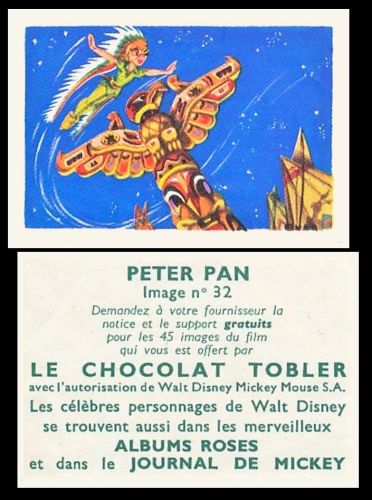
Actually this week I have indexed two back issues, and was starting a third when the temporary hiatus came. Then, when we rejigged the website, we had to take it back slightly in date, and the cards I had entered only that morning did not survive. These have now been restored, because I still had them on disc, but doing that slowed me finishing that third edition, but not because there were loads of cards to change, as there was actually only one card to alter in that entire third newsletter, for the 7th of May, 2022, and it was this one, for Monday the 9th of May, which is now become the small form of Chocolat Tobler`s "Les Celebres Personnages de Walt Disney", with a proper card back - and not another one of the postcard backed ones that we used later on. The thing that actually slowed me down was that I was experimenting with the new capability to line up the caption centrally beneath the card, which is something that will eventually spread across the website.
The next earliest of those newsletters was for the 14th of May, 2022, in which, on rechecking there were a couple of gaps, caused by the removal of the new cards.
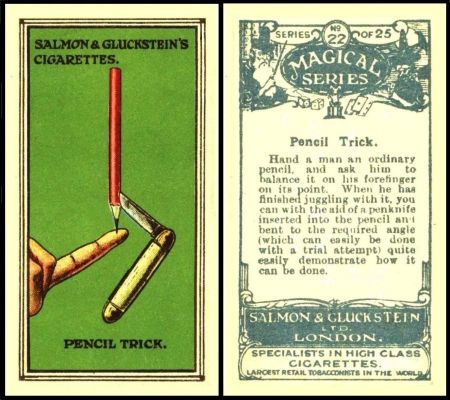
These started with this Salmon and Gluckstein`s "Magical Series" which had been added in on Monday the 16th of May, to take the place of a strange image, only showing the reverse of an unidentified Ty-phoo tea set with a fountain pen on it. I felt it was quicker to change the card than try to find out which set the back was from and then relocate the card to add the front. The only other change was to the card immediately thereafter, for Tuesday the 17th of May, which is now a Liebig card from "Paesaggi dell Alaska", issued in 1957, instead of yet another American Tobacco "Flags". Though I do expect I will find several more of that set as I work on back.
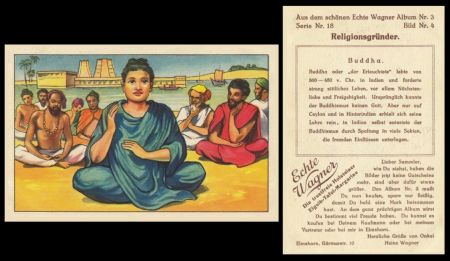
The newsletter of the 21st of May 2022 also had a couple of changes. The first one was a new card for World Meditation Day, which, that year, was on Saturday the 21st of May. It was the sleeping Buddha from the "Architectural Monuments" section of Morris`s "General Interest", but we have used that section before, so it is now one of those lovely cards issued by Echte Wagner with margarine. The title of the set is actually "Religionsgrunder" which translates not to world religions but to the founders of religions, hence our card was not of Buddhism but of Buddha himself. The other founders are Christus, Confuzius, Mohammed, Moses, and Zarathustra. It`s such a lovely set that it appears here, though we did also change Monday the 23rd of May to Ogden`s "Trick Billiards". But the rest of that edition remains the same as it was when originally published.
To back issues published in this week in times gone by, they are as follows :
- https://csgb.co.uk/publications/newsletter/2021-11-13
- https://csgb.co.uk/publications/newsletter/2022-11-12
- https://csgb.co.uk/publications/newsletter/2023-11-11
- https://csgb.co.uk/publications/newsletter/2024-11-09
- https://csgb.co.uk/publications/newsletter/2025-11-08
- https://csgb.co.uk/publications/newsletter/2025-11-15
As to what is going on this week, well here are the dates of our forthcoming meetings :
- Monday the 16th of November : London - from 5 p.m, with an auction, of approximately 100 lots, starting at 6 p.m. That`s held at The Carpenters Arms” 12, Seymour Place, Marble Arch, Central London W1E 7NE, and it is free entry to all collectors. Might be a good chance to combine some Christmas shopping, or nip in on your way home from work.
- Friday the 20th of November : North West - from 4 until 8 p.m, at Barton Village Hall, Garstang Road, Broughton, Preston, Lancashire PR3 5HE.
- Saturday the 21st of November : East Anglia- from 8.00 a.m. to 3.00 p.m. - with auction at 11 p.m, at Roydon Village Hall, High Road, Roydon, Diss, Norfolk IP22 5RB. EACC members get free admission with their annual subscription, and visitors pay £3. This month the dealers booked in are Peter Beer, Steve/Paula Lewis, Daryn Moyse,
John Shaw, Richard Buckle, Brian Pentalow, and Robert Butterworth -- a full house of delights.
by the way, thanks to everyone who has now sent in their 2027 dates. These are flagged up in our diary section as they are added, so if your branch name has no flag please do send your dates in asap please.
And so there we must bring our weekly journey and reminiscing to a close. I hope you had fun along the way, and picked up some useful snippets with which to entertain your friends. Thanks for stopping by. And don`t forget to pop back next week to see what we will discover together then.