
Is it just me, or has the week shrunk... because now it definitely seems that Saturday is coming up much faster than it used to. Or maybe that was because I spent two nights watching the Eurovision Song Contest....? Anyway here Saturday is, and here, also, is a new newsletter, which I hope will entertain, inspire, and amuse... And don`t forget if there is an anniversary or important date coming up in your thematic interest, just send us an email - webmaster@card-world.co.uk - and we can work on it together
Website News :
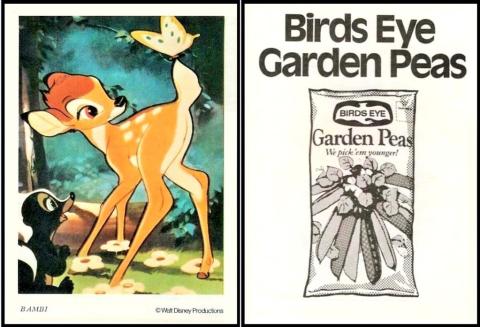
This week we have also found the time to index a number of back issues of our newsletter, namely those of the 21st of October 2023, the 28th of October 2023, the 4th of November 2023, the 11th of November 2023, the 18th of November 2023 and the 25th of November 2023. Most of these were added without much effort, but there are now entirely new cards - this one, of Walt Disney`s Bambi, replacing a duplicate of F. & J. Smith`s "Famous Explorers" in the 11th of November 2023 edition - and a Lorillard "Circus Scenes" replacing a duplicate of Gallaher`s "Great War Series" in the 21st of October 2023 edition
What`s On This Week
We are hot off the mark this week, starting with today, Saturday the 16th of May, up in East Anglia. They meet from 8.30 a.m. to 3.30 p.m. - and have an auction at 11 p.m - at Roydon Village Hall, High Road, Roydon, Diss, Norfolk IP22 5RB. East Anglia club members get in free with their annual subscription, everyone else pays £3 admission each time.
Then tomorrow, Sunday the 17th of May. the Cotswolds Branch has an
All Day Fair, from 9 am until 3 pm at Uckington Village Hall, The Green, Tewkesbury Road, Uckington, Cheltenham GL51 9SR
Monday the 18th of May is London Branch, they meet from 5 p.m., upstairs at The Carpenters Arms” 12, Seymour Place, Marble Arch, Central London W1E 7NE, and also hold an auction of approximately 100 lots, starting at 6 p.m. If you are in the area, for work or pleasure, remember admission is free to this one, to everyone.
Then on Friday the 22nd and Saturday the 23rd of May there is a grand postcard fair at Woking. While this is essentially a postcard fair, many dealers do also have cards, memorabilia, and ephemera. So I will hopefully be heading over there on one of the days, whichever one is drier....
And now to our diary dates, starting with :
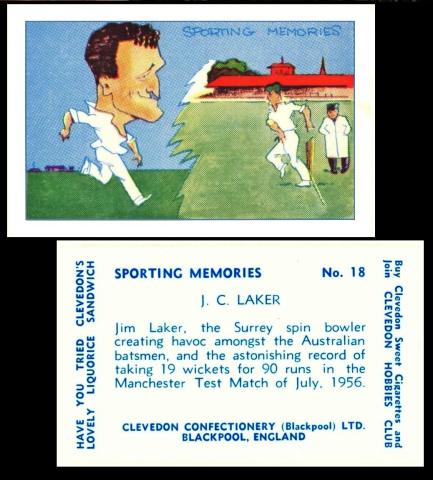
CLEVEDON Confectionery (Blackpool) Ltd. [trade : confectionery : UK- Blackpool] "Sporting Memories" - blue back (1960) 18/25 – CLE-270.a : CLZ-20
Let us start our new week with a record, from seventy years ago, how time flies, because today, in 1956, the England cricketer James Charles "Jim" Laker took all ten Australian wickets for eighty-eight, in forty-six overs, at the Oval.
He had been born on the 9th of February 1922, in Shipley, Yorkshire. His father was a stone mason, but walked out when his son was only two, leaving him and his four sisters to be raised by his mother, a teacher, and lifelong cricket fan, and it was she who also taught him the game, because, as she freely admitted, she knew he would be a great batsman one day.
In 1932 she met another man and the family moved a little way away, where they were very happy. Her son was settled at a new school and joined the cricket team, from where he was discovered, in 1938, by Yorkshire County Cricket Team, who invited him to attend special coaching sessions. And though his mother could ill afford it, she made sure he had the best cricketing kit she could manage to buy, even getting it from the sportswear shop run by the acclaimed batsman, and renowned player, Herbert Sutcliffe. Our man`s talent was spotted straight away but there was no space on the team, so they introduced him to Saltaire Cricket Club, and he joined them straight away, though Yorkshire still kept him on their books.
In 1941 he joined the Army, volunteering at the age of nineteen and being sent to the Royal Army Ordnance Corps, with whom he went to Palestine and Cairo, and with whom he developed his cricketing skills to an all time high, for many of his fellow men were enthusiastic but not professionally trained, so the balls were prone to flying hither and yon, and hitting them at all was almost impossible.
He returned to England, on a standard leave, in 1945, and whilst he was here his mother died. He seems to have been given compassionate leave and licence to stay in this country, with a posting to the War Office in London, and his relocation was almost certainly why, in 1946, when he was demobbed, he started playing for Surrey County Cricket Club, and when they offered him a professional contract, Yorkshire did not stand in his way.
Two years later he also started to play for England, going to the West Indies in 1947-48. His "rookie" card came in 1947 too, though technically it is not a card at all, it is a transfer, part of one of two sheets to be cut out at home.
At that time the England team were in a bit of slump, but the 1950s saw the beginning of their recovery, even though our man was left off the team to tour Australia in 1950-51. This was not such a disaster as it appeared, as he was asked to play on the Commonwealth XI, and he also used the time to get married, to a girl he had met in Cairo, during his time with the Royal Army Ordnance Corps; they even honeymooned in New Zealand, because he was coaching the Auckland Cricket Team. There was much discussion of staying on out there, but the newlyweds decided to return to England.
His first regular Test spot came in 1956, against Australia, and he was very successful, so much so that he was voted BBC Sports Personality of the Year, the first cricketer ever to win. Part of that was due to our match, against the Australians, on the 16th of May, but it was not an England match, it was simply Surrey against Australia, at The Oval. Our man came in to bowl just after lunch and kept going until just before the end of play, taking all ten Australian wickets for eighty-eight runs, in forty-six overs. And later the same year, in the fourth Test of the the proper Test Series, at Old Trafford, he took nine wickets for thirty-seven runs in the first innings, and ten wickets for fifty three runs in the second.
In fact most of his cartophilic appearances come from the 1940s and 50s, ending, poignantly, with our 1962 set of "Sporting Memories" by Clevedon Confectionery, which looks back at his July 1956 Test Match performance. After that the cards on him are also tributes and "All Time Greats" style cards.
After he retired he remained on the field, as a commentator and broadcaster, for both ITV and BBC. But sadly he died, on the 23rd of April, 1986, aged just sixty-four, from complications that set in after what was predicted to be a simple gall bladder surgery. His wife survived him, and lived to be almost twice his age, dying at the age of a hundred and two, in 2021.
Our set first appears in our original British Trade Index part two, as
- SPORTING MEMORIES. Lg. 98 x 64. Nd. (25) ... CLZ-20
That is all it says, but there is a revelation in our updated British Trade Index, which suddenly reveals a second colourway, as
- SPORTING MEMORIES. 1960. 98 x 64. Nd. (25). Backs in (a) blue (b) black ... CLE-270
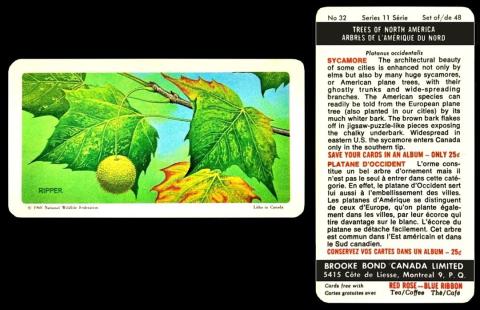
BROOKE Bond & Co. Ltd [trade : tea and coffee : O/S - Montreal Canada] "Trees of North America" - Series 11 (1968) 32/48 - BRM-36
Today, in 1792, the New York Stock Exchange is said to have been founded, in a very simple way, with some friends, beneath a buttonwood tree, on Wall Street.
In fact, we are not sure they were all friends, for they were a group of twenty-four stockbrokers, who met together amidst a crisis, to set some rules for how stocks should legally and fairly be traded, and with the hope that they could avert the sudden rise in commission and dealing rates. But we do know that, to this day, the centre of finance in New York remains on Wall Street. Sadly the original tree has long gone, though there is another tree, planted outside the current New York Stock Exchange, and there is also a plaque, on the wall, at 68 Wall Street.
Today we call this crisis the Panic of 1792, and it happened through March and April, but it actually began occurring far earlier, in In December 1790, when the Treasury Secretary Alexander Hamilton called for the creation of a Bank of the United States. This opened in 1791, and investors had to pay $25, for which they received a stock certificate, however the $25 was just the first instalment, they were also honour bound to pay another three payments, making $375 in all, a quarter of which was to be in cash, and three quarters of which was to be in tradeable financial assets — like bonds. Now as often happens, because the bank was new, everyone that could afford to do so wanted to take part, and suddenly there became a rash of people who were not of the bank selling stock certificates for it, some of which were legal and some of which were not, and as demand soared, so did prices, to the point where the initial certificates were being sold on as over ten times their value. Of course this was not sustainable, and when the double edged sword of high prices and falling sales started to cause a panic, Alexander Hamilton stepped in and made the goverment purchase $150,000 of public debt.
What happened in the 1792 Panic was related, as the Bank started allowing massive loans, and people, especially prominent bankers, took advantage, using the money they had borrowed to buy up stocks. However, the way a loan works is that the money is eventually returned to the bank, with interest, and it soon became apparent that very little of the money was ever going to be returned. This led, pretty much, to the bank running out of money, and it was made worse when the news leaked and everyone wanted their money out. It was only sorted out by Alexander Hamilton, again, who ordered the banks to loan money held in reserve in order to bring the market back under control.
By May 1792 this panic, too, was over, but, with an eye to the future, our Buttonwood Agreement was signed. And you can actually read it, if you have good eyes, at NYSEButtonwood.
However, for all its good intentions, it never actually stopped runs on banks, and they are still with us, in times of national peril, in every country of the world - something we showed previously on this website, as our Card of the Day for the 25th of August 2025
As for the buttonwood tree, opinions vary as to how it got its name. Some say it is because of the round fruits that look like buttons, though I always think a button is flat, to fit through the other side of the coat - whilst others say that because the wood was very finely grained it was used for making clothing and shoe buttons. Now the mention of shoe, or especially boot, buttons actually makes the first theory more plausible, because those sort of buttons fitted through loops and did tend to be small and round, with much longer thread than for a coat.
The correct name of the tree, in any case, is the American Sycamore, or Platanus occidentalis. Oddly, the Sycamore is in the Bible, and it was a tree of Egypt, Palestine and the surrounding areas; indeed we think the word Sycamore comes from a word in Hebrew, "shiqmah". And the Sycamores we have in this country came from America, being brought back by John Tradescant the Younger from his trip to Virginia.
This set is one of the later Brooke Bond issues and it does not appear in our original British Trade Index part two, though some set do, namely CU.1 to CU.10. It has to wait until our original British Trade Index part two, almost twenty years later, where the list is continued with sets CU,11 to CU.17. Our set is described as :
- Series 11. Trees of North America. Nd. (48). Issued 1968. ...BRM-36
Now sadly for our updated British Trade Index it was decided not to include these Canadian sets, only to mention them, briefly, in the heading, as "Cards also issued in Canada"
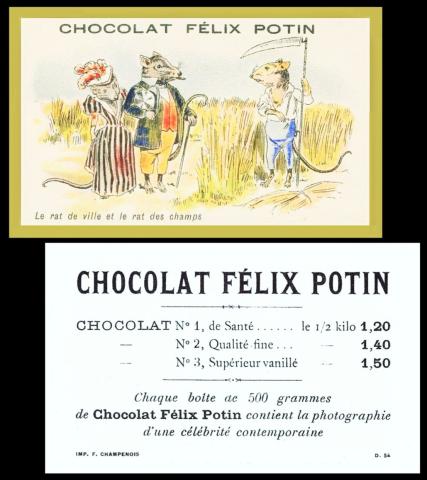
Chocolat Felix POTIN [trade : chocolate : O/S - Paris, France] "Fables da la Fontaine (1900?) Un/??
You may well think this a bit odd for "No Mow May", but without a man called Edwin Beard Budding, that event would not exist. You see, he invented the lawn mower, and today, in 1830, he signed an agreement with a man called John Ferrabee, who is usually said to have been a local engineer, but it seems he was a bit more important than that as he was going to cover the all important, and expensive, costs of development, obtain the letters of patent and sort out the rights to manufacture, sell and license other manufacturers.
The idea of having a machine to cut grass came to our man all at once, when he visited a cloth mill, (though some sources say he worked there), and he saw a machine that cut any patches of raised nap off the surface of the cloth that was being produced. It appears that he had been searching for a way to regulate the growth on lawns and playing surfaces, which makes me think he was an amateur sportsman, presumably cricket. And remember at that time the only way to cut grass was the time honoured, and back breaking, scythe.
So he came home, and tinkered, and on the 31st of August, 1830 he gained a British patent. However it took almost a decade before he could make one work, using animal power, because it was fiendishly heavy; and it would be another six decades before he made a push along, steam driven, one. Amongst his first customers was the Zoological Gardens in Regent`s Park, who presumably had plenty of animal power.
I really wanted another card here, but can`t find one, so if you have the lawn mower, from the set of "Modern Inventions" by Slade and Bullock, in either the blue or black colourway, I would love a scan of front and back. Many thanks in advance.
But until that arrives, La Fontaine was a man, a writer, called Jean, because he was French. His great love was fables, from all around the world, and he marvelled at how much they had in common. He also rewrote them, using pieces from the many variations to make a perfect tale, and they were published, between 1668 and 1874, as La Fontaine`s Fables.
Our card shows the tale we call "The Town Mouse and the Country Mouse" but, on the card they call it "Le rat de ville et le rat des champs". Its a very old tale, all about how the grass is greener on the other side of the fence, and it was included as one of Aesop's Fables, way back in ancient Greece....
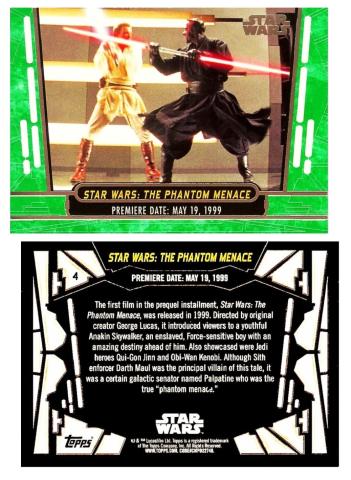
TOPPS [trade/commercial : cards : O/S - USA] "Star Wars 40th Anniversary" (May 2017) 4/200
Today in 1999 saw the release of a film called "The Phantom Menace", except most people know it as "Star Wars - part one", just not the part one which others call Star Wars, because that was part four....
Confused already? If so let me explain.
In 1977 a film was released called Star Wars. It told the story of a princess, Leia, rescued by a young man who turned out to be her brother, Luke - and it was followed by two sequels, "The Empire Strikes Back", and "The Return of the Jedi".
After that nothing happened for sixteen years, and then along came "The Phantom Menace", which told a story of a Jedi Master called Qui-Gonn Jinn and his apprentice, the young Obi Wan Kenobi, who are trying to protect another princess, called Padme Amidala, who will eventually turn out to be the mother of both princess Leia and Luke Skywalker. And along the way they meet Padme`s future love interest, Anakin Skywalker, who will become the father of both the Amidala children, before he turns to the dark side, and ends up as Darth Vader.
Suffice to say that if you want to watch the whole saga, from the start, at least as far as the films are concerned, you have to start with "The Phantom Menace".
This card is pretty unusual, because of its colour.
You see, the base set, of two hundred cards, has a black border. That covers the Star Wars canon from that original film in 1977 right up to "Rogue One" in 2016 - but they also include CGI spin offs, "The Clone Wars" and "Rebels", and the animated series of "Droids" and "Ewoks".
Our set, with the green borders, only has a hundred selected cards, and you could also get borders in blue, gold, purple, and red. The backs of all the coloured cards are the same as the base set, just in black, which my scanner does not pick up at all well. You were supposed to get one green card in every pack, and one blue card in every four packs, but the gold and red were only inserted in the hobby boxes, and I`m still not sure how you got the purple ones.
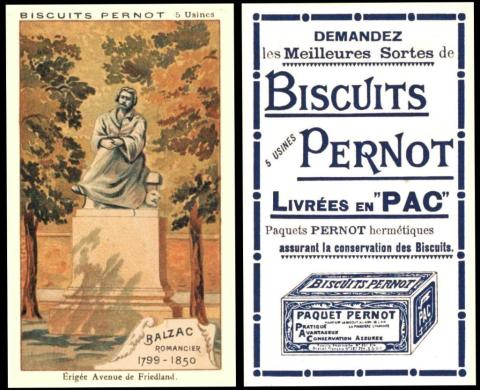
Biscuits PERNOT [trade : biscuits : O/S - France] "Statues" (1900?) Un/25?
Today, we were going to celebrate an ending, which I seldom do, of "Cheers", an American television sitcom, about which it soon became very obvious I knew nothing about and had little enthusiasm for. In fact I never watched a single episode. Though cards were issued, so maybe I will persevere in September, when the first episode was screened.
So instead of that, let us speak of Honore de Balzac, a French novelist and playwright, who was born today in 1799. He came from a family who were always striving to be better respected; his father was one of eleven children, and he went to Paris in 1760 with just one coin in his pocket, which was worth, at that time, about a pound, but within six years he had become a Freemason, and Secretary to the King`s Council, and he had also changed his surname to Balzac rather than Balssa. When he was fifty, he married, the daughter of a wealthy haberdasher in Paris; she was just eighteen. In 1798 the pair had a son, who died, and a year later they had Honore, named after the Saint of Amiens, in a bid to keep him safe. They then had two daughters and another son.
Our man was sent away to school, which he did not like. Many of his books feature cruel governesses and teachers, and we can but hope it was embroidered. The family moved to Paris, and briefly allowed him to stay, but then he was sent off to the Sorbonne University, and after that he went into law, at the request of his father. He did not enjoy it, and soon left, announcing that he was going to become a writer. It seems that at that point the family distanced themselves from him as he reports on living in a succession of small and rather grimy lodgings. However, to his credit, he did keep going with his dreams, though his first few novels were abandoned midway. He then met the son of an actor, who was called Auguste Le Poitevin de L’Egreville, though he used several pseudonyms. The two started collaborating on writings, but mainly short stories, and this seems to have changed things for our man, who began to return to his idea of writing longer sagas. He also had a brief dalliance with a duchess, Laure Junot, the wife of a French general, who was actually also courted by Napoleon Bonaparte.
The problem with our man seems to have been that he was quickly enthused to start a new scheme, but just as quickly off on another venture. He continually borrowed money, and had many failed or just abandoned businesses. However, in 1832, he was suddenly struck by the idea of a great novel which he called "The Ways of the World", but which would be published as "La Comedie Humaine", or The Human Comedy., and he would stick to this, writing, and, of course, rewriting sections of it almost every day. In fact it was never finished, because other things came along, some professional and some personal. There was a brief hiatus when he courted another writer, again married, and to an older man, the Mayor of Sartouville, and this resulted in his becoming a father.
There was also another relationship, at about the same time, with Countess Ewelina Hanska, again a married lady, to an older man, this time a Polish land owner, and after he died, in 1841, she married Balzac.
Sadly, just five months after the wedding Balzac died, of gangrene, something that seems to have been blamed on their trip to Paris, during which he did suddenly become weak and unwell. And he was buried, amongst other writers, at the famous Paris cemetery, Pere Lachaise.
This is a fascinating set, and so far we know of the following statues :
- Alphand
- Auguste
- Balzac
- Berlioz
- Boucher
- Buffon
- Charlemagne
- Chartier
- Chevreul
- Daudet
- De Banville
- De Maupassant
- Henri IV
- Lamartine
- Lecomte de Lisle
- Louis XIV
- Meissonier
- Murger
- Ney
- Sedaine
- Washington and Lafayette
If you know any more, please tell us. However there is another set of statues, in vertical format, and they are not part of this set they belong to one called "Paris Autrefois et Aujourd`hui" - or Paris yesterday and today.
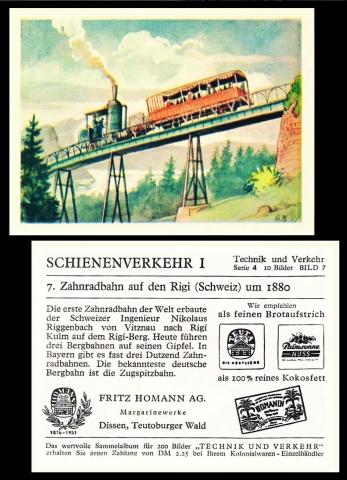
Fritz HOMANN A.G. [trade : margarine : O/S - Dissen, Germany] "Technik und Verkehr - Schienenverkehr I" / Technology and Transport - Rail Transport I (1933) 7/?
Onwards, and upwards, as today we have two events on the same date, one year apart - the first train to use the first "rack" railway in Europe, the Rigi Bahnen, in 1870, and the opening of the system to the general public one year later.
Lets start with what a rack railway actually is, and the clue is in its other name, of a cog railway. This is a specially made railway for gradients above, and sometimes considerably above, ten per cent. The steepest rack railway at the time of typing this is the Pilatus Railway, also in Switzerland, which climbs slopes with a gradient of 48%.
The rack system uses a system of rails, but has an extra rail with teeth on it, and this joins together with the cog wheels on the train, allowing it to keep its footing on the track.
In actual fact it was an English invention, by a man called John Blenkinsop, and the first rack railway in the world was also in England, running between Middleton and Leeds in West Yorkshire. And it opened in 1812, a year after the Blenkinsop system had been designed and patented.
As to the Rigi Bahn, that starts in the centre of Vitznau, near Lucerne, and uses steam or electric locomotives. It also has a snowplough, because it is a mountain track. It was originally built by a Swiss engineer called Niklaus Riggenbach, who had patented the toothed rack system in 1863, and he was given permission to build what would become the Rigi Bahn on the 9th of June 1869. He set straight to work, and despite the fact that he had to build the track, and fit it to the changes along the way, he was able to run a train along the route on the 21st of May 1870. And one year later he personally drove the first train on its maiden, paying passenger, trip.
At that time it did not go all the way to the summit, it stopped at another Rigi , Rigi Staffelhohe, simply because that was in another canton, Schwyz, and they had not agreed to have a railway built on their lands. However shortly after the first train descended some citizens from across that border approached the council and started the process to extend the line. This was allowed, but only if the company, and work force, involved came from Schwyz. And so for a very long time the same train went all the way up to the top over both the tracks but it paid the Schwyz company a ground rent to use their section. This only ended in 1992, when the two companies merged. And the oddest thing of all is that the journey from the border to the top of the track is only just over a mile long.
We don`t know much about this set, yet, but we know there were twenty sub-series within it and they all fitted into a single album.
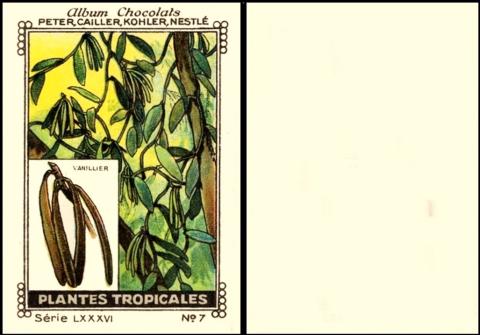
PETER, Cailler, Kohler, Nestle [trade : chocolate : O/S - Switzerland] "Plantes Tropicales" - Serie LXXXVI (1930s) 7/12
Today is #NationalVanillaPuddingDay - and the one thing you need, above all else, to take part, is the vanilla.
Vanilla always sounds a bit "meh", but it is a very interesting flavour, just not as strident as many others. And I have to say the pods look most unappetising, as well as the thought of scraping them out to reveal the goodness within.
Actually the vanilla is related to the orchid, and there are three species, but all come from Central America and Mexico.
For a long time it was hit and miss as to whether pods arrived at all, but in 1841 a young child, who was already a slave, discovered that it was possible to make the pods grow by hand pollinating the plants, and it is to him that we owe the success of vanilla today, though others tried to claim that they did it first, and even that he saw them and copied them. These claims all fell by the wayside, and today we credit, with much appreciation, little Edmond Albius, of Reunion, for our vanilla crops.
This is one of those lovely little thin paper cards, but look, it starts with the name of Peter, rather than Nestle. And I have not actually found this set with Nestle`s name coming first.
The cards in the series show :
- Bananier Banane - banana
- Theier - tea
- Dattier - date
- Agave
- Cotonnier - cotton
- Cacaoyer - cacao
- Vanillier - vanilla
- Cafeier - coffee
- Canne a Sucre - sugar cane
- Ananas - pineapples
- Cocotier - coconut
- Bambou - bamboo
This week's Cards of the Day...
This week I am celebrating a local-ish event to me, and that is the Batchworth Boat Rally, though before 2023 it had another name, of the Rickmansworth Canal Festival. It is taking place this weekend, in Rickmansworth, which is just a few stops away on the Metropolitan Line, albeit the Chesham/Amersham branch which I pick up at North Harrow - and it promises lots of fun and entertainment, along with a chance to look at lots of narrowboats, and even travel on them. Which, as I will be accompanied by water loving nipper, may not be a good idea. Actually none of it may turn out to be a good idea with him, but I will take my chances...
It does not seem that we have featured canals much on this website, and primarily the Panama and Suez Canals when we did. However we did mention that Port Vale Football Club is named for the Trent and Mersey Canal as our Card of the day for the 11th of November 2023, and speak briefly of the Bridgewater and Manchester Ship Canals on Tuesday the 21st of May, in our newsletter of the 18th of May 2024. That may be because I now know canals and narrow boats are not exactly popular subjects for cards, which means that I predicted, and rightly, that we would have to look at a few world-wide ones this week - though in the end that was only in the last two days.
As far as our clue cards, they were :
Saturday, 9th May 2026
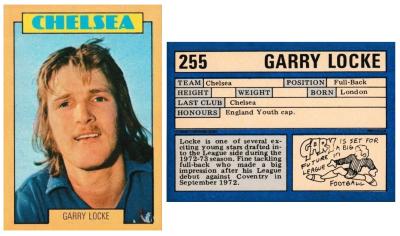
Our first clue was going to, once more, be Brentford, where the Grand Union Canal actually begins, (at the Thames Lock), but we have used them such a lot, and I was saved by Garry Locke, whose name is only an "e" away from a lock on a canal.
A lock is actually the most important feature of a canal, because it enables the vessels travelling on it to be raised and lowered onto all the different waterways which form part of the same canal system. How it works is that the boat motors in to a little box, through a gate, and the gate seals behind it. Then, whilst it is still in its water, someone turns a handle on the mainland, and the little box rises or falls, depending on the height of the water it is going to join. Then, once it is at the same level, the gates are opened on the side in front of it, and the vessel motors merrily out.
As far as Gary John Locke, he was born on the 12th of July, 1954, at Park Royal, in Middlesex. He started out at Chelsea, but on their youth squad, and they kept him on as a senior, from 1971 until 1983. He was also voted their Player of the Year in 1974, which was the end of the same season that these cards were issued. They tell us that he won an England Youth Cap, and that he "is one of several exciting young stars drafted into the League side during the 1972-73 season." It also tells us that he "made his League debut against Coventry in September 1972". However it spells his name wrong on both sides of the card, calling him Garry with two "R"s - but, curiously, they get it right for the cartoon, which says "Gary is set for a big future in League Football".
In 1974 he appeared on one card and two stickers. The card was another A. & B.C. Gum "Footballers", which we know as 1974-75. That tells us that the tournament for which he won his England Youth Cap was held in Spain in 1972, and from that he was given his chance with the first team. It also has his height (5` 10"), and his weight (10.8 stones). The stickers were Panini/Top Sellers` "Football 1974-75", and FKS`"Wonderful World of Soccer Stars", but neither of those had any biography at all.
In 1982 he was loaned out to Crystal Palace, and made it permanent the following year, staying until 1986, in which year he moved to Sweden, and played for a team called Halmstads Bollklubb, who never seem to have appeared on a card. He didn`t stay there long though, as in 1987 he moved even further away, to New Zealand, and a team called Napier City Rovers. There he did very well, even making captain, but then, in 1991, was suddenly passed over for a spot on the team, which led to him moving on again, to Waikato United, also in New Zealand. That means he probably appears on several antipodean sets we know nothing about, unless readers from those parts tell us.
The set appears in our original British trade index part three, as part of a group :
- Football Series - 1973-74 (A) ... ABF-51
1. Players, 80 x 55. Back in style of ABF-51.1, except checklist cards
1. English issue. (262) Cream border to front, back in blue and black, issued in two batches
(1) Nd. 1/131. Checklist at No.36
(2) Nd. 132/234, 236/261 and 263/4. Nos. 235 and 262 not known. No.182 is with a checklist back, listing (a) Nos.132-264 (b) Nos.132-261. No.241 (John Toshack) is found with picture on front (a) head and shoulder (b) full length
It almost certainly next appears in our updated British Trade Index, but I can`t find it! The only 1973/4 are black and white, which these are not. Anyway I`ll keep looking.
Sunday, 10th May 2026
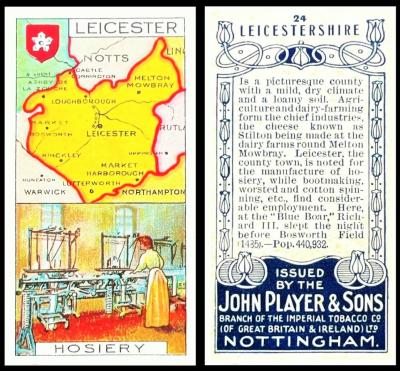
Our second card showed Leicester, and, on this card, running right up the middle, even named as so, is the River Soar. Now that waterway is a tributary of the River Trent, but as it flows in a northwardly direction, past Leicester, it becomes part of the Grand Union Canal.
In fact the earliest time that the river was mentioned as becoming converted into a canal was in 1634, and King Charles I even provided the money for the works to take place, but none ever did, and it was not until 1794 that a Leicester Canal, almost forty miles long, was opened. And, in 1814, that was linked to the Grand Junction Canal, and renamed as the Grand Union Canal, but nothing to do with ours, or at least not until 1931, when our Grand Union Canal acquired the length of its namesake, plus the Leicestershire and Northamptonshire Union Canals, from the Grand Junction Canal Company.
This set has a sibling, an unnumbered version, which is exactly the same pictures and text. Both are first recorded in our original reference book RB.17 as :
- 54. COUNTIES AND THEIR INDUSTRIES (adopted title). Small cards. Fronts in colour. Backs in blue, with descriptive text. Home issues. Series of 25.
A. Unnumbered, see listing below. Date of issue not known.
B. Numbered. Previously recorded as issued in 1914, but according to Messrs. Player`s records issue took place in November, 1919
In the alphabetical listing below, number in B is given in parenthesis.
1. Bedford (11)
2. Cheshire (18)
3. Connaught (12)
4. Cornwall (22)
5. Devonshire (14)
6. Dumbarton (20)
7. Edinburgh (15)
8. Hampshire (25)
9. Kent (5)
10. Lancashire (8)
11. Leicester (24)
12. Lincolnshire (7)
13. Monmouth (2)
14. Munster (10)
15. Norfolk (21)
16. Northampton (9)
17. Northumberland (3)
18. North Wales (1)
19. Nottingham (19)
20. Perth (4)
21. Roxburgh (13)
22. South Wales (16)
23. Stafford (10)
24. Ulster (23)
25. Yorkshire (17)
Whilst typing this out I did rather wonder why the compiler didn`t make the numbered version A and use the numbers on the card, rather than assigning numbers to unnumbered cards and working out their alphabetical order ? And the only reason I can think of is that they were sure the unnumbered set was issued first, maybe even in 1914....
This order continues into our World Tobacco Issues Index, where the pair are recorded as :
- COUNTIES AND THEIR INDUSTRIES (A). Sm. (25). See RB.17/54 and H.349 ... P72-28
A. Unnumbered.
B. Numbered.
This is much the same in our updated World Tobacco Issues Index, just shortened, to :
- COUNTIES AND THEIR INDUSTRIES (A). Sm. (25). See H.349 ... P644-066
A. Unnumbered. B. Numbered.
Monday, 11th May 2026
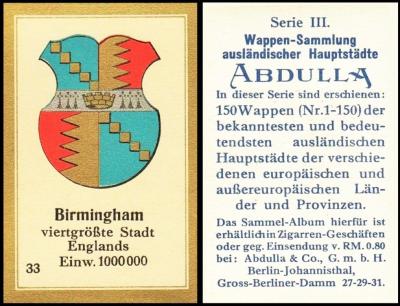
And lastly our third clue card brought you the other spur of the Grand Union Canal, which starts at Napton Junction, where it meets the Oxford Canal, and goes off to Birmingham.
The text on the front of this card tells us that Birmingham was the fourth largest city in England, with a population of 1000000. And that is precisely why the canal system went there, although, in fact, despite the Grand Union Canal having been more or less created on the 30th of April, 1793 (that being when the Grand Junction Canal Act was passed), it only acquired a Birmingham arm in 1928, with the purchase, by the Regent`s Canal and Dock Company, of the Warwick and Birmingham Canal, and the Birmingham and Warwick Junction Canal. And at that point it was realised that the canals in that area would not link up with the lower ones, as they were too small, in width and depth, and the locks could only just about manage one small narrowboat at a time. Therefore a new Act, the Grand Union Canal Act was passed in 1931, which allowed for the necessary dredging and widening of the canals, and lengthening of the bridges and locks.
The Birmingham canal is rather twisting, which can be imagined from the fact that there are 166 locks and it is only 137 miles long. However, some of these locks are together, in very close proximity - ten at Stockton, and twenty-one at Hatton. The Stockton Flight was constructed in 1800, and widened in 1930, whilst the Hatton Flight was built before the opening of the Warwickshire and Birmingham Canal in December 1799, but allowed to fall unto decay, so much so that the current flight was built alongside the remnants over the span of two years, 1932 and 1934.
Now we did have a reference book to Abdulla, in conjunction with Adkin and Anstie, but it only catalogued the English language issues.
That means this set`s first appearance comes in our original World Tobacco Issues Index, with the other German Language Issues as section one of the Abdulla listings. And the entry there reads :
ABDULLA & Co., London and Berlin
Founded 1902. Taken over by Godfrey Phillips, 1926. Trading 1956. German Branch liquidated, 1934.
1. GERMAN LANGUAGE ISSUES. About 1928-33. Special albums issued.
- LANDERWAPPEN-SAMMLUNG (Coat of Arms Series). Sm. 65 x 45. Nd. ... A5-3
1. "Die Wappen der Fuhrenden Staaten der Erde" (Arms of the Leading Countries of the World). Nd. 1/110.
2. "Serie II. Staaten u. Landerwappen Sammlung" (Arms of Provinces and Countries) Nd. 111-220 (110)
3. "Serie III. Wappen-Sammlung auslandischer Haupstadte" (Arms of Foreign Towns etc). Nd 1/150
This text is identical in our updated version, except for the code, which has been changed to A065-040
Tuesday, 12th May 2026
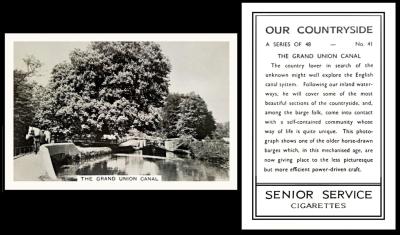
Wonder of wonders, this is actually a card not just of a canal, but the Grand Union Canal its very self. But I don`t know whereabouts, so maybe you do?
This set actually has a sibling too, as revealed by our original World Tobacco Issues Index, which reads :
- OUR COUNTRYSIDE. See Ha.564-4. ... P18-72
A. Small (28)
B. Medium (48). "Senior Service" brand issue. Two printings.
Ha.564-4 leads us to the original handbook, which was published by the London Cigarette Card Company, and it tells us that this set has other issuers too, the text in full reading :
GALLAHER GROUP. Four Photographic Series. Fronts glossy photographs in black and white. Four numbered series as follows :-
- 564.1 - Beautiful Scotland
- 564.2 - Coastwise
- 564.3 - Flying
- 564.4 - Our Countryside
Each series issued as follows :
- Gallaher - Medium Size, series of 48
- Illingworth - Medium Size, series of 48
- Peter Jackson -
A. Small size, series of 28
B. Medium Size, series of 48- Pattrieouex -
A. Small size, series of 28
B. Medium Size, series of 48, inscribed "SENIOR SERVICE CIGARETTES" without firm`s name. Captions in front in large or small letters
Now by the time of our updated World Tobacco Issues Index, little has changed, save the card code, and the entry reads :
- OUR COUNTRYSIDE. See H.564-4. ... P246-720
A. Small (28) B. Medium (48). "Senior Service" brand issue. Two printings.
However, this time the H.564-4 leads us to another handbook, our own, and the text in there is slightly different, for it calls the cards photoprints, not photographs. However all the other text remains the same :
GALLAHER GROUP. Four Photographic Series. Fronts glossy photoprints in black and white. Four numbered series as follows :-
- 564.1 - Beautiful Scotland
- 564.2 - Coastwise
- 564.3 - Flying
- 564.4 - Our Countryside
Each series issued as follows :
- Gallaher - Medium Size, series of 48
- Illingworth - Medium Size, series of 48
- Peter Jackson -
A. Small size, series of 28
B. Medium Size, series of 48- Pattrieouex -
A. Small size, series of 28
B. Medium Size, series of 48, inscribed "SENIOR SERVICE CIGARETTES" without firm`s name. Captions in front in large or small letters
Wednesday, 13th May 2026
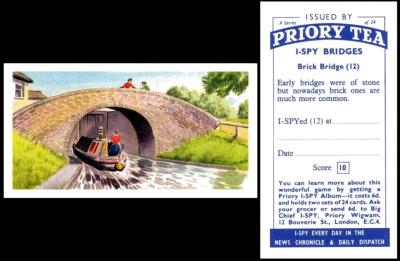
Not sure where this bridge is, but it shows a barge, and so it is here.
This is actually most people`s ideal canal scene, slowly chugging through the idyllic countryside, where children race to the bridge to wave at you. And on the right hand side you can see how the towpath runs beside the water, rising to the bridge. Now usually the towpath would have gone under the bridge so that the horse could have continued to pull the boat along, but in some cases the bridges were too small, and so the horse was unhitched and walked over the bridge to meet you on the other side. And in some cases, where the bridge was very long and the boat had no other power, the driver and his mate would have to lie on top of the boat and propel it through by their feet, a method called legging.
I am delighted to be able to add another set by this issuer, they are one of my favourites, possibly because they were amongst the first non-Brooke Bond sets that I ever acquired. We have a home page for all the Priory I-Spy cards, with our Card of the Day for the 10th of July, 2024, from "I-Spy Out and About" which you may think breaks my rule of alphabetical listing, but which was the first of these sets to ever be issued, in 1957.
Our set is described in our original British Trade Index part two, as :
Priory Tea & Coffee Co. Ltd., London, S.E.1.
Cards issued 1957-64. Small size 69 x 37 m/m. Special album issued to house the 13 series, listed below in order used in album. Series numbers appear only on album sheets.
- SERIES 8 "I SPY BRIDGES". Sm. Nd. (24) ... PTT-8
Now in our updated British Trade Index, the set appears slightly differently, as :
PRIORY Tea
Priory Tea & Coffee Co. Ltd., London, S.E.1. Issued about 1910, and 1957-64. Cards 69 x 37. Special album issued to house all 13 sets. Albums to take one or two sets were available for 6d. The `Series` No. appears only on the album sheets.
- SERIES 8 "I SPY BRIDGES". 1959. Nd. (24) ... PRI-645
Thursday, 14th May 2026
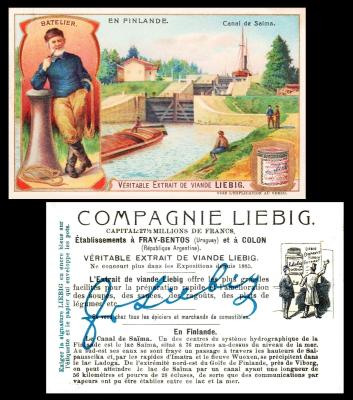
This card may show a canal in Finland, but it also demonstrates, exceedingly well, what happens in a lock. If you look at the card, you will see that there is the rigging of a tall ship right at the line of horizon. Now that is on a river or waterway all its own. but it has halted and and come to the gate. Pretty soon, the gates will open, the ship will come in along with some of the water from the top level, and the gate behind it will close, leaving the ship in a compartment.Then the front gates will slowly open and the water and the ship will come down until it is level with the next compartment, and can sail into it. Then the procedure will be repeated until it reaches the level of the canal we can see at the bottom.
The canal on this card is said to be at Saima. Now that could be the French spelling, or it could be an error, because today we know the canal as the Saimaa Canal, with two final "a"s. It enables ships to travel from Lake Saimaa to the Gulf of Finlanda, via the city of Vyborg, and it is both the best known and the most important canal in the country, some forty three kilometres long with eight locks, three of which are in Finland and five of which are in Russia. Construction of the canal began in 1845 and it was opened on September 7, 1856.
The cards in this set each have a large figure of a typical local person and show views of :
- Jeune Garcon en Costume d`Hiver - Esbo.
- Maitre d`Ecole - Helsingfors - L`Eglise St. Nicolas et le monument d`Alexander II]
- Bucheron - Le Lac de Kesamonsaari
- Laitiere - Ancienne tour sur la place du marche a Vibourg
- Batelier - Canal de Saima
- Paysan - Torrent a Imatra
I havent had time to translate these into the other languages. I`ll do that over the weekend!
Friday, 15th May 2026
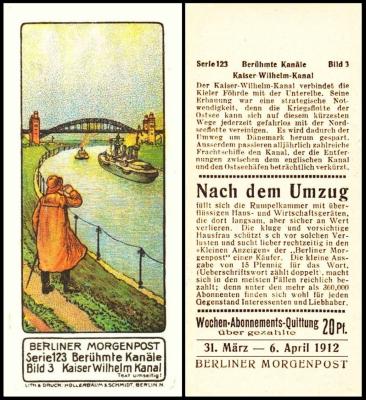
And so as the sun goes down on another week, this seemed to be a very suitable scene indeed.
What we are looking at has has several names. At one time it was the river Levensau, which was improved and extended from 1777 and renamed the Eider Canal. That was then upgraded and straightened from 1887 and called the Kaiser Wilhelm Canal, because he opened it in December 1894.
The canal is actually vitally important, because it links the North Sea to the Baltic Sea, but don`t look for it on a modern map, as it changed its name to the Kiel Canal in 1948.
As for the bridge, that keeps the old name alive, for it is the Levensau High Bridge, in the German state of Schleswig-Holstein, and it was built in 1894, as the first bridge to cross the canal. Since then it has been widened, and frequently, because it had a major problem, being unable to be used by trains and cars at the same time, so they took it in turns. That strange situation lasted right until 1954, when for the first time trains, cars, and people could cross the bridge at the same time, though it did lead to the shortening of the original towers.
Today, there are two bridges, because the traffic even outgrew the 1950s modifications; the second, a four lane road for motorway traffic, opening beside ours in 1984. That left our bridge for just local traffic and the railway trains. Then it was decided the canal needed to be widened again, and our bridge would have to go. At first, in 2018, it was going to be entirely demolished and another bridge built in its place, but then it was discovered that there were sitting tenants, five thousand of them, in the old towers, the largest population of assorted bats anywhere in Europe, and, rather wonderfully, they were given the right to stay.
These cards were printed by Hollenbaum and Schmidt, of Berlin, North, and they were primarily poster printers, whose company began in 1909. During the First World War they were heavily involved in printing propaganda posters, but they seem to have become more peaceable in the Inter-War years, which is when these cards were issued. They never printed the Berliner Morgenpost, but they printed the first advertising poster for them as early as 1902.
I only seem to be able to find five cards in this set , which are :
- Suez-Kanal : 17 Marz - 23 Marz 1912
- Gotakanal (Schweden) : 24 Marz - 30 Marz 1912
- Kaiser Wilhelm Kanal : 31 Marz - 6 April 1912
- Panama-Kanal : 7 April - 13 April 1912
- Canalegrande (Venedig) : 14 April - 20 April 1912
Well I am most surprised but it is eleven o`clock on Friday night, and this newsletter is almost done, including, amazingly, and unusually, all the titles - and the write ups from the reference books, though to be honest that was only needed for two cards.
Hope you enjoyed your weekly reading. And if you did, do spread the word, and the weblink, to any collectors you know.
Thanks for tuning in, and do come back next week.
And now I`m going to brew up my bright pink kettle and have a hot chocolate.....