
Saturday springs into view, and so does our regular newsletter. Though this was another week when it had to slot into medical things, two district nurses, seven carers, trips to hospitals, phone calls and emails making and changing appointments, and innumerable changings and washings of entire sets of clothing. I did manage to fit in a trip to the clipper, for nipper, and a carer`s meeting too. So, all in all, not a bad week, though any idea of holiday and new home slid further out of sight and out of reach, even if not out of mind.
Actually it is not just Saturday, it is Easter Saturday, and, back in 2022, our theme of the week was all about Easter. You can re-read that newsletter, or read it for the first time, at https://csgb.co.uk/publications/newsletter/2022-04-15
website news :
Not much to report this week, but I have almost taken the index back to May 2024 - adding the diary cards in for the 8th of June 2024, 15th of June 2024, 22nd of June 2024, and 29th of June 2024.
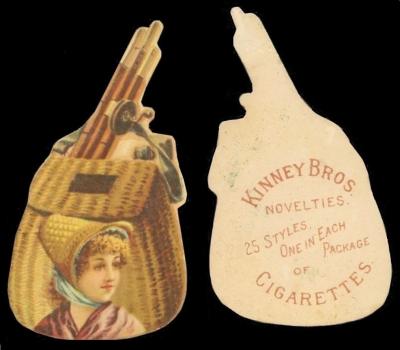
I was halted with the next one by the fact that I found I had used Morris`s "General Interest - Strange Craft" in it, and that was already in the index. The card of the basket boat on the rivers Euphrates and Tigris seemed the most obvious one to lose as it was the worst scan, but I could not find another basket boat, not even a coracle. Then I did what I ought to have done before I started hunting and asking, and that was check what the theme actually was, because it turned out it was not the boat, it was the basket, and after that I quite quickly found an interesting basket, a fishing creel from Duke`s "Miniature Novelties". However, once that was in place and I resumed indexing, I found we had used that set before as well. Then a brainwave, as they were based on the Kinney set of "Novelties", so I have acquired that version, in the "25" printing, and it is already in place.
Forthcoming Events :
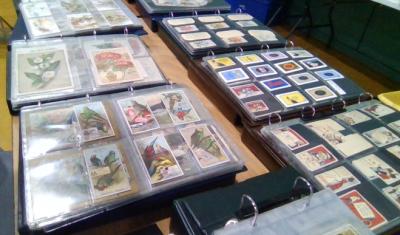
As we head towards the better weather, we thought we may add this section here, for easy reference. So coming up this week we can nip along to these four gatherings, and hopefully at least one of them is near you:
- Saturday the 4th of April : Lincolnshire - from 10.30 a.m. at Kirton Leisure, 31a Willington Road, Kirton, Boston PE21 1EP.
- Sunday the 5th of April : Winchester & Solent - from 1.30 p.m. until 4.00 p.m. at Botley Market Hall, High Street, Botley, near Southampton SO30 2EA
- Thursday the 9th of April - Cotswolds : from 5 p.m. at Uckington Village Hall, The Green, Tewkesbury Road, Uckington, Cheltenham GL51 9SR
- Thursday the 9th of April - Reading : at 7.30 pm (for 8 pm start) at Charvil Village Hall, Park Lane, Charvil, Twyford RG10 9TR.
now moving on to this week`s other sort of
diary dates :
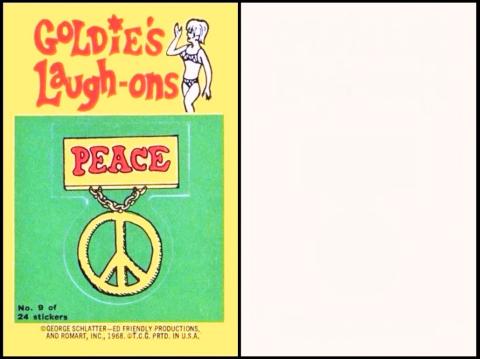
TOPPS [trade : bubble gum : O/S - USA] "Goldie`s Laugh-ons" (1968) 9/24
Let us start with a plea for peace, in these uncertain times, and a remembrance that today, in 1958, the first major anti-nuclear march took place. The march, from London to Aldermaston, also saw another first though, for it introduced the CND Symbol, which, to this day, unaltered, remains the most potent portrait of peace.
It was drawn by Gerald Herbert Holtom, who was an artist, and a designer, and a graduate of the Royal College of Arts, plus, also, a fervent believer in peace and disarmament, who, as a conscientious objector, had been sent to spend the Second World War working on a farm, in Norfolk.
Today we know the symbol, but few of us know the meaning of the design, for it is a conjoining of two signal letters in the semaphore system, the "N" (both arms pointing to the floor at a forty five degree angle) and the "D" (one arm raised above the head, one arm straight down the body). These two letters were not simply chosen because they made a good symbol, but because they were the first letters of Nuclear and Disarmament.
You may be wondering the significance of something else too, the end of the march, at Aldermaston. This is a village in Berkshire, but it is also the site of a manor house, Aldermaston Court, which was bought in 1938 by Associated Electrical Industries. Not that long after that, an R.A.F. base was built in the area, and after the Second World War Associated Electrical Industries were well sited to build Britain`s first nuclear programme, cunningly concealed under the name of "High Explosive Research". That research began on the 1st of April, 1950, and it almost immediately started to attract attention, of a negative nature, especially from the Campaign for Nuclear Disarmament.
By 1958, they had realised the most effective campaign was not a paper one, it was to be a march. The meeting point was to be in London, and then they would march, over the Easter weekend, en masse, up to Aldermaston, peacefully, with banners and signs. The signs were circular, and made of cardboard, and they were stuck on to sticks. Two hundred and fifty signs were made with the symbol in black on white, to be used on the first half of the march, and two hundred and fifty were made with the symbol in green on white, to be used on Easter Sunday and Easter Monday.
Almost as an afterthought, pin badges were also made, of pottery, using white clay, and having the symbol on them added with black paint. Each came with a note, that explained that, being made of clay, they would survive a nuclear explosion. They were made by Eric Austen, a member of the Kensington branch of CND, who had, oddly, been born in Norfolk, and had also been a conscientious objector, who was sent to work in forestry during the Second World War.
Strangely, the sign was never registered as a trademark, the Campaign for Nuclear Disarmament believing that to do so would place restrictions on its use. And it is certainly very well known. However I did begin to believe the one place it had never been used was on a cigarette or trade card, until I came across this one.
This is a sticker, and it is an offshoot of a card set, the 1968 Topps "Rowan and Martin`s Laugh-In", based on, and using scenes from, the popular TV show of the same name.
That started out as a one off show in September 1967, and then got a regular slot, for six seasons, from 1968 to 1973,. It was named for the surnames of the two main presenters, Dan Rowan and Dick Martin. Another of the part-time presenters, "Goldie", appears on our card, in a bikini, but not mentioned is the fact that had a surname, which was "Hawn". She left after season three, and went into movies, where she soon gained a even bigger fan following.
There are seventy-seven cards, and twenty-four stickers, in this set. The cards credit George Schlatter - Ed Friendly Productions, and Romart, Inc. George Schlatter was an agent for MCA Records, who left to manage a nightclub on Sunset Strip, where Rowan and Martin used to perform before they hit the big time, and he became the producer/director of the Laugh-In. Ed Friendly was also a producer on the show, with his own company, specialising in westerns, who then moved into racehorse ownership, very successfully. As for Romart, with Romart was indeed a combination of Rowan and Martin, and it was their own production company.
The cards were issued by Topps in America and by O-Pee-Chee in Canada. The Canadian ones do not actually say O-Pee-Chee but you can tell them apart because after the copyright symbol and the initials "T.C.G." they continue with "Ptd. in Canada" - whilst the Topps ones say "Ptd in U.S.A.". Both versions issued the stickers. And they are true trade, because the packets contained a strip of bubble gum.
It does not appear that these were issued by A. & B.C. Gum. Perhaps they thought them too American, or perhaps they felt that because the show was not syndicated to the British Isles nobody would have wanted the cards.
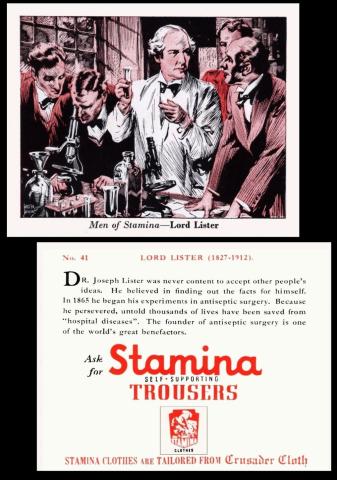
The STAMINA Clothing Company [trade : clothing : O/S - Sydney, Australia] "Men of Stamina" (19) card 41
From Peace to Prosperity, in a health way, today, in 1827, saw the birth of Joseph Lister. His family were Quakers, and well educated - his father being a scientist and a wine merchant, and his mother having been a teacher`s assistant in her mother`s school.
However, the background of his paternal line had been in farming, it had been a chance visit to an event by the Society of Friends that had altered his great-great-grandfather`s entire life, so much so that he gave up the land, joined the Society, and moved to London, where he opened a tobacconists. Sadly I cannot find much more about this, yet.
Joseph Lister`s father specialised in optics, and spent thirty years developing special lenses for microscopes that eventually gave the highest, clearest, magnification than any before, and would lead to his induction into the Royal Society in 1832. These machines would go on to impact several future members of his own family, and many doctors and clinicians besides - one of his sons, Arthur, specialising in botany, and one of his grandsons becoming Professor of Clinical Surgery at University College Hospital, specialising in Neurosurgery.
Our man would also use a microscope, and one of his father`s hand -crafting, but his speciality would become the prevention of disease. At University, however, he studied botany, anatomy, and chemistry. All that altered when one of his classmates was given the task of applying the ether on the first occasion when it was used, at least in England, by Robert Liston, to render a patient incapable of feeling pain for an invasive operation. The patient - since I spent ages hunting who it was, and you may also be interested - was a footman, named Thomas, or, in some accounts, Frederick, Churchill, who had his lower leg amputated.
By all reports, Joseph Lister was not a great surgeon, but he did have an enquiring mind, and would pore over notebooks searching for the facts on everything. What changed his life was a complete accident, he had just begun working at University College Hospital, as a resident, when there was an outbreak of a bacterial infection in one of the wards. The diagnosis was Erysipelas, a skin complaint, and quite a common problem, though it can be fatal. The professor of surgery put it down to the air becoming infected, but Lister noticed that the more recent surgical cases were the worst affected, and also that if the wound was cleaned up it would sometimes heal itself. He was given the thankless task of autopsies, which he found very useful, and from which most of his discoveries arose. However, the vital link was not made until much later, when he realised that inflammation of a wound inevitably came before the wound went septic, and then the patient would develop a fever, and probably die. And it was not until Louis Pasteur made his observations, into micro-organisms, that Joseph Lister began to realise the organisms were infections coming from outside the patient, soiled surgical or patients clothing, germs in the atmosphere. His early remedy for this was to disinfect the wounds, starting with a kind of creosote, later changed to carbolic acid, and then refined still further to phenol, as manufactured by Frederick Crace Calvert from the Royal Manchester Institution.
In 1893, his wife died, and he never recovered. He found no joy in his studies, and closed his private practise. He did keep on with his work at Kings College Hospital, but by the end of the year had left that too. He suffered a stroke, and though he was surgeon to Queen Victoria, and to her family, it is telling that her son, Edward VII, was operated on by another, Sir Frederick Treves. In 1908 he moved from London to Walmer in Kent, where he died on the tenth of February, 1912, aged eighty-four.
The artist of these cards was Walter Lacy Jardine, of Sydney, and they were produced from his paintings, commissioned for the cards. He was born on the 6th of May 1884, the tenth child of a carter called Alfred Henry Jardine, who was actually of London, England, birth. When quite young it was obvious that he had quite the talent for drawing and so his family managed to get him apprenticed out to a newspaper artist called J. H. Leonard, who sent him off for lessons, and found him employment at the "Australian Star" newspaper. He worked for them for twenty years, despite the paper changing its name to "The Sun" in 1910. Of course by that time he was fairly famous, and had just returned from studying art and illustration in Europe and America. He also had joined forces with J.B. Jones, an ad-man, and by 1916 they would not only have a company, "J. & J. Ltd", but be the employer of artists and apprentices who could be used for fill in work if too many commissions came along at once. This does not seem to have survived his marriage, in 1918, and we know they both moved to New York in 1923. Here he became an even more successful illustrator, and that work is much sought after today. But for some reason New York did not suit him, and in 1928 he was back in Sydney, as a freelance. This is when he first made the acquaintance of Stamina Clothing. He died on the 24th of February 1970, in Killara.
The Stamina Clothing Company, the issuers of this card, was a subsidiary of Australian Woollen Mills Ltd., and operated out of the same address, 27, Sydenham Road, Marrickville, a suburb of Sydney They were mens outfitters, who diversified into boys wear and school wear. The cards were issued with the clothing, hidden in one of the pockets of the trousers or shorts - which makes it rather a miracle that any are in good condition today. In all there were thirty sets, but there are a lot of varieties, much redrawing, reversing of images, new captions. A veritable feast for the type collector.
I will only give a rough guide to the sets here, then expand when I use a card from series one as a Card of the Day, but briefly...
- Series 1, 2, and 3 were all portraits of famous men, entitled "Men of Stamina"
- Series 4 is sometimes listed as the same. but the number is also quoted for a set called "An Ideal Cricket Eleven", with eleven cards
- Series 5 and 6 returned to portraits of famous men, entitled "Men of Stamina"
- Series 7A and 7B featured everyday heroes, workmen, in all kind of occupations but were still called "Men of Stamina"
- Series 8 was similar to the first six sets but the men were all Australian, or had Australian connections.
- Series 9 through 12 were scenes not portraits and included the set from which our card originated - I just don`t know which one yet.
- Series 13 was called "Women of Stamina" and were all females.
- Series 14 through 16 returned to the portraits of men, entitled "Men of Stamina"
- Series 17 through 23 were transport and animal cards
- Series 24 had an R suffix and was called "Famous Authors, Artists and Composers"
- Series 25.R, was "Famous Statesmen", and that was the last set, issued in 1966
This set is very different from the head and shoulders cards that we also know as "Men of Stamina", and, curiously, Joseph Lister actually also appears on one of those portrait sets, as card fourteen of set four, which comprises eighteen cards - the text on that card reading "JOSEPH LISTER (1827 - 1912). Famous surgeon - introduced the antiseptic system which revolutionised modern surgery - "the greatest triumph in modern surgery". A Man of Stamina"
Joseph Lister`s "rookie" card is universally regarded to be card 165 of Ogden`s "General Interest" - series F, issued in 1902, which calls him "Lord Lister" something he became in 1897. I`m not sure that there isn`t an earlier continental chromo somewhere though. And we also know that he appears in the second series of Felix Potin`s "Celebrites", as "Lister, Medecin". The Stamina cards came next, and then, in 1969, he was featured as card no.9 of Brooke Bond`s "Famous People", again as Lord Lister. This set was officially reprinted with a black back in 1973.
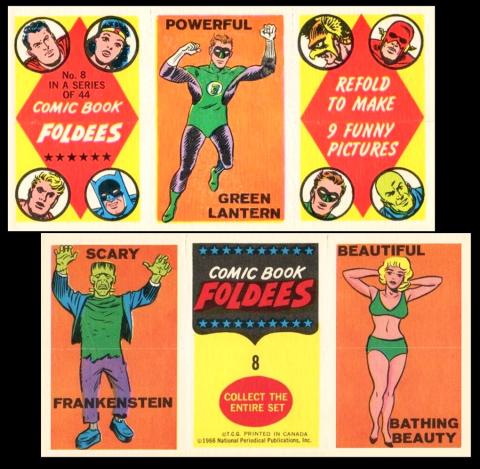
O-Pee-Chee [trade : gum : O/S - Canada] "Comic Book Foldees" (1966) 8/44
For our third diary date, it seems fitting that we use a triple folder, and speak of three men - Eli Katz, Gil Kane, and the Green Lantern.
Eli Katz was born one hundred years ago, on April the 6th, 1926, in Latvia, and arrived in Brooklyn, New York, aged just three. As soon as he discovered them, and possibly because his English was not so good, he was enthralled by comic books, so much so that he dropped out of school after getting a summer job at a comic publisher, MLJ. He thought he was going to be an artist, and he was, but he had to work up to that; he started by simply rubbing out any errant pencil lines that made the original drawings look messy, and, sometimes, but very sometimes, filling in little gaps in the border panels. It was but a summer job, but somehow, though there were lots of other workers who just tootled about behind the scenes, he was hired formally, and given a strip, "Inspector Bentley of Scotland Yard".
About six months later he was approached by National Publications, who hired him on a freelance basis. But shortly after that, aged just eighteen, he was drafted. This turned out to only be a short spell, just under two years, but when he came back to comics, he found everything had altered, even in the world of the superhero. National were also not too keen on rehiring him, but he persevered. And perseverance brought him through the dark years when comics were seen as subversive, the cause of crime and delinquency, and even investigated as having communist links. All this saw comics alter forever, and also lead to a more underground, and even more subversive form, the graphic novel.
Gil Kane enters the story in May 1941, as a name attached to a story, "The Counterfeit Money Code" in "Zip Comics". This revolved around a character called Jim Kendall - but also known as the Scarlet Avenger, or the man who never smiles, due to the fact his face had been altered in a plane crash which killed the rest of his family. He was a mainstay of "Zip Comics", and feature in the first seventeen editions.
As for the Green Lantern he was created in 1940 by Bill Finger and Martin Nodell. He was a railroad engineer called Alan Scott, who was involved in a catastrophic train wreck, involving bridge sabotage. In fact he was the only person on the train to survive. He finds out that his freak survival was only down to the fact that he was holding a green lantern. Now this lantern was not of this earth, it had been made out of magic metal that had fallen to Earth with a meteor, and, because it was kind of hard to carry a lantern everywhere, he made part of it into a ring, which had to be charged up, using the lantern, when its powers waned. .
Eventually he would become one of the founding members of the Justice Society of America. But he fell out of favour, and his last appearance in any comic was in 1951, in the "All Star" comic, issue 57.
In 1959, the Green Lantern was reinvented, by John Broome, as Harold "Hal" Jordan, a former fighter pilot, a Korean War veteran, and now a test pilot, who is also the head of an intergalactic police force called the Green Lantern Corps. He still wears a ring, but it now channels willpower and makes it into either energy or a protective shield - as well as allowing him to fly, and travel into space. John Broome asked Gil Kane to bring Hal Jordan to life, which he did, modelling him on the actor Paul Newman, who was his next door neighbour.
Though this Green Lantern was way ahead of its time, and frequently showed his social awareness, he was cancelled in 1972. By this Gil Kane had stepped away, and returned to another of his former friends, "Doc" Savage, He also became part of the Marvel Universe, working on Conan the Barbarian, the Incredible Hulk, and even the Amazing Spider Man.
In 1976, the Green Lantern returned, after which he became a cult hero, with several other "alternate Universe" personas, across a range of comics, films, and videogames.
In 2011 he was the star of a motion picture, played by Ryan Reynolds.
But sadly Gil Kane never got to see that, for he had died, on January the 31st, 2000, of cancer
This is the Canadian version of the set - but we featured the Topps one in our newsletter of the 6th of December, 2025, as the diary date for Thursday the 11th of December 2025. And it turns out that there was a set of these issued, under license, in England, by A. & B.C. Gum.
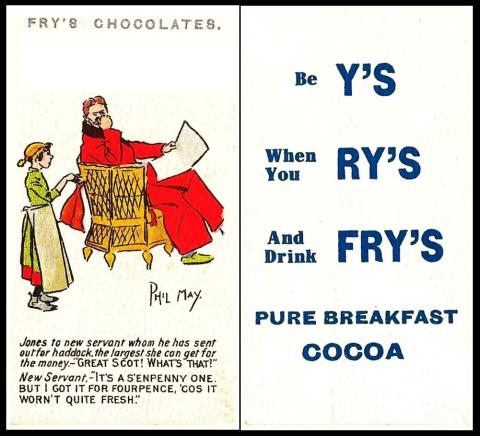
FRY`S Cocoa [Phil May Sketches (1905) Un/50 - FRY-290 : FRY-12 : H.72
Now for a little bit of fun, as today is #NationalNoHouseworkDay. I`m not sure that is entirely possible, for if you think about it, there is always housework, you can never entirely eliminate it, you can only postpone it - and then you end up doing double the day after. Even if you live in your car you have to sometimes wash the dashboard, clean the lights, and shake out the dust and dirt from the mats on the floor.
You can reduce housework, in some ways; eating out definitely saves you doing the washing up, and paying to sleep in a hotel every night means you never have to make a bed or wash the linen. However these are costly on the purse. And you are shifting your burden on to someone else.
In olden days, of course, the housework was done by someone else, either servants or slaves, though in many ways these two have a certain similarity. There were, at one time, servants for everything, that is why so many Victorian ladies were of large proportion. Today we think we have eliminated much of the stigma about having servants by producing robots, but their human masters still have to change the batteries or plug them into the mains. And a robot vacuum cleaner skidding about the floor may as well have a target painted on its back as far as households with dogs are concerned.
Then there is another problem, even with robots, which is humorously surmised on our card, and that is if you do employ a servant, human or robot, it will never do the job to your satisfaction, there will always be places left undusted, things knocked off the shelf and broken, or, as on our card, the sort of cost cutting that you would never do if you went to the shops by yourself.
In our original British Trade Index the set is described as :
- PHIL MAY SKETCHES. (A). Sm. 65 x 36. Unnd. (50). See H.72 ... FRY-12
In the updated version of that book, it is slightly altered, to :
- PHIL MAY SKETCHES. (A). 1905. 65 x 36. Nd. (50). See also Tobacco Handbook H.72 ... FRY-290
There is an error here, for these Fry cards are not numbered, only the tobacco ones are. And I say tobacco ones in the plural because H.72 tells us that this set was actually issued by two, namely F. & J. Smith, in 1908 (you can see that in the newsletter for the 29th of September 2023, just scroll down to Thursday, 5th October), and by W.A. and A.C. Churchman in 1912 (you can see that, or at least the version with "Churchman`s Cigarettes" on the front, as a Card of the Day for the 4th of January 2026).
Strangely, the trade version we show here, by Fry`s, was issued first of all, in 1905. It was not issued with their chocolate though, as the back shows us, it was issued instead with cocoa, for drinking. Cocoa would have been how they started, but we must give thanks to Joseph Storrs Fry, who took over in 1795 and first employed a mechanical servant to grind his beans, a steam engine, produced by James Watt. And though there were undoubtedly a few that did not grind to his total satisfaction, the engine was way easier.
And all the cards are exactly the same as in all the versions, though our set is unnumbered, hence the list below is slightly different, being in alphabetical order.
- A fact
- A real grievance
- Affable Country Doctor (to former patient)
- Ardent Politician (evidently playing his trump card)
- Bailiff (who has been very well treated and settled with)
- Benevolent Lady
- Bill Snooks
- Brown
- Conversation Overheard by sympathetic old Lady
- Did you go to Smith's Buryin ?
- Do you want an errand boy ?
- Does your poetry pay ?
- Drunken Tramp
- English as she is spik
- Excuse me, but is your name Pole Carew ?
- Farmer Brown
- Fat Capitalist
- How did your Billie get runned over ?
- Hullo, old chap
- I must congratulate you
- I want you to take me to St. John`s Wood, Cabbie
- Jocular Briton
- Jones to new servant
- Josser
- Little Girl
- Minister
- Moses
- Mr. and Mrs. Binks
- My Father 'e once caught a fish
- Now, Boy, where does Port wine come from ?
- Obliging
- Overheard in Sydney
- Overheard near the Zoo
- Overheard on a Cab Rank
- Sarcastic
- Say, Brown
- Scene; Outside Popular Theatre
- Shure, if I was as big as ye'self…
- Sol Jacobs
- Spare a copper, Sir
- Stout Party
- Sy, Bill
- The Vicar
- Thirsty Pedestrian
- Thought reading
- Visiting Day on a Gunboat
- Weary Willie
- What sort of bait…
- Why don't we have open air cafes ?
- Youngster
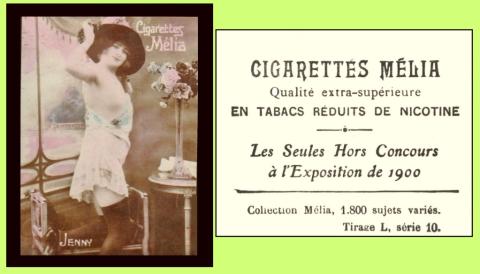
MELIA Freres [tobacco : O/S - Algers, Algeria] "Collection Melia" - Tirage L, serie 10 (???) Un/1,000
Let us move on from our torpor, and get out some cards. And I bet that few of us knew that today is #TradingCardsForGrownUpsDay.
So, you may ask, what is a trading card for grown ups anyway?
Some may say it is a card of the first person to make your heart skip a beat, certain proof you are growing up and putting away those childhood things.
Then there is the theory that you become a grown up when you start to lose interest in cards of cute cartoon characters, but that is certainly wrong, for that description applies to Pokemon, and it is definitely not children who pay such prices as $16,492,000 (or £12 million), in February of this year, for a single card, the 1998 promo of Pikachu Illustrator, in Japanese, of which only thirty nine exist worldwide. Admittedly there may have been more interest in the card through its connection to its former owner, one Logan Alexander Paul, an American influencer, professional wrestler, entrepreneur, boxer, singer, actor, and You Tube vlogger. Sadly, it was bought not by a collector, but by a venture capitalist, to add to his ever growing stash of alternative assets, which almost certainly means it will be trapped in the darkness of a vault, until he grows tired of owning it. For Logan Paul also bought it as an asset, in July 2021 for $5.275 million (or £3.8 million), which at that time made it the most expensive Pokemon card ever to be sold.
And, just in case you are wondering, the T.206 of Honus Wagner only ever reached $5.124 million, on February the 21st, 2026.
Others may cite cards of a decidedly more "grown up" nature, which are becoming more and more openly available, especially from the Far East. And we have gone for that sort of thing here, from the Near East, though it is, in comparison to the modern definition of such things, very gentle indeed, "Jenny", whomsoever she was in real life, being deceivingly decently clad in a white, or maybe pink, full body suit, though she is happy enough to show off her thick black stockings. In fact it is gentle for Melia as well, because some of their cards featured models who were perfectly okay with being displayed in all their non-body-suited glory.
Melia Freres - which means Melia Brothers - was founded in 1840. At first its tobacco and cigarettes were retailed through a little store on the corner of Place du Gouvernement and Rue Bab-el-Oued, however word soon spread of the quality of the tobacco and they were able to expand. They also took part in exhibitions, at Rouen in 1896, Brussels in 1897 (and 1910), Paris in 1900, Marseille in 1906. In 1908 they were large enough to exhibit at the Exposition Anglo-Francaise, which we know better as the Franco-British Exhibition, held at White City in London between the 14th of May and 31st of October. They are entered in the catalogue as ""MELIA (Gabriel), manufacturier en tabacs, Alger."
After the First World War, they had a new factory built, six thousand metres square, and fully mechanised. It was opened on the 16th of July 1914. Reportedly the annual output from this factory was 5,000 kilos of tobacco and three million cigarettes. It was called "The House of Melia", and was a local landmark.
Our set is one of those catalogued in our original World Tobacco Issues Index as :
MELIA Freres, Algiers, Algeria
French language issues. Most cards inscribed "Cigarettes Melia" only.
- PHOTO SERIES 2. (A). Md. 65-67 x 48-50. Black and white or brown photos, some hand coloured. Printed back, in black. Unnd. Actresses, Beauties, Views, etc. ... M88-3
1. Inscribed "Cigarettes Melia" in design
(1) Back "Collection Melia, 1800 sujets varies - Tirage L, Serie 10.
(2) Back "Collection Melia", 1200 sujets varies - Tirage R no. 16.
(3) Back "4me Collection Melia - 1500 sujets varies - Tirage E n. 7 de la Marque Etoile, Paris"
2. Inscribed "Cigarettes Melia, Alger" at base below picture. Back "Collection Melia - 1500 sujets varies (Tirage A)
It appears to me that the set of 1500 cards listed last were actually first, and this is backed up by "Tirage A", as well as the fact that the last set under the first group is the "4me" or fourth, series, and yet there are only three sets in the first group
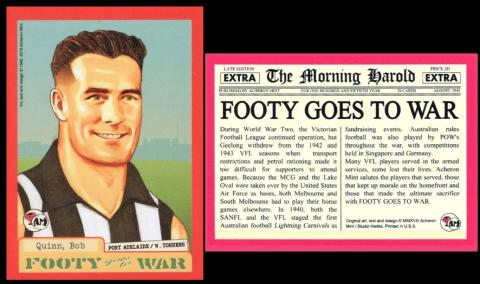
ACHERON Mint [trade/commercial : O/S - Australia] "Footy Goes to War" (2018) Un/20
Today saw the birth of someone I probably never would have heard of if I didn`t hunt for diary dates. His name was Robert "Bob" Berrima Quinn, and he was born today, in 1915, at Birkenhead, but the one in South Australia.
The tale really begins with his great uncle, John Baptist Sidoli, who was a football player, and had founded Port Adelaide Football Club. But Bob Quinn`s father, a wharf labourer, was also a football player, John Quinn, and he captained Port Adelaide Football Club in the years 1904 and 1905. He never forgot his day job though, and the "Berrima" in his son`s name was a tribute to what he felt was the best ship he ever worked on, S.S. and later H.M.A.S. Berrima, planned as a passenger liner for P & O, and launched in 1913, but whose fate turned out to be rather different, for she was commissioned as an auxiliary cruiser and fulfilled a number of tasks, including transporting troops, and towing the AE2 submarine. She was even torpedoed in the English Channel in 1917. She started work for P & O in 1920, but for less than a decade, as her route, Australia to Cape Town, was closed in 1929. And the following year she was sold, for scrap, to the Japanese.
Returning to our tale, John Quinn taught all his sons, Bob, Jack, Tom and George, the skills and nuances of the game, but also respect for their fellow players, to always try their hardest, but not if it meant ruining someone else`s match. And they would all go on to play for the family team, Port Adelaide, though Bob was probably the best, making his debut for the team on May the 6th, 1933
Bob was arguably the best footballer in his family, and in 1939 he became captain-coach of Port Adelaide. Then he enlisted in the Australian Imperial Force, in June 1940, when he was twenty-five years old. He was sent to Palestine, and would go on to fight at Tobruk, where he was awarded the Military Medal for an incident in which he was laying a segmented metal pipe, filled with explosives, beneath a barbed wire barrier, almost under the noses of the Germans.His section was closest of all and he was hit by shrapnel, in the leg and face, but refused all treatment before all his men were off the field. He was also injured in Papua New Guinea, shot in the arm, and suffered a knee injury that was feared could cripple him for life. Still he refused to leave the forces, and he was not discharged until 1944, two years after his youngest brother, George, who had lied about his age in order to enlist, had been killed in action, in Egypt.
When Bob Quinn came back to Australia he got married, and wanted to play football again. Port Adelaide welcomed him back, and made him a life member, but there had to be adjustments; he had to almost entirely change his playing style to compensate for his injuries, and he wore a leather guard on his arm where the shrapnel wound still shone bright. once more. This did not always protect him, and in the 1945 semi final he fell, landing heavily on that arm, and breaking it, just below the wound, though he refused to leave the field.
He retired at the end of the 1947 season, after just a hundred and eighty-six games for Port Adelaide, though he had kicked in three hundred and eighty-six goal. At first he went into coaching, but it did not suit him, and he moved out to run a public house in Kadina, in South Australia. He still played the occasional game for local sides, but that came to a halt when he fractured his pelvis in 1950. To give himself another pastime he bought a racehorse, and another public house, in Adelaide.
He died, in 2008, aged ninety three, outliving his wife by thirteen years, but leaving four children of his own, eight grand-children and twelve great-grand-children.
He has a permanent memorial at the Adelaide Oval too, where a gate is named after him.
As for Acheron Mint, it seems to be run by an American artist called Evan Driscoll, who also runs Studio Hades. The Acheron Mint impression is for Victorian Footy League and Australian Footy League cards, and it seems t have started in 2013 with a set called "Sportsmen of Oz". It then issued a series of sets looking at the decades, starting in 2014 with "Inside 50s", and issuing one a year, moving up through the decades until 2016, when he issued "Inside 70s", and also a second set of "Inside 60s". Then, in 2017, he returned to his first set and did a follow up to that as well, which was called "Sportsmen of Oz, series 2"
They are all very attractive cards but only issued in very short runs under ten of each card, sometimes half that. And they sell for amazing figures at online auctions.
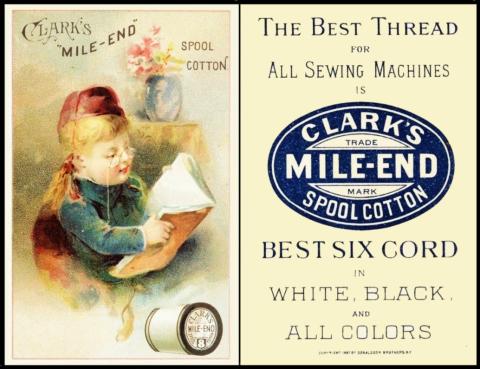
.John CLARK [trade : cotton : ] "advertising card - child reading (1887) Un/1
And now we close, sadly not with the first human cannonball, as that proved to have been on the second of April, not the tenth (in 1877), but that`s a date for next year in the book already.
Instead we have a similar subject, the firing of a child, or at least the firing of their imagination, for today is #NationalEncourageAYoungWriterDay.
Now you may be wondering why I have a child reading, and the truth is I ran out of hunting time for a child and a pen, but I justify the inclusion of this card by saying that reading and writing tend to go hand in hand - if a child is taught how to read, even of just a few basic words, then writing them down is easier, whilst once you can form a few letters, reading is already underway.
Throughout the ages there have been young writers, including Mary Shelley, who wrote Frankenstein at the age of eighteen. However, the path to success is not instant, and sometimes not even possible. Writing should always be something you do because it gives you pleasure, helps you grow, and allows you to dream about things you might like to do in the future. That is the most important thing to teach any child.
Today, it is easier than ever for a child to become a writer, at least on social media - where short stories, verses, and observations are thrust online every second. Some of these will be looked at once, perhaps, and never get as much as a like. What sets writers apart is that those who become famous, for a long time, never give up, despite rejections and indifference. They know, in their heart, that they have something to say, and are just as sure that one day, if they never give up, someone will read their words and contact them. And all the while they wait, they are getting better at writing....
This is a slightly different Clark card than the other ones we featured, as it is for "Mile End" brand. This proves it is after 1883, when the American subsidiary of John Clark, Jr. & Co., of Glasgow, became the "Clark Mile End Spool Cotton Company" - but before 1899, when Spool Cotton Company took over and merged Coats` "Cotton Spool", Clark`s "Mile End" (today`s card), and "O.N.T." - or "Our New Thread", (which we featured as our Card of the Day for the 11th of June, 2024.
And though I thought this one a one off, it appears that there are a few more of these heavily shaded, non-solid backgrounded, children`s cards, namely :
- girl in mauve cap and blue coat reading book
- girl in straw hat and brown top with bowl of food and insect
- girl in large pink beret with yellow dress and black and white cat
- girl in blue hat with blue coat whirling a diabolo
This week's Cards of the Day...
saw a new week, and a bit of fun, for whilst in England, and many other countries in the Western hemisphere, it will be April Fool`s Day on Wednesday the first of April, in France it will be a whole different thing.
You see in France the day is called April Fish, or "Poisson d`Avril", and it was first recorded in 1508 by a poet, from the Loire Valley, called Eloy d`Amerval. He is a shadowy figure, about whom almost everything is conjecture. Even his surname is not, it just means that he came from Amerval, an area near Calais. His birth is estimated simply because he is listed as being part of the choir at the chapel at Savoy in 1455, and so he must have then been younger than fifteen. He then appears in various references to the French Royal Court, but suddenly disappears after the publication of his most famous poem, `Le Livre de la Deablerie" in 1508; however this caused a great deal of controversy, for it was, in the main, an imaginary dialogue between Satan and Lucifer. So it may have been that he simply laid low, or even changed his name to avoid getting into trouble. That means we do not even know when he died.
For our tribute to the April Fish, we thought we would start you off with three cards that each contain two clues... and they were as follows
Saturday, 28th March 2026
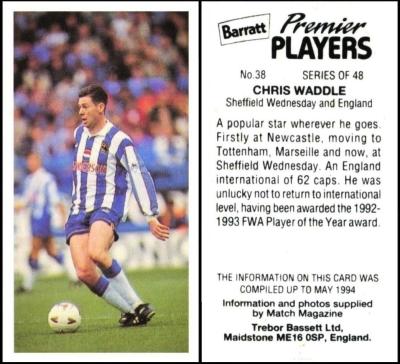
The first, easy, clue was the fact that this man played for the French team of Marseille, and that club is mentioned on the reverse of the card. However there was a reason not mentioned, nor shown, and that is that he was renowned for wearing a mullet - hairstyle - whereas a mullet - fish - is very popular in France, especially around the area of Marseille.
Christopher Roland Waddle was born on the fourteenth of December 1960, in Felling. At the time of his birth, Felling was part of County Durham. but when he was fourteen, it was transferred to become part of the Metropolitan Borough of Gateshead, in the County of Tyne and Wear.
His first team was Pelaw Juniors, made up of young players who lived on his council estate, a variety of ages and abilities, which must have been a great way to hone his skills against all comers. In 1978, he moved on to Tow Law Town, which you may never have heard of, but which were founded in 1890, and joined the Northern League in 1920.
Though he went to work in a factory, he never gave up his dream of football, and had several trials with leading teams, all of whom knocked him back. He was especially sad that Sunderland turned him down, as that was the team he had always been a fan of. Then, in July 1980, the Second Division team, Newcastle United, offered him a place, for a transfer fee of a thousand pounds. On the set of Panini "Football 88" it is revealed that he "Made his League debut for Newcastle against Shrewsbury in October 1980." It was there that he had his first cartophilic appearance, card 180 of Panini`s "Football 85" stickers. That, oddly, tells us a different birthplace, of Hepworth. Now I cannot even find Hepworth, but I can find Heworth, which is in the Gateshead area, and is actually part of a ward called Pelaw and Heworth.
He was at Newcastle only until July 1985, when he was sold to Tottenham Hotspur, for a slightly different amount, of £590,000. His first match for his new side saw him score two goals, half of the tally which beat Watford 4-0. That means his second card is also a sticker, Panin`s "Football 86", and curiously this quotes a slightly lower transfer fee of £500,000. The same year he also appears in an England strip, as the two of spades in Dandy Gum`s "World Cup Mexico 86" playing cards, issued with "Football Bubble Gum" - and also as card 416 of Panini`s "Mexico 86". Neither of these have any descriptive text.
Once more we can thank Boss Leisure`s "Emlyn Hughes` Team Tactix", issued in 1997, for adding some levity to the proceedings. They tell us that his nickname is "Wiggley", but not why, and that before he joined Newcastle he "worked in a sausage factory". This might be a card, but it is borderline cartophilic, as it is actually part of a board game.
In fact his first actual trade card appearance has to wait right until 1988, when he is shown in action on card 38 of Barratt`s un-named set, which has come to be known after the fact that the set was issued with Football Candy Sticks.
In July 1989, he was sold, to Marseille, and that is the second link in our clue chain, for red mullet is one of the chief fish in the Marseille area, being either cooked as a whole fish, or cut up and added to bouillabaisse, especially if there are not that many shrimp in the catch of the day, for red mullet has rather a shrimp-y taste. It looks like his only appearance in a Marseilles strip comes as part of the oddly named "Foot 92 en images", issued by Panini in France for the season. There is an added bonus if you find the album because he is one of only three players who appear as cards on the front cover. The transfer fee to Marseille was up once more, by a long way, to £4.5 million. During his time there, the team won the French Championship three times on the trot, in 1990, 1991, and 1992. The fans loved him too, and in 1998, a while after he had left the team, he was voted its second best player ever, only beaten by Jean-Pierre Roger Guillaume Papin.
He left Marseille in July 1992, and returned to England, being bought by Sheffield Wednesday, for just a million pounds. His first appearance in their strip comes as part of Panini`s "Football 93", where he is card 228. However there is no descriptive text there, only wording about the fact that you can get the album at all good newsagents.
In 1996 he moved to Scotland, being signed by Falkirk, though, almost immediately, was loaned out to Bradford City. The following year, he was actually signed, all those years later, by Sunderland, for £75,000, but it was again only a short-term stay, from March until May 1997, when he was given the chance of becoming player-manager at Burnley. However he moved on again in the autumn, turning up at Torquay United in September 1998. That was also short-lived, because Sheffield Wednesday approached him, asking if he would like to become their coach. That took him through to June 2000, after which he played for several non-league and local sides, and started a second career as a commentator.
Sunday, 29th March 2026
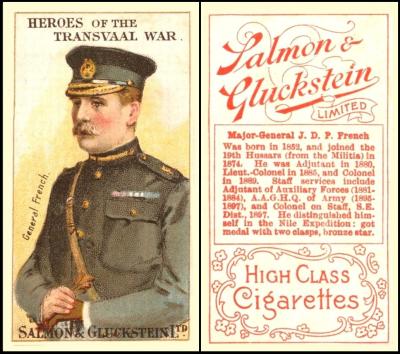
The largest clue on the front was that the card was issued by Salmon and Gluckstein, the salmon, called saumon, being the most popular fish of all in France. And the most popular sort of the fish, oddly, is saumon fume, or smoked salmon - which you probably connect more with Scotland.
The other clue was the fact that this man is Major-General John Denton Pinkstone French, shown here at the Boer War, where he was a cavalry commander, but who would go on to become the Commander-in-Chief of the British Expeditionary Force, and the 1st Earl of Ypres.
Our original World Tobacco Issues Index catalogues the set as ;
- HEROES OF THE TRANSVAAL WAR. Sm. 68 x 38. Unnd. (40).See H.389. ...S16-8
The H.389 here is the original London Cigarette Card Handbook, and that entry reads as follows :
- H.389. HEROES OF THE TRANSVAAL WAR (titled series). Fronts in colour. Unnumbered series.
Pre 1919
Salmon & Gluckstein - Series of 40. Captions in (a) dark brown (b) light brown. A few subjects only have been seen in the (b) printing
Overseas
Star Tobacco Co. of Bombay - Series of 52, with Playing-card insets. Two cards only have been inspected (Nos 20 and 30 below) and it is not known how the card values are distributed over the subjects.
- (a) Col. Baden-Powell
(b) Maj-Gen. Baden Powell- Col. J.F. Brocklehurst
- Gen. Sir Redvers Buller
- Lt. Col. J.J. Byron, Australian Artillery
- Maj. Lord Edward Cecil
- Maj. Gen. Sir H.C. Chermside
- Lord Chesham, Yeomanry
- Lieut. Gen. Sir C.F. Clery
- Capt. C.F. Cox, New South Wales
- Cmd. Egerton
- Commander Ethelstone, R.N.
- General French
- General Gatacre
- Col. Greene. Commanding Natal Carabineers
- Maj. Gen. Fitzroy Hart
- Maj. Gen. Hildyard
- Gen. Sir Archibald Hunter
- Col. Kekewich
- Maj. Gen. Kelly Kenny
- Lord Kitchener
- Capt. Lambert. Kaffrarian Scouts
- Capt. Lambton, R.N., C.B.
- Maj. Gen Lyttelton
- Brig. Gen. Hector Macdonald
- Col. Mackinnon
- Lieut. Gen. Lord Methuen
- Col. Plumer
- Col Rhodes
- Lord Roberts
- Maj. Robin. New Zealand
- Capt. Scott, R.N,. C.B.
- Maj. Gen. Sir C. Holled Smith
- Col. Spreckley
- Gen. Sir W.P. Symons
- Lieut. Gen. Chas. Tucker
- Sir Forestier Walker
- Gen. Sir Charles Warren
- Maj. Gen. Wauchope
- Gen. Sir George White
- Maj. Gen. Woodgate
We also have the catalogue, uniform with that handbook, which tells us that odds were currently being retailed at between 3/6 and 10/-, with sets at £20. It makes no mention of light or dark brown, so that seems to suggest the light was the result of the ink running down during the printing process.
The Star Tobacco Co. of Bombay did not appear in the catalogue, but it does appear in our original World Tobacco Issues Index, with our set being recorded as :
- HEROES OF THE TRANSVAAL WAR. (A). Sm. 62 x 36. Front 6, with playing-card inset. Back 4, (52). Illustrated in "N & N", Vol.7 No.4 ... S114-3
The curious front and back numbers are explained in the header for the issuer, and you are redirected to the "X" codes at he back of the book. That is but a block, which I will add as soon as the scanner wants to work rather than make odd grumbling noises.
Our updated World Tobacco Issues Index catalogues the set as ;
- HEROES OF THE TRANSVAAL WAR. Sm. 68 x 38. Unnd. (40).See H.389. ...SO41-200
That H.389 directs us to an entirely different book. our own handbook. issued in 2003. That entry is rather exciting, as it adds in the cards of the Star Tobacco`s playing card version, as follows
- H.389. HEROES OF THE TRANSVAAL WAR (titled series in Salmon & Gluckstein only). Fronts in colour. Unnumbered series.
Pre 1919
Salmon & Gluckstein - Series of 40. Captions in (a) dark brown (b) light brown. A few subjects only have been seen in the (b) printing.
Overseas
Star Tobacco Co. of Bombay - Series of 52, with Playing-card insets. No series title. Values known shown in parentheses below (41 different known)
- (a) Col. Baden-Powell
(b) Maj-Gen. Baden Powell (eight of hearts)- Col. J.F. Brocklehurst (jack of hearts)
- Gen. Sir Redvers Buller (nine of hearts)
- Lt. Col. J.J. Byron, Australian Artillery (6 of hearts - and - Queen of Clubs)
- Maj. Lord Edward Cecil (three of spades)
- Maj. Gen. Sir H.C. Chermside (king of hearts)
- Lord Chesham, Yeomanry (ten of clubs)
- Lieut. Gen. Sir C.F. Clery (seven of diamonds)
- Capt. C.F. Cox, New South Wales (seven of clubs)
- Cmd. Egerton (five of diamonds)
- Commander Ethelstone, R.N. (six of clubs)
- General French (ten of hearts)
- General Gatacre (jack of diamonds)
- Col. Greene. Commanding Natal Carabineers (five of hearts)
- Maj. Gen. Fitzroy Hart (three of diamonds)
- Maj. Gen. Hildyard (six of spades)
- Gen. Sir Archibald Hunter (four of spades)
- Col. Kekewich (king of clubs)
- Maj. Gen. Kelly Kenny (two of diamonds)
- Lord Kitchener (nine of clubs)
- Capt. Lambert. Kaffrarian Scouts (nine of spades)
- Capt. Lambton, R.N., C.B. (four of clubs)
- Maj. Gen Lyttelton (seven of hearts)
- Brig. Gen. Hector Macdonald (eight of spades)
- Col. Mackinnon (ace of spades)
- Lieut. Gen. Lord Methuen (king of diamonds)
- Col. Plumer (eight of diamonds)
- Col Rhodes (ace of diamonds)
- Lord Roberts (eight of clubs)
- Maj. Robin. New Zealand (ten of spades)
- Capt. Scott, R.N,. C.B.(five of clubs)
- Maj. Gen. Sir C. Holled Smith (five of spades)
- Col. Spreckley (seven of spades)
- Gen. Sir W.P. Symons (queen of diamonds)
- Lieut. Gen. Chas. Tucker (queen of hearts)
- Sir Forestier Walker (ten of diamonds)
- Gen. Sir Charles Warren (six of diamonds)
- Maj. Gen. Wauchope (four of diamonds)
- Gen. Sir George White (nine of diamonds)
- Maj. Gen. Woodgate (two of spades)
That means that the cards we have yet to see are :
- clubs - two, three, jack, and ace
- hearts - two, three, four, and ace
- spades - jack, queen, and king.
That probably means that either, just like "Lt. Col. J.J. Byron, Australian Artillery", some people can found on more than one card - or that there are other people who appear in the playing card version but not the Salmon and Gluckstein one. Anyway if anyone can add anything to this, please do !
Monday, 30th March 2026
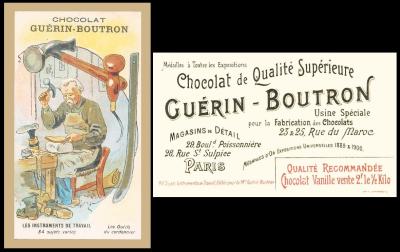
Firstly this was a card issued by Chocolat Guerin-Boutron of Paris in France. That was reasonably easy, especially if you had already fathomed out the French link.
The second one was a bit more of an observational task, in that here we have a shoemaker, and bottom left is a pair of boots, one of which is on its side, revealing of its sole And a sole is yet another popular French fish, most often used in Sole Meuniere, where it is floured, buttered, fried, and then topped with lemon.
Today it is a classic dish, but its name proves its true origins, for a Meuniere was the wife of a miller, hence the flour with which the fish receives its initial dusting.
As far as this set, it deals with tools and their uses, and there are a marvellous assortment of trades and equipment. Even better than that, you have a main image of the man or woman using the tools and the tools are also drawn separately on the front of the card.
And here are all the tools in the set, all eighty-four of them ...
- L`Aiguille et la Fil [female seamstress with needle and thread]
- L`Aiguille a tricoter [woman and knitting needles]
- L`Archet [man in smock with bow saw]
- La Batteuse a vapeur [farmers with steam threshing machine]
- Le Battoir [woman with clothes beater]
- La Beche [gardeners and rot cutting shovel]
- Le Bisaique [joiner and chisel/mortise chisel]
- La Bouclier des Terrassiers [tunnellers and rope drawn trolley for removing earth]
- La Brouette [builder and wheelbarrow]
- Le Broyeur a chocolat [chocolatier and cocoa grinder]
- Le Burin [engraver and cold chisel]
- La Canne du verrier [glass blowers and blowing tubes]
- La Charrue [the plough]
- La Chevre [builders with pulley winch]
- Les Cisailles [roofer and tin snips]
- Le Ciseaux [woodworker with chisel]
- Les Ciseaux [tailor and scissors]
- La Cognee [tree cutter and axe]
- Le Composteur [printer with type blocks]
- Le Crible [gold miner and dirt sieve]
- Le Cric [stonemasons with hand winched lifting tool]
- Le Crochet du portefaix [porter and luggage carrier]
- La Drague [dredging boat]
- L`Ebauchoir [sculptor and clay moulding tools]
- L`Echenilloir [gardeners and long handled loppers]
- L`Enclume [blacksmith and anvil]
- L`Etau [workman and vice]
- L`Excavateur [steam driven excavator]
- La Faucheuse mecanique [farmer and grain harvester]
- La Faucille [female cutting corn with handbill hook]
- La Faux [farmers and the scythe]
- Le Fendoir [butcher and meat cleaver]
- La Fer a repasser [laundrymaid and flat iron]
- Le Fer a souder [man with soldering iron]
- Le Filet et la Harpon [fishermen, nets and a harpoon]
- Le Fleau [farmers and the flail
- La Forge Portative [workmen and portable brazier]
- Le Four [potters and kiln]
- La Fourche [farmer and forks]
- La Gouge [woodcutter and chisel]
- Le grue a vapeur [steam driven sand excavator]
- Le Herse [farmer and horse driven harrow]
- La Houe [farmer and hoe]
- La Hotte du Vendangeur [back-mounted bucket for collecting grapes]
- La Laminoir [metal workers and rolling mill]
- La Lime [workman and file]
- La Machine a percer [workmen and giant drill]
- La Machine de coudre [seamstress with sewing machine]
- Le Marteau et les Clous [case maker with hammer and nails]
- La Marteau-Pilon [workers and drop hammer]
- La Masse du sculpteur [stone-sculptor and hammer]
- Le Metier a Fileau [seamstress with spinning wheel]
- Le Metier a Tisser [weaver and loom]
- La Meule d`aiguiser [knife grinder]
- Le Moulin a farine [farmer and grain mill]
- Le Niveau d`arpenteur [surveyor and theodolite]
- Les Outils di cordonnier [shoemaker and his tools]
- La Palette [artist and palettes]
- La Pelle et la Proche de Terrasser [workmen with pick and shovel]
- La Pelle du Boulanger [male baker and baker`s peels]
- Le Perforateur a tunnel [miners with tunnelling device]
- Le Pic de Mineur [miner and pick]
- Le Pinceau [house painter and paint brushes]
- La Presse a bras [printer and hand press]
- La Presse a vapeur [laundrymen and steam press]
- Le Pressoir [farmer and winepress]
- Le Rabot [carpenter and hand plane]
- Le Rateau [gardener and rake]
- Le Rouleau [farmer and roller]
- La Scie a main [carpenter and hand saw]
- La Scie de long [carpenters and a whipsaw]
- La Scie de scieur de pierre [stonemason and stone cutting saw]
- La Scie mecanique [carpenter and large table saw]
- Le Secateur [lady gardener and secateurs]
- Le Secateur [male gardener and secateurs]
- Le Serpe [male gardener and pruning knife]
- Le Soufflet du Forge [blacksmith and bellows]
- Les Tenailles [metal worker and pincers]
- Le Tissonnier et la Pelle a Charbon [boiler-workers with poker and coal shovel]
- Le Tour du Mecanicien [machinist and lathe]
- Le Tour du Potier [potter and potter`s wheel]
- Le Treuil [miners and winch]
- La Truelle [builder and trowel]
- Le Vilbrequin [builder with hand cranked drill]
Tuesday, 31st March 2026
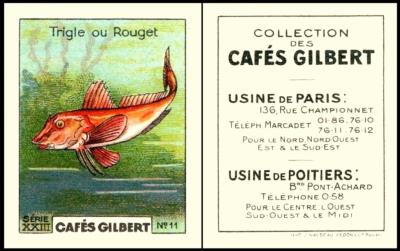
Cafes Gilbert seem to be very elusive, and all I have been able to find out about them is what is on the back of our card - that they had a branch in Paris, and another in Poitiers. If you look closely on the card though, right at the very bottom right of the reverse, there is a printer`s name, J. Naudeau-Redon et Cie, of Poitiers - so the Poitiers branch, despite being at the bottom of the card, must have been the primary branch.
Looking at this led me to a Maurice Gilbert, who founded the business in 1902, and called himself an importer and coffee grinder. They seem to have been regulars at all the French exhibitions, and were known for their steam grinding machines. In 1915 Maurice took over a place called Le Manoir de Beauvoir, in Mignaloux-Beauvoir, from the widow of the former owner, Charles-Théodore Allenet, which he seems to have used as a country retreat, because he still kept his own house in Poitiers, at least until the War came a bit too close to Poitiers, at which time he relocated to the Manor.
He also had a hotel, which was built for him, in Art Deco style, in 1933. It was not completed until 1935. That was confiscated by the German army in 1941. Maurice Gilbert died in 1944, aged eighty, leaving a widow and at least one son, but for some reason they did not get the hotel back after the war, it was taken over as the headquarters of the organisation responsible for restoring order and even for pardoning people who were suspected of being collaborators if they were not. In 1946 ownership,but only of half of the building, was given back to his widow, but when she died in 1960 it was bought by the city and used as an adjunct to the University. In 1994 it became the local administrative court.
The fact that another of the set shows breeds of hens was very fortunate, for it meant that my chicken correspondent, Malcolm Thompson, was able to send me some additional information.
He tells me that there were twenty-four sets, which fitted into a single album. two hundred and eighty-eight cards in all, and that all of these cards were printed by J. Naudeau, Redon, et Cie, in about 1935. The sets are not always titled as to the set on the cards, in fact it looks like only set seven is - nor titled in the album either, which means that it was up to the delight of the person who stuck them in where the series were placed. However each of the cards does have a set number, which are :
- - I - African Animals
- - II - Birds
- - III - Sports
- - IV - Boats
- - V - Means of Locomotion
- - VI - Coffee
- - VII - "Colonies Francaises"
- - VIII - Uniforms
- - IX - Occupations (untitled)
- - X - Peoples of the World
- - XI - Dogs
- - XII - Calendar Months
- - XIII - Agricultural Machinery
- - XIV - Regional Costumes
- - XV - Dwellings
- - XVI - Butterflies
- - XVII - Breeds of Hens (untitled)
- - XVIII - Breeds of Horses
- - XIX - Bird`s Nests
- - XX - Reptiles
- - XXI - Aeroplanes
- - XXII - Songbirds
- - XXIII - Marine Fish
- - XXIV - Freshwater Fish
The description on our card is also odd, for the fish is titled "Trigle ou Rouget", but when you search for Trigle there is no such thing, only the Italian for red mullet, which is "Triglie". Rouget is the French word for the same fish - but on no other card are there two words for the same fish.
Another curiosity is card six, the Morue, for that is the French word for a cod, but only after it has been dried and salted, before that, whilst it is still swimming, as on our card, it is known as a cabillaud.
The set comprises
- Carrelet et Sole - [plaice and sole]
- Doree ou Saint Pierre [john dory]
- Hippocampe - [sea horse]
- Maquereau - [mackerel]
- Merlan - [whiting]
- Morue - [salt cod]
- Raie bouclee - [thornback ray]
- Regalec - [giant oarfish]
- Requin - [shark]
- Thon - [tuna]
- Trigle ou Rouget - [red mullet]
- Zanclus cornulus - [Moorish idol]
Wednesday, 1st April 2026
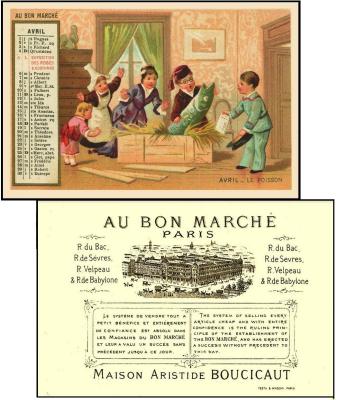
This card was supplied by a reader, and it changed the course of the week, for I was planning to celebrate Poisson d`Avril with simply French fish. The reason for that was that although I knew there were postcards for this event, I did not know there were proper trade cards, and now I do.
A lot of collectors call this set "mois", or months, but that is not strictly correct. It also leads to confusion with another Au Bon Marche set, which is called "Mois", or more correctly, "Mois de l`Annee", which means moths of the year. Our set is actually name "Calendrier" or calendar, because the panel on the front is a calendar of dates.
The cards in our set are :
- Fevrier. Le Carneval [The carnival, possibly Mardi Gras]
- Mars. Les Oeufs de Paques [Easter Eggs]
- Avril. Le Poisson [April Fools Day]
- Mai. Mariage aux Champs [country wedding]
- Juin. Grand Prix [horse racing - presumably Longchamp]
- Juillet. Les Bains de Mer [bathing at the seaside]
- Aout. Les Voyages [holidays]
There is actually a bit of advertising amongst these cards, for if you look at our card, in the calendar panel there are words in red ink, namely "Expositions des robes & costumes", and that is a company announcement, for "Exhibitions of dresses & costumes". Likewise, on the February card it marks the 16th as "Mise en Vente - de blanc, toiles, lingerie, rideaux" - which means "For Sale - white goods, canvases, lingerie, curtains". And on the March card there are two events, marking the 1st as "Mise en Vente - des Gants & Dentelles", namely gloves and lace, and the 15th through 17th as "Expositions des Nouveautes d`Ete" which are new goods for the Summer.
The one thing nobody seems to know is why only seven months were issued. Do you?
Thursday, 2nd April 2026
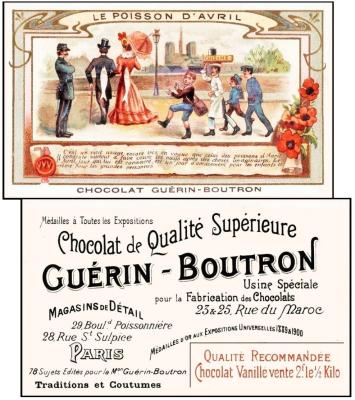
This card will instantly amuse readers of Belgium, Canada, France, Italy, and Switzerland - but the why may not have been noticed by readers from other countries. To let you in on the secret, look at the man and lady, and they have white objects on their backs, which are actually paper fish. You see, in those areas of the world, one of the most common April Fools Day pranks is to try and stick a paper fish, the larger the better, to some unknowing person`s back, and then everyone who sees it will laugh and the poor person who is sporting the fish will not know why.
Today the practise continues, but it is stressed that the fish is taped on. And that made me wonder what the pranksters did before? Glue maybe?
People with unwonted fish stuck to them appear on many postcards, but until I saw this card I did not know that it appeared in cartophily too. And now I do!
Now when I looked at the back of this card I was not sure if there were 18 or 78. But a list proves there are a lot more than eighteen after just a quick hunt, and the tally currently stands at sixty-four, which are :
- A la Statue de Strasbourg - (vertical)
- Bal a Bord d`un Cuirasse - (horizontal)
- Bal a la Hotel de Ville de Paris - (vertical)
- Bapteme de Cloche - (vertical)
- Bapteme du Tropique - (horizontal)
- Bataille de Fleurs a Nice - (vertical)
- Carrousel Militaire a L`Ecole du Saumur - (horizontal)
- Combat de Coqs - (vertical)
- Concours de Peche a la Ligne - (horizontal)
- Concours Hippique - (horizontal)
- Course en Baquets
- Courses d`Automobiles - (horizontal)
- Courses de Bicyclettes - (horizontal)
- Courses de Chevaux (Bretagne) - (horizontal)
- Courses en Sac - (horizontal)
- Defile des St. Cyriens a Longchamps - (horizontal)
- Fete de Guillaume-Tell (Suisse) - (horizontal)
- Fete de Jeanne s`Arc a Orleans - (horizontal)
- Gymkhana - (horizontal)
- Jeu de la Pole - (vertical)
- Jeunes Gens Plantant le Mai - (horizontal)
- La Benediction des Bles - (horizontal)
- La Benediction des Barques (Pecheurs d`Islande) - (horizontal)
- La Cueillette du Gui - (vertical)
- La Farandole - (horizontal)
- La Fete des Vendanges - (horizontal)
- La Fete des Vieux Pots - (vertical)
- La Fete de Triomphe a l`Ecole ou St, Cyr
- La Fete du Boeuf Gras - (horizontal)
- La Fete du Carri (Vaucluse) - (horizontal)
- La Foire an Pain d`Epices - (horizontal)
- La Gargouille a Rouen - (horizontal)
- La Messe Rouge - (horizontal)
- La Mi-Careme (Fete des Blanchisseuses) - (horizontal)
- La Presetation du Drapeau - (horizontal)
- La Priere a Bord - (horizontal)
- L`Arbre de Noel - (vertical)
- La Rosiere de Nanterre - (horizontal)
- La Ste. Barbe (Fete des Artillerie) - (horizontal)
- La Ste. Catherine - (vertical)
- La Tarasque de Tarascon - (horizontal)
- Le Carnaval de Nice - (horizontal)
- Le Depart de la Classe - (horizontal)
- Le Geant Gayant a Douai - (vertical)
- Le Grand Prix de Paris - (horizontal)
- Le Guet de la St. Maxime - (horizontal)
- Le Jour de l`An a Lesneven (Finistere) - (vertical)
- Le Mages a Trest - (horizontal)
- Le Pape des Fous - (horizontal)
- Le Poisson d`Avril - (horizontal)
- Les Courses d`Echasses - (horizontal)
- Les Faux de la St. Jean - (vertical)
- Les Noces d`Or - (horizontal)
- Les Regates - (horizontal)
- Les Veterans a la Colonne Vendome - (horizontal)
- Le Tirage au Sort - (horizontal)
- Mariage de Normandie - (vertical)
- Marie au Ble a Valenciennes - (horizontal)
- Opera - Bal Masque - (horizontal)
- Pelerinage de N.D. de Lourdes - (horizontal)
- Procession de N.D. des Dunes a Dunkerque - (horizontal)
- Une Noce a Robinson - (horizontal)
- Une Noce chez le Photographe - (horizontal)
- Un Pardon en Bretagne - (horizontal)
if anyone has any more do let us know!
Friday, 3rd April 2026
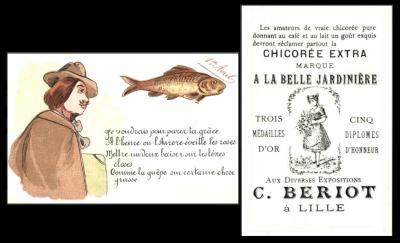
This card is rather like a funny valentine, showing a person, with a verse. And in fact the festivities of Poisson d`Avril did seem to encourage men and women with a hidden fancy for each other to make them the object of ridicule, in the hope that desire may follow.
The idea seems to have been either to put these cards through the door of someone who you thought radiated the qualities on the card, or to pin them on their person as an alternative to just a paper fish.
There are men and women, and so far we know of :
- female in red blouse with basket
- female in red coat with humped shoulders
- female in white dress with large collar
- male in brown coat, rather artistic
- male with beard, rather unkempt
- male with cane to mouth
- male with devil`s horns
- male with lemon squeezer hat
and the verses are humorous - for example, ours reads : "Je voudrais pour parer la grace, A l`heure ou l`Aurore eveille les roses, Mettre un doux baiser our les leines (?) cloves (?) , Comme la guepe our certaine chose grasse" That seems to translate to "I would like to take your grace, at the hour when Dawn awakens the roses, to place a sweet kiss on the lean cloves, like the wasp on a certain fat thing." - but some parts don`t seem to fit.. .I`ll tinker with it later.
So there you go, we have come to the end, and most of it is in place, which means that over the weekend I will be able to devote a bit more time than I thought to the indexing of back issues of our newsletter. Its actually a quick task, if all the cards are able to just slot in to the index - it only gets halted if I go to drag the title across to the other screen and find it is there already, because that means I have to hunt for a new card, and sometimes a new subject. Nowadays I do not have that problem, for before I start working on a card I can check if it is there already, and if it is I just reject it and go hunt another,
I hope you all have a happy Easter, and that the weather is kind if you are out hunting eggs. You are supposed to eat the eggs on Sunday, by the way - this is because during Lent, eating eggs was forbidden, and so it was a very special thing to eat an egg on Easter Sunday. In fact there are lots of superstitions about eggs at this time, including the belief that if your hen laid an egg on Good Friday, and you kept it for a whole century, it would turn into diamonds. However if you cooked an egg on Good Friday and ate it on Easter Sunday it would allow barren women to give birth, and make men live longer. This year nipper will have his first Easter egg, a special dog-friendly one, made by Webbox, who know that dog mums tend to be as soft a touch for their dogs as other mums are for their children.... But by the next time I write this section, Easter will be gone, and perhaps Waitrose will stop selling two packs of hot cross buns for £3.00.... including one which is a combination of chocolate and fudge. What can I say.....
except for ... have a great weekend