
Welcome to a new weekend, and this one comes with a little nudge, for it is but a month until our convention, so it is time to check your wants lists are up to date, sort and price up your spares for swapping, and estimate how many wallets, leaves and albums you might require until you are next able to save the postage by buying them in person.
This week things went smoother, I got all the subjects earlier, even with some wrangling and changing, and the pictures were all uploaded by Friday lunchtime, however I had miscounted and believed the card of the day to be a diary date, so I had to quickly get another card. As to whether there are reference book details, that will depend on how quickly I rocket through the rest of the text not yet done, but I did include several continental cards just to speed me up, for they do not appear in the reference books I have.
website news
I had another rally with the back issues of our newsletters this week and managed to add those of the 6th of June 2024, the 13th of June 2024, the 20th of June 2024, the 27th of June 2024, and the 3rd of July 2024 to the card gallery and index.
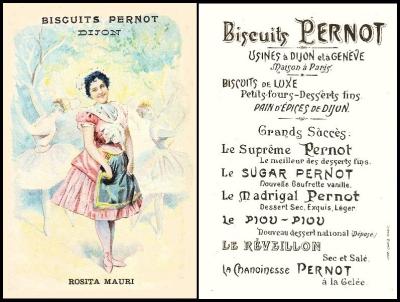
None of those gave me too much trouble, except I had a duplicated set, Guerin Boutron`s first series of "Livre d`Or Celebrites Contemporaine".
At first I thought it would be much easier to find another card of General Joubert the Boer War leader than it ever would be to find one of Rosa Mauri the ballerina, but I could find no beard that rivalled the card of General Joubert that I already showed, and so in the end Rosa Mauri was the one who changed, to this Biscuits Pernot set which seems very elusive indeed, so scroll down to Friday, 19th July in the newsletter of the 13th of June 2024 and see whether you can add any more names.
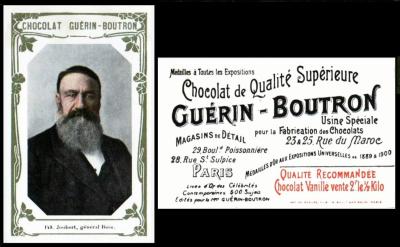
Speaking of the brilliantly bearded Boer battler, I have also started noting down all five hundred names in the first series of Guerin Boutron`s first series of "Livre d`Or Celebrites Contemporaine" on its page, which is https://csgb.co.uk/cardoftheday/2025-12-03 - because I now know a reader who has a complete set, of both. That will be a slow job though.
Anyway, the next newsletter to tackle will bring us into May 2024, and I may, given time, get the whole month added before next week`s newsletter, which will start whittling them down for it will add a years worth of cards in just twelve weeks.
And now onwards to our current newsletter.... and
this week`s diary dates :
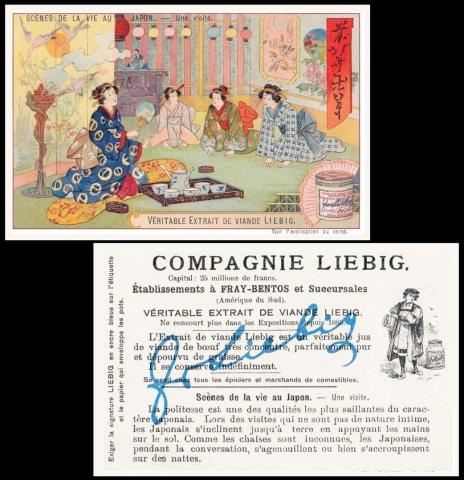
LIEBIG [trade : meat extract : O/S - South America] "Scenes de la Vie Au Japon" (1904) F.781 : S.780
This afternoon when it gets to three o`clock, and you sit to sup your tea and eat your hot cross bun, spare a thought for Sen no Rikyu, whose day it is today and who was the main inventor and influencer of the Japanese tea ceremony, making it into not just a drink but an art form.
Sen no Rikyu was born some time in 1522, into a family of famous merchants, in Sakai which is now part of Osaka. He was well educated, for his family were wise and realised that trade, not war, would be the future - and indeed the Murimachi Shogunate era, a military way of life, ended in 1568.
Sakai was one of the most prosperous ports, and the drinking of tea, which had been introduced to Japan from China in the twelfth century, was a great way to encourage new business as well as keep suppliers on your side. You may be surprised with what I am about to say, but the blend of choice, and often the deal-maker, was matcha. This was made from young leaves, steamed, not boiled, to preserve their tenderness, dried carefully, and ground gently to a fine powder.
When Sen no Rikyu was twenty-three, he hosted a tea party that went down in history, for the fineness of his blends, the stillness and silence of the ceremony, and his knowledge both of the product and the ceramic from which it was sipped. He already had a liking for using locally made pottery, often producing few bowls a month, rather than importing it from outside Japan. He believed that local grown tea was enhanced by local made bowls, that the materials that made up both, being from the same area, worked together, enhancing the flavouring. And he would later commission bowls, to be made in the strange medium of raku, where they were hand moulded, and rapidly cooled often leading to natural cracking of the glazes and the unmistakeable natural marks of flames and smoke - a process which never creates two items exactly the same.
It was also he who transformed the tea ceremony, making a much smaller, more intimate space, designing of the paper walls and windows to allow for the sights and sounds of the outside world to still be there, but filtered, close but unreachable, so that you knew you were part of a larger world but could only just grasp a semblance of it as it passed you by.
We do not know much of Sen no Rikyu`s middle years, but in 1575 he is recorded as serving tea to the warlord Oda Nobunaga, who dreamed of making the separate warring factions and their tightly bound areas of land into a single Japan. He never quite managed that, for he was betrayed by a deputy, or perhaps someone else using that deputy as a pawn to keep their own identity secret. However, after Oda Nobunaga`s suicide, his former retainer, Toyotomi Hideyoshi, a fellow believer in unifying Japan, took over, and made acquaintance with Sen no Rikyu, perhaps knowing how tea cemented the bonds of loyalty in trading terms. Toyotomi Hideyoshi did manage to accomplish what his master never could, and it is due to him, as well, as, perhaps, to tea, and its strengths, that Japan today is one country.
For his assistance, Sen no Rikyu became a valued friend and advocate, almost equal to Toyotomi Hideyoshi`s own kin, especially his half-brother Hidenaga. However, suddenly, things changed. Some suggest that Toyotomi Hideyoshi, or his aides, became uncertain of having a lowly born person in such a high position; others that he was jealous how close Sen no Rikyu had become to Hidenaga. This came to a climax after Hidenaga`s death on the fifteenth of February, 1591, when Toyotomi Hideyoshi gave orders for Sen no Rikyu to kill himself, and for his children to be banished.
There is much debate on the date of death of Sen no Rikyu. Some say it was as early as the twenty-eighth of February 1591, whilst others give the date as today. That seems to support the reasoning for today being his memorial day, and we know that in Japan there are memorial services annually on this date; however research seems to support that this allows one month, for mourning, after his death. As for the other oft quoted date, of April the 21st, 1591, that is actually the February date, altered from the traditional Japanese calendar to the modern Gregorian one.
In 1595, Toyotomi Hideyoshi seems to have grown regretful about his actions, and he gave orders for the children to be both pardoned, and allowed to return. He also returned to them several pieces of Sen no Rikyu`s tea equipment which he had taken for his own use.
His son, Sen Doan, inherited some property in Sakai, but had no children, so technically the direct masculine lineage ended with him. However, Sen no Rikyu`s daughter, Okame, married a man called Sen Shoan, and he was enamoured with the family he had joined, so much so that he started restoring the tea ceremony, and then opened schools to teach how to perform it. These three schools survive to this day. And their son, Sen Sotan, continued that legacy.
Our card was issued in Dutch, French, and German (as "Aus dem Japanischen Leben"). The French version, which we show here, is definitely the easiest to acquire. The cards we know of, so far, from the three different versions, are :
- Growing Rice
French - Culture du Riz
German - Reiskultur
- Dancing
French - Danse
German - Tanz
- Washing Clothes
French - Laveuses
German - Wascherinnen
- Travelling by Boat
French - Promenade en Barquette
German - Bootfahrt
- Travelling by Carriage/Rickshaw
French - Promenade en Voiture
German - Spazierfahrt
- A Visit
French - Une Visite
German - Visite
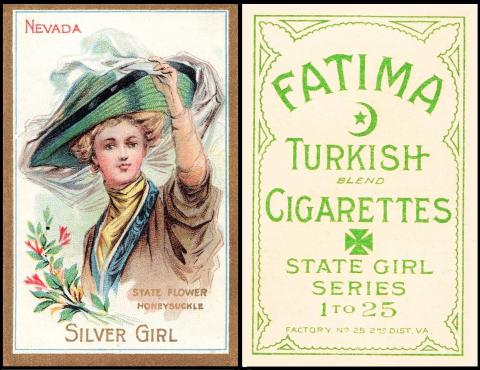
AMERICAN Tobacco Co [tobacco : O/S - USA] "State Girl Series" (19??) Un/25 - A565-152.A : A54-76.A : ABC/T.106 : USA/T.106
This day really held me up. It started out as a moonlight flit, by the Baltimore Colts, but then that date turned out to be yesterday, not today - though I do now have a card all ready for next year. Then I found out that it was the eighty-eighth day of the year, and that we celebrated #WorldPianoDay, because a piano has eighty-eight keys. But we seem to have chatted about pianos a lot.
Eventually, though I have not been able to establish why, a reader told me it was #NationalNevadaDay - and a check in the search box of our site proves that I have not visited Nevada that much, so off we go.
It turns out that Nevada has no coastline, and has always been pretty sparsely populated. Today three quarters of its population live in a small area called Clark County, which just happens to contain the city of Las Vegas, where most of the State`s residents work. Strangely, gambling in Nevada was outlawed in 1909, but re-legalised on March the 19th, 1931.
Originally it was Native American country, but the name Nevada is Spanish - given it by early explorers and colonists, who thought the snowy mountaintops looked like Sierra Nevada back home.
At one time it belonged half to California and half to Nuevo Mexico, which led to it being renamed the New Mexico and Utah Territory in 1850. In 1859 someone found silver, the first big discovery of that material in the United States, and just as the Gold Rush of California ten years before everyone who was anyone, or no-one, flocked there, so many that it was decided to split the area into two and carve out Nevada Territory, in 1861.
Then, on October the 31st, 1864, Nevada became the 36th state to join the Union. That is one of its big claims to fame, as the American Civil War was still raging, and only two states joined up during that time, the other being West Virginia. We do not know how Nevada came to be granted statehood as it was well short of the minimum population quota, by twenty-thousand head.
Today, most people know two things about Nevada, and both are kind of linked.
The first is that it is home to "Area 51", a top secret place which the Air Force tries to hide by calling it Homey Airport or Groom Lake. Its also illegal to fly over the site, or to enter it, and defenses are used without restraint. The first unauthorised entry was by Greenpeace, in 1983, they managed to stay inside the site for a week, but were then arrested and charged with trespassing. The government tells us that it is simply where they test new military systems and equipment, but lots of people are still of the opinion, supported by the fact that Nevada is a complete hotbed for UFO sightings, that the ship, and the aliens, captured, alive, at Roswell, were held here and forced to tell the secrets of interplanetary travel so that America could try to duplicate their craft and their technology.
The second is that in 1951 a portion of the Nellis Air Force Base and Range, which includes Area 51, started nuclear testing, over nine hundred bombs being exploded above or below ground, often involving masses of troops, either on manoevres, or just sitting and watching. The overground tests could clearly be seen from downtown Las Vegas, and felt, when the wind whipped up, leading to a huge amount of deaths from cancer, to this day. The last detonation there was said to be on July the 17th, 1962, but underground testing continued, right until 1992, after an eleven day protest at which five hundred and thirty people were arrested. However, sub-critical testing still goes on, and a great deal of radioactive material is regularly transported there, which is said to be for disposal. One thing has changed though, as they now run public bus tours, albeit under tight security, no cameras, phones, binoculars, or other recording devices - and they are not allowed to remove anything from the site.
This card comes from a time before all that, when a pretty girl tipping her hat at you was pretty exciting - probably more so than the scantily clad dancers and other entertainers that are to be seen in Las Vegas today. But you can thank her, because there was a strong possibility that you might have had another of my X-Files cards in this place, for the base was featured twice, in season one episode two, "Deep Throat", and again in the season six double header, "Dreamland", screened as episodes four and five, and also known as the one with the body-switch, which is rather fun.
Also altered is the state flower, no longer the sweet honeysuckle, which seems to have been named state flower in 1903, but only briefly, for in 1917 it was replaced by the gnarly "big sagebrush", which hardly even counts as a flower, though it is proof of the desolate nature of much of its lands and hard to destroy, even with radiation - though curiously it was not made the official state flower until 1967.
The set appears under the group issues section of American Tobacco Company in our original World Tobacco Issues Indes, catalogued as :
- STATE GIRL SERIES. Sm. 67 x 43. Unnd. (25). Brand issues. See ABC/T.106. Ref. USA/T.106 ... A54-76
A. "Fatima"
B. "Perfection" (on paper)
C. "Richmond Straight Cut"
In our updated version the only real difference is the spacing, the removal of the long out of print American Book of Checklists code, and a new card code and it appears there as :
- STATE GIRL SERIES. Sm. 67 x 43. Unnd. (25). Brand issues. Ref. USA/T.106 ... A565-152
A. "Fatima" B. "Perfection" (on paper) C. "Richmond Straight Cut"
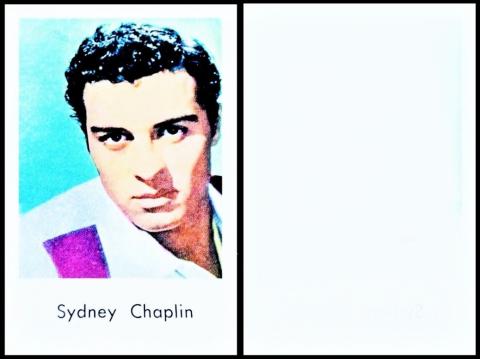
Anonymous [trade : gum : O/S - Holland] "Film Stars" - set two (1963) Un/208
Here, in our first centenary of the week, we have a card which says it is of Sydney Chaplin, but when compared to other cards of the moustachioed 1910s and 20s film star, it appears here as if he must have fallen into the fountain of youth, and done some swimming, for here, in the 1950s, his youth has returned.
However, it is not a typo, nor the use of a really early picture. The truth is that the Sydney Chaplin on this card is Sydney Earl Chaplin, born today, one hundred years ago, as the second son of Charlie Chaplin and Lita Grey. He was born early, five weeks before time, and named for his father`s elder brother, the Sydney with the moustache. However the marriage was not a happy one, and his parents divorced less than a year after his birth, This was one of the first divorces to really hit the headlines, and not in a good way. It was costly, too, with Lita Grey being awarded over $600,000 for herself and $100,000 in trust for Charles Spencer Chaplin junior and Sydney Earl Chaplin.
Lita Grey would go on to be married four times. Her two sons were brought up by her grandmother, and then sent to boarding school. Both children left school and went in the Army, without any thought of becoming an actor, but both ended up doing so. Our man much preferred the stage to the screen, and appeared in several shows and plays on Broadway, he was a good singer, and was nominated for two Tony awards, one of which he won. And he seems to have become closer to his father, who directed him in three plays and cast him in both "Limelight" and "A Countess in Hong Kong".
Sydney Earl retired in 1970, and bought a restaurant, called "Chaplins". He was married, twice, and had a son, called Stephan. And he appeared in two documentaries about his father. In fact it turns out that when Charlie Chaplin`s film "The Great Dictator" was reissued in 1952 he did some of the promotion for it.
He died, of a stroke, on March the third, 2009, at his home. He was eighty-two.
Strangely this card is usually dated as having been issued in 1963-65, but he was not in any films at that time, his last had been "Quantez" in 1957, a Western, in which he played the son of an Apache, and he would not make another until "A Countess in Hong Kong", released in 1967. It seems to have been reprinted several times as there are a variety of colours, too many and too different to be simply the ink running out or being refilled, ours is a decidedly blue one, but you will also find it in green. In addition our card shows signs of set off, having one blue corner on the reverse, and this is caused by wet cards, fresh from the printer, being piled up on top of one another, in a stack that is too tall, and weighs down on the cards at the bottom, transferring any wet ink if allowed to stay piled for too long.
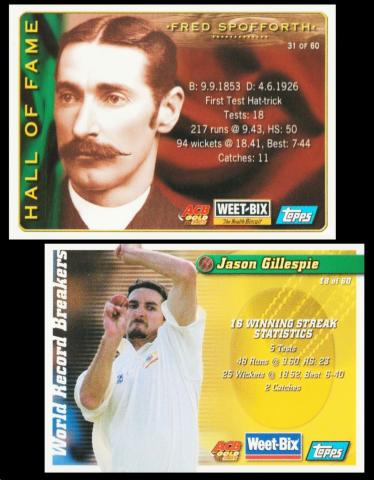
Topps / Weet Bix [trade : cereals : O/S - Australia] "ACB Gold Weet-Bix Cricketers" (2002)
Today in Frederick Robert "Fred" Spofforth`s Test Debut. He would go on to take fifty test wickets, and become the first to take a Test Hat-Trick, in 1879. Then he moved to England, and played for Derbyshire.
He was born on September the 9th, 1853, in Balmain, New South Wales, Australia, and his father was a director of the Bank of New South Wales. Most of his childhood was spent in New Zealand, then he came back to Sydney and got a job at his father`s bank, as a clerk.
We don`t know when, or why he first became interested in cricket, but we do know that he was sufficiently impressed by the England Cricket Team`s tour in 1863 and 1864 to change his style from underarm to overarm. And we know that ten years later he was part of the New South Wales team that faced off against an English team including W.G. Grace.
Three years after that, in March 1877, he was signed up to play in the second match of the first ever "Test", against an English side under the captaincy of James Lillywhite. That led to his inclusion in the first Australian side to visit England, in May 1878, where, to everyone`s amazement, the visitors won, by nine wickets. This is the game which led to his nickname, as after he had bowled the great W.G. Grace out for a duck, he was reported to have said, in the dressing room, afterwards, "Ain`t I a demon". Strangely he never called himself "The Demon Bowler", out of deference to John Jackson, an English cricketer, whose nickname that already was; not even after his death, in Liverpool Workhouse Infirmary, on November the fourth, 1901.
In 1886, during another tour of England, he met, and married a Derbyshire girl, and took her home to Australia. However she was not happy there and so they came back to England. Her father, Joseph Cadman, had a tea company, called the Star Tea Company, (which had been founded in 1873, in Manchester, with a partner by the name of James Fish) and he gave his son-in-law a job, though we are not sure what (though he had, however, been a clerk in the Bank of New South Wales). The company changed its name to Star Supply Stores, and in 1922 it became the owner of Ridgways Tea, originally founded in 1836. However, in 1929 International Tea Co. Stores bought it out.
Fred Spofforth was glad of the job, whatever it was, as he was not technically allowed to play cricket for Derbyshire until he had been a legal resident for two years, but an exception was made in 1889 so that he could play two matches against Yorkshire. Again I am not sure why these matches were that important. The following year he was allowed to play for Derbyshire, and also to captain it. He seems to have stayed there until the late 1890s, then he moved over to club cricket, at Hampstead, so he must have moved down south. However on the fourth of June, 1926, he died, at the age of seventy two, at Long Ditton in Surrey. The cause of death was chronic colitis, a swelling of the colon.
Strangely, there are no cigarette cards of him at all, and no trade cards until 1950, when he suddenly appears on a plain backed, anonymous one issued by Sporting Publicity of Hunslet in Leeds. This was a set of thirty-two cards, twenty-two current players, and ten `Cricketers of the Past`, of which card twenty-nine was F.R. Spofforth. Unfortunately, the cards are titled "Past Masters", right at the very bottom, which leads to much confusion. The picture is a caricature, in black and white, with an enlarged head.
You have to wait another thirty-six years for another card, issued by John Brindley of Portsmouth, number sixteen in a set entitled "Australian Cricketers". This is a really attractive set, with a back akin to a proper old cigarette card, and the front is a black and white image of Mr. Spofforth in a tweed jacket. Apparently that comes from a cabinet card of 1880, using a photograph by F. Hawkins of Brighton.
After that there are a few more in quick succession. This includes a very interesting one issued through the Sunday Times newspaper, in which he is number one of a set of forty "200 Years of Cricket" stickers. The picture used is his "Vanity Fair" caricature, originally published in July 1898, which was titled beneath the image, after his nickname, "as The Demon Bowler". However, because it is a sticker, there is nothing at all on the reverse.
Another important one is County Print`s "Australian Test Cricketers 1876-1896", issued in 1989 as a limited edition of just two hundred sets, because this has a biography on the reverse, reading : "F.R. Spofforth. NSW/Vic/Derbys. Fred "The Demon" Spofforth, known to his compatriots as Frank, developed into the world`s greatest fast bowler during the 1880s. In 1878 he became the first bowler to achieve the "Hat-Trick" in Tests". On the 1882 Tour to England he captured 188 wickets (at 12.26 runs apiece) and followed this with 216 (at 12.50) in 1884. A dislocated finger disabled him for a month in 1886 but he was still Australia`s most successful bowler in the Test Matches taking 14 wickets (at 18.57 runs each). In 18 Tests he has totalled 94 wickets (at 18.41). From 1889 until 1891 he played for Derbyshire and since he has settled in London he has played club cricket for Hampstead." I have to say he looks awfully startled in the picture on the front side though!
Our card also has a biography, but only brief and rather cryptic, simply "Fred Spofforth. B : 9.9.1853. D : 4.6. 1926. First Test Hat-trick. Tests : 18. 217 runs @ 9.43. HS : 50. 94 wickets @ 18.41. Best : 744. Catches : 11". The "ACB" in the title is the Australian Cricket Board, who presumably selected the players. It is a curious card though, one of those which shows an entirely different person each side; so if you collect cards of Fred Spofforth, you need to add Jason Gillespie to your checklist, just in case only his side is shown on an internet auction or listing. I have one of those on my checklist, from the Rittenhouse "Twin Peaks Quotable Cards" series, in the hope that someone will be selling off their Q.11 of Gordon Cole, really cheaply, not realising the importance of Denise Bryson, who sits resplendent on the other side. But I have been very unlucky with that so far.
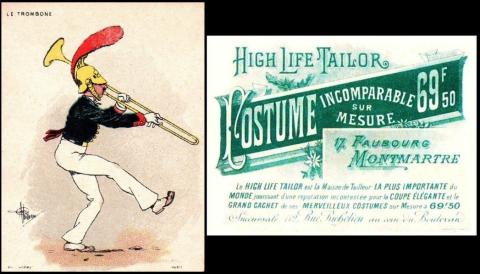
HIGH Life Tailor [trade : clothing : O/S - Paris, France] "Musique" (1900) Un/?
Today, a day for all musicians, it is #NationalTromboneDay.
The trombone is a strange instrument, akin in many ways to the trumpet, and its name derives from Italian, where "tromba" actually means trumpet, the other bit on the end, the "-one" meaning large.
In France, they developed a similar instrument, seemingly independently, this was called the saqueboute, and it appears in the mid fifteenth century. That would come across to England and be renamed, almost certainly phonetically, to the sackbut - though on its first appearance, in court records (tantalisingly I have not been able to establish why it was in such a place) it was called the shakbusshe.
It seems that it remained as the sackbut right until the eighteenth century, when trade was such that small things like sheet music was able to be imported from Italy, and on those the name trombone was used. I imagine that trombone gained acceptance so readily simply because sackbut is not exactly a very polite term.
Like the trumpet it is part of the brass section of the orchestra, and the sound is encouraged by the player blowing gently into a mouthpiece which does not, as you may imagine, act to amplify the sound, but instead to cause the air column inside the instrument to vibrate, making a wave of sound that comes out of the end.
Now you might recognise this card, for we used another of the set, featuring the cello, or violincello, but issued by a different company, Biscuits Georges, as our diary date for Monday the 29th of December in our newsletter of the 27th of December, 2025. And on that page you will find the eight cards known so far, but under this maker there are several other cards, not yet seen in that printing, of La Clarinette, La Grosse Caisse - or the bass drum - La Piano, and Le Violon
We also know that our version today can be found with the backs printed in different colours, of blue, brown, green and red. Whether this means it was reprinted several times I do not know.
And I have just been told that High Life Tailor also issued another set the same as Biscuits Georges, namely "Les Sportes".
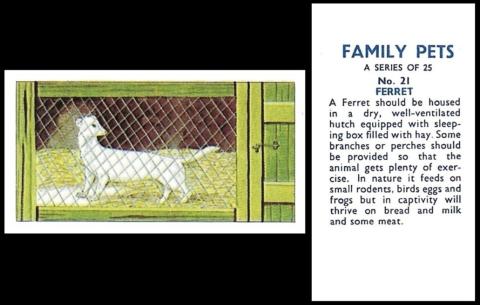
ANONYMOUS [trade : ?? : UK] "Family Pets" (1960s) 21/25
Today, at least in America, it is #NationalFerretDay - for our ferret festival takes place annually on May the fifth. But I could not find anything else for this date, and we seem to have only ever briefly spoken of the ferret in lists of various animal cards, it is time they had a proper mention.
Its Linnean name is Mustela furo, given it in 1758, and it belongs to the Mustelidae family, mustela actually meaning weasel. There are about seventy creatures in the family, including otters and even wolverines, and their closest familial link is actually the canines. However they appeared on the earth at about the same time as rodents, and this has resulted in them being classed as rodents, even as vermin.
We think that they were domesticated to use them to hunt for food. In North America they were seen as good pets, despite their teeth and often feral behaviour. However this card is definitely not North American.
The common name of ferret comes from Latin, furrittus, or little thief, and this seems to have come from its habit of stealing eggs, and other foodstuffs. However, just like puppies, they will take socks, slippers, fluffy toys etc.
A young ferret is called a kit, and then it becomes either a hob, if male, or a jill, if female. Neutering changes this, to a gib or hoblet, and a sprite, respectively.
As for their collective group name, that is a busyness, which certainly describes them admirably.
I cannot believe that the only true cigarette card of a ferret is the 1909 "Nature Series" by John Player - its card 33. Nor that we have to wait fifty years before it comes along on a trade card, Horniman`s Tea "Pets". And it`s no use looking in Europe, as the French for ferret, which is furet, seems only to bring up cards of children`s games.
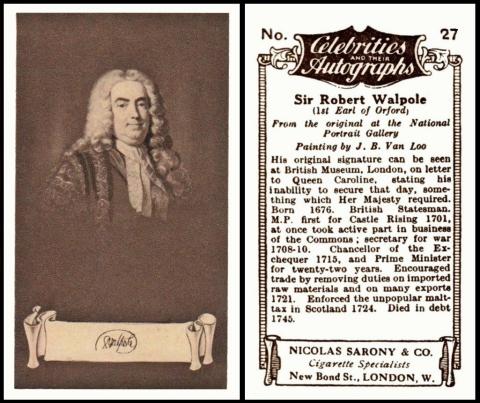
Nicolas Sarony [tobacco : UK] "Celebrities and their Autographs" S111-1.A : S26-7.1.A
Today in 1721 Robert Walpole became, to all intents and purposes, Britain`s first Prime Minister, a post he would hold until the eleventh of February 1742. However he never used the term Prime Minister, only First Lord of the Treasury. And he was also the Leader of the House of Commons and the Chancellor of the Exchequer
He was born on the 26th of August 1676, at Houghton, Norfolk one of nineteen children of a Whig politician who represented the borough of Castle Rising. Our man had a good education, for his mother was also of good blood, being the daughter of Sir Geoffrey Burwell of Rougham in Suffolk, starting out at private school, thence to Eton, and off to King`s College in Cambridge. He wanted to be a clergyman, but that was forever altered in 1698, when his sole remaining brother, Edward, died, and he found out that he would have to return to Houghton and be trained to run the family estate, which extended over Norfolk and Suffolk.
We can only hope he was a quick learner, as his father died in November 1700. Though actually it appears that coming home had awakened a whole other way of life for young Robert, for what he most enjoyed, much more than running the estate, was the political goings on of his father`s life, so much so that in January 1701 he stood for election at Castle Rising, his father`s seat, and won. He only stood down the following year because there was a sudden vacancy at King`s Lynn, which he knew, through his father`s papers, would never un-elect him. And it never did.
Things changed a bit in 1705 though, as he was brought to the attention of Queen Anne, and asked to join the council for her husband, who was Lord High Admiral. That got him an introduction to Lord Goldolphin, who made him Secretary of War in 1710, and, two years later, Treasurer of the Navy, concurrently. Unfortunately the Whigs lost in the General Election of that year, through their actions over the prosecution of Henry Sacheverell, though, strangely, our man was not dismissed as Treasurer of the Navy for a further year.
In 1712, perhaps through old grudges not having been served, he was found guilty of corruption over animal feed contracts in Scotland, though he had made no personal profit in the deal. He was arrested and put in the Tower of London, but released, and again voted in as M.P. for King`s Lynn in 1713.
The following year saw King George I take the throne. He was a staunch supporter of the Whigs, and suddenly they were the party of the day, romping in past the Tories in a huge landslide, gaining over a hundred and twenty seats. And in October of that year Robert Walpole was back, as First Lord of the Treasury, only the third man to hold the post since its creation in October 1714. He then lost his post in 1717, but was re-installed on the 3rd of April 1721, remaining until his resignation on the eleventh of February, 1742. And that makes him the longest serving "Prime Minister" of all.
After he resigned, he was created the Earl of Orford, later Lord Orford. And he remained interested in politics, often returning to the Houses of Parliament to make speeches. But he found Norfolk rather cold and gloomy in his later years, and his health declined. On his death, on the eighteenth of March, 1745, aged sixty-eight, he was found to have a huge stone in his bladder that undoubtedly hastened his decline and probably caused his death. He was buried at Houghton, and his sons took over his Earldom, in turn, his eldest first, and on his death, by his youngest,
Our original World Tobacco Issues Index tells us that this is a set of many permutations, and you will find the entire listing of all those groups as the Card of the Day for 26th June 2023 - which is the large sized format of our set, However as this small sized set comes first in order I may swap this card for a large size and that for the small, some time, when I have nothing to do....
The listing of our first series is, therefore :
- CELEBRITIES AND THEIR AUTOGRAPHS. Small 70-72 x 41-43. Large 78 x 63. Brown gravures. ... S26-7
1. Nos. 1/25 (25)
Size (A) small (B Large
This week's Cards of the Day...
...wondered how many readers we have who already know that it is #NationalJoeDay on March the 27th... ? Well, whether you knew or not, if Joe is your first, or any middle name, get ready to celebrate - and that also goes for any Joels, Joeys, Joses, as well as for ladies called Joanna or Josephine, and people, of either sex, who are just called Jo. And all these names are actually derivatives from another form of the name, Joseph, which is Hebrew, and used in the bible, both in the Old Testament and the New Testament.
We have already featured a few Joes on Cards of the Day and in the newsletters, and several of them were even card issuers - a quick flick through ending up with all these....
- Joseph Bardou [Societe JOB" - https://csgb.co.uk/publications/newsletter/2022-11-19 [scroll down to Friday, 25th November]
- Bazooka Joe - https://csgb.co.uk/cardoftheday/2024-02-02
- Joe Beckett - https://csgb.co.uk/publications/newsletter/2023-09-29 [scroll down to Sunday, 1st October]
- Joseph Beresford - https://csgb.co.uk/publications/newsletter/2023-09-02 [scroll down to Friday, 8th September]
- Joseph Cole - https://csgb.co.uk/cardoftheday/2023-02-06
- Joseph Crosfield [soap] - https://csgb.co.uk/publications/newsletter/2025-10-04 [scroll down to Sunday, 5th October]
- Joseph "Joe" Darling - https://csgb.co.uk/publications/newsletter/2025-11-15 [scroll down to Friday, 21st November]
- Joe di Maggio - https://csgb.co.uk/publications/newsletter/2023-11-25 [scroll down to Saturday, 25th November]
- Robert Joseph Finan - https://csgb.co.uk/cardoftheday/2022-04-23
- Joe Fortenberry - https://csgb.co.uk/cardoftheday/2024-07-05
- Joe Frazier - https://csgb.co.uk/publications/newsletter/2026-01-10 [scroll down to Monday, 12th January]
- Joseph Fry and his son Joseph Storr Fry [chocolate] - https://csgb.co.uk/cardoftheday/2022-07-05 and https://csgb.co.uk/cardoftheday/2025-09-15
- G.I. Joe - https://csgb.co.uk/publications/newsletter/2025-02-01 [scroll down to Saturday 1st February]
- Louise Josephine Kerlin - https://csgb.co.uk/publications/newsletter/2022-10-01 [scroll down to Wednesday, 5th October]
- Joe Louis - https://csgb.co.uk/publications/newsletter/2022-05-07 [scroll down to Friday 13th of May]
- Joseph Mohr - https://csgb.co.uk/publications/newsletter/2025-12-20 [scroll down to Wednesday, 24th December]
- Joseph Allen Pattreiouex [tobacco] - https://csgb.co.uk/cardoftheday/2021-12-25
- Joe Shlabotnik - https://csgb.co.uk/cardoftheday/2025-07-21
- Joseph Smith - https://csgb.co.uk/publications/newsletter/2026-01-03 [scroll down to Sunday, 4th January]
Saturday, 21st March 2026
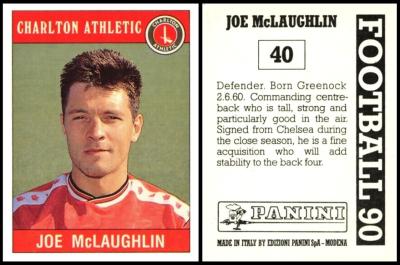
This was our first clue, and our first Joe, Joe McLaughlin, born in Greenock, Scotland, on the second of June 1960. We usually associate him with wearing a blue Chelsea strip, which he did for most of his career, but here he is at Charlton Athletic, where he had only just turned up when this card was produced, and he only lasted there for a year before moving on to Watford. And in actual fact this is his only cartophilic appearance in those Charlton Athletic club colours, which is why we picked it!
His rookie card appears in Panini`s "Football 81", card 514, which is a double card with a fellow Greenock Morton man, Jim Holmes - though, oddly, the team is listed in the card as simply "MORTON". Double cards are interesting but you only get half the space for text. This one tells us our man is a "Defender. Ht. 6.0. Wt. 11.8. Age 20. Signed to the club direct from youth soccer in 1977, and made his League debut on the centre of the defence against Partick Thistle in August 1979. He held down a regular first team place in the number 5 shirt for the rest of the season"
Just one year later, on card 472 of Panini`s "Football 82" the statement about his team origins is altered, for this text reads "Joe McLaughlin. Defender. Ht. 6.1. Wt. 12.5. Age 21. Joined the club straight from school in 1977 and made his League debut against Partick Thistle in August 1979. Now a regular first teamer who could chalk up his 100th League game this season". This is another double portrait card, this time shared with John McNeil, a fellow Morton Man.
When we look at Panini`s "Football 83", on which he is reunited with Jim Holmes, this backs up the theory that he "joined the club straight from school in 1977". However it seems like they may have just used most of the same text, for only the end paragraph differs, the whole reading "Joe McLaughlin. Defender. Ht. 6.1. Wt. 12.5. Age 22. Joined the club straight from school in 1977 and made his League debut against Partick Thistle in August 1979. A former Under-21 international who could be on the verge of a full cap.".
Another year forward and Panini`s "Football 85" may show him in a Chelsea strip, all on his ownsome, but, as the card even admits, he had actually joined them some time before, for somewhere between £95,000 and £100,000 - reports vary. Despite that, it must be said, the text does not differ that much in parts, though it moves the words around, for it reads : Joe McLaughlin. Defender. Born Greenock. Ht. 6.1. Wt. 12.5. Age 24. Former Scotland Under-21 international who made his League debut for Morton against Partick Thistle in August 1979, having joined the club straight from school in 1977. After 134 League appearances in Scotland he transferred to Chelsea in the summer of 1983, and missed only one match in Chelsea`s promition campaign, appearing in the number five shirt".
And it must be said that the reusing of the text continued with Panini`s "Football 86", though he had aged another year, and dropped half a stone - for that card reads : Joe McLaughlin. Defender. Born Greenock. Ht. 6.1. Wt. 12.0. Age 25. Made his League debut for Morton against Partick Thistle in August 1979 and went on to clock up 134 League games in Scotland before joining Chelsea in the summer of 1983. A former Scottish Under-21 international, he is now the regular number five for Chelsea.".
Thankfully in 1986, we get a slightly different biography, on one version of the Daily Mirror "Stick With It" cards - though the other version is blank backed. It is a strange text though, as it reads "Look-alike for pop star Paul Young. A Scot who has been the strength of the side in defence. Everton bid £600,000 for him at the start of the season, but favourites to get him are Celtic. Chelsea`s price is £650,000". The Everton bid is confirmed on a set issued by Boss Leisure in 1987, it is called "Emlyn Hughes Team Tactix" and it says "Look-alike for pop star Paul Young. Transferred from Morton in 1983. Everton have already bid £600,000 for this Scottish Under-21 cap".
However, Joe McLaughlin played on for Chelsea, longer than for any other team, almost double the games that he had appeared in for Greenock Morton. And he would also appear on more cards in that strip. including later tribute cards, than any other. Then, in 1989 he was sold, to the team on our card, Charlton Athletic, who actually paid the asking price of £650,000, and that, at the time, was the most the team had ever paid out for a player. Yet, after just one season at Charlton, just thirty appearances, they sold him to Watford for £500,000.
He stayed at Watford for two years, then he waved goodbye to England and returned home. His new Scottish home was Falkirk, for four years, though the first season he had an injury that rules him out of all but eight matches. Despite that, they held him fast, and the next year their patience was rewarded, as they won the First Division championship, and the next year almost qualified to play in Europe. Now after some dogged detective work I can confirm that though there is not a word of this on the cards, both the 1994 and 1995 Panini "Scottish Premier League" sticker sets show him at Falkirk, who were sponsored in those years by Beazer Homes.
In 1997 he moved to Clydebank, and in 2000 he ended his career at St Mirren, after just three games and one single goal.
Sunday, 22nd March 2026
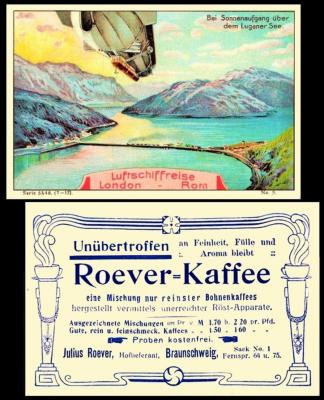
Our second clue, of Sunday the 22nd of March, was the red herring, for, in America, coffee is often called "a cup of joe". And this German card is certainly an attractive one, by Julius Roever of Braunschweig.
There are many theories as to why coffee is called joe, and I am not sure I believe any of them. The most popular are that it comes from a combination of the two words java and mocha - that it was a drink for the working class, the men of which, in American slang, are known as Joes - or that during the First World War the Secretary of the American Navy banned alcohol but would allow coffee, and his name was Josephus Daniels. The last story seems the most plausible, and it also gives us another variant Josephus, for Joe.
I could have had anything for coffee, and perhaps I ought to have found an American card, but I knew I would have fun with this airship the moment I saw it. I also thought I may be able to tie it to an actual flight and get a date, but so far I have not. The only one that comes close is the 1931 trip to Rome of LZ.127, or the "Graf Zeppelin", however that took off from Friedrichshafen, not London, and landed at Ciampino Airport in Rome. However it did land at the London Air Park in Hanworth, twice, on the 18th of August 1931, and on the 2nd of July 1932. I have not been able yet to find out anything about the first visit, but the second was part of a round - Britain tour, and on both visits there was a chance for any general public in the area to pay and have a joy ride.
These cards just look a bit too early for either of those trips. And perhaps it was more akin to gentle propaganda, dreaming of a trip that would start in London and end in Rome.
The set is usually said to be of twelve cards, and I have to say they are very attractive ones indeed, with lovely colouring. However, it appears, by the wording to the bottom left of the border, to have been issued in two parts, Serie 5547 being cards one to six and Serie 5548 being cards seven to twelve.
The cards in the set, or two sets, are
- Vor der Abfahrt in London
- Abschied von London
- Begegnung uber dem Kanal. Die Kuste von Frankreich in Sicht
- Das Luftschiff in Antwerpen
- Das Luftshiff uber Koln */Rhein
- Das Luftschiff auf der Rheinfahrt bei Caub und der Pfalz
- Das Luftschiff uber dem Rheinfall bei Schaffhausen
- Nachtlicht Begegnung im der Schweiz. Vierwaldstatter See und Seelisburg
- Bei Sonnenaufgang uber dem Luganer See
- Ankunft in Mailand
- Ankunft in Florenz
- Vor der Landung in Rom
Monday, 23rd March 2026
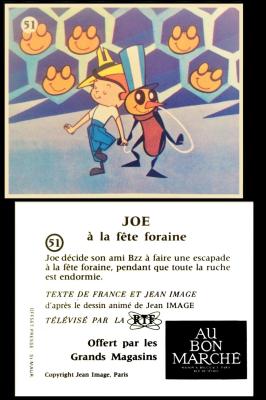
And lastly we had a Joe who never existed, save for in this animated cartoon, dancing with a bee called Bzz.This Joe was once really well known, but he seems to have been forgotten. However as the story behind him is ecologically sound maybe it is time to reboot him.
If you were French you may have known the background to this card immediately, and maybe have been transported back to a time when this character was the highlight of your week`s television viewing. Though the series did appear right across the world, and it turns out to have been the first animated series ever to have been dubbed into Welsh. However it passed me completely by and I had never heard of any of it!
So, if you are in the same boat as me, the little human on this card is a character called Joe, and he was the star of an animated television series produced in 1960, called "Joe chez les Abeilles". Now that translates to `Joe at the home of the bees`. In charge of the directing, producing, and also the writing, of the film and the television series was Imre Hadju, a Hungarian-French director, producer, and script writer, who used another name, Jean Image. The basic story was that Joe comes across two young men trying to steal honey from a hive. He manages to get them to stop, and then the Queen Bee comes out and thanks him, by miniaturising him to the size of a bee, and allowing him to enter her world, where he makes friends with a bee called Bzz.
In 1973, there was a film, an hour long, known as "Joe Petit Boum Boum", which doesn`t really translate to anything, or at least not to anything sensible, only `Joe and the Little Boom Boom". Mind you in England it was known as "Johnny the Giant Killer". The story of that is slightly different, it revolves around some boys, including Joe, who are out camping and come across a castle. When they go inside they are captured by a giant, who puts them in a machine and shrinks them. Joe manages to escape and then he saves the hive, with the ending being his convincing the bees to storm the castle and rescue his friends. Our version of the title makes it sound like the giant comes to a sticky end too.
The most intriguing thing about this card is the issuer, for it is our old friend Au Bon Marche who we are much more likely to associate with gilded chromos. However, it appears that they moved with the times, and embraced modern culture, even if it was as radically different as this card was. They also issued albums for the cards, which is where we get the title above, as the first wording, top right, is "las aventures JOE", or the adventures of Joe. These albums seem not to have taken the entire set, only one of the episodes, because if you look at the cards they have "JOE" at the top and then another title, namely
- JOE chez les abeilles
- JOE captif des guepes
- JOE Le Justicier
- JOE et la fete des abeilles
- JOE a la fete foraine
and each of these fits into a separate album with spaces for the first two cards in that group being stuck on the front cover beneath a heading that has the separate titles above.
Tuesday, 24th March 2026
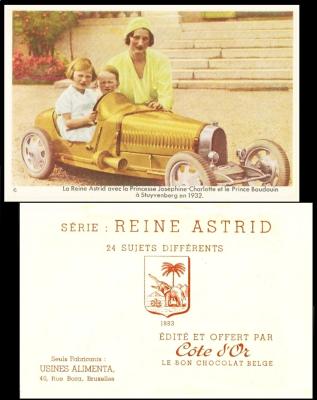
Here we have Queen Astrid with two of her children, Josephine Charlotte and Baudouin. Queen Astrid was actually Swedish, and after being proposed as a good match for many future Kings of Europe, including our Prince of Wales, the future Edward VIII. However in 1926 it was announced that she was to marry Prince Leopold of Belgium. The wedding took place on the fourth of November, 1926, in Stockholm and then in Brussels.
Princess Josephine-Charlotte Stephanie Ingeborg Elisabeth Marie-José Marguerite Astrid was born on the eleventh of October 1927 at the Royal Palace of Brussels. Josephine was an unusual name in Belgium, but it was partially in respect of one of her great-aunts, Princess Josephine-Caroline of Belgium, and partially in honour of a book she much enjoyed reading during her pregnancy - but more about that tomorrow....
The family moved to Stuyvenberg, in Laeken, part of Brussels, where this picture was taken, in 1930. Her younger brother, Baudouin Albert Charles Leopold Axel Marie Gustave is also seen in this picture, and he was born at Stuyvenberg on the 7th of September 1930.
On the seventeenth of February 1934 King Albert I, the King of Belgium, was killed in a mountaineering accident, whilst climbing on his own. He was fifty-eight years old. On the twenty-third of February, just a few days later, his son and Princess Astrid became King and Queen.
On the sixth of June 1934, a new son was born, at Stuyvenberg, who was christened Albert Felix Humbert Theodore Christian Eugene Marie. When he was almost a year and three months old his mother and father were involved in a car accident, and she was killed, along with her as yet unborn fourth child. The King survived, apparently he had looked over at his wife, who was looking at a map. However reports differ of what happened then, as some say he ran into a tree and others a lake.
On the 11th of September 1941, whilst he was a prisoner of war at Laeken Castle, the King remarried, to a lady who had been born in England, though she was of Belgian descent. Her name was Mary Lilian Henriette Lucie Josephine Ghislaine Baels, and she had actually met him in 1933; it seems like she was rather smitten from then on, and their paths kept crossing. However she did not want to be Queen, or her children to be and eventually a compromise was reached, that she would be titled as the Princess of Belgium. and that any children would be called Prince or Princess but never become King or Queen. They would go on to have three children, Prince Alexandre, Princess Marie-Christine, and Princess Marie-Esmerelda, but she also loved her step children as if they were her own, though reportedly they took a while to warm to her.
Josephine Charlotte and her brothers were also imprisoned, and it seems her new step-mother and her first child were too. They were eventually released on the 7th of May 1945 and moved to Switzerland. The Belgians considered the King to have surrendered too soon, and he was deeply unpopular. The first one of them to return to the country, briefly, was Josephine Charlotte, in April 1949, and she would make regular visits, with the family moving there permanently once the monarchy was restored and her brother Baudouin was King.
On the 9th of April 1953, five years after they had first met, she married Jean Benoît Guillaume Robert Antoine Louis Marie Adolphe Marc d'Aviano, who would go on to become the Grand Duke of Luxembourg. They would go on to have five children. She christened her first, born on the 17th of February, 1954, Princess Marie-Astrid of Luxembourg.
She enjoyed being able to be involved with charities, but she did not entirely enjoy royal life, and she was always seen as being too reserved by the general public. But she found a kindred spirit in her husband, whose aunt had been forced to abdicate during the First World War because she was seen as being too pro- German, and who, with his family, had spent much of the Second World War on the run.
She died, of lung cancer, on the tenth of January, 2005, aged seventy-seven.
I am not going to lie, this card got the nod entirely because of the Bugatti pedal car. However this one is a strikingly different colour, usually they are French Racing Blue, or yellow and black, which was the favourite colour combination of Ettore Bugatti.
The pedal cars started out as a little treat, a one off, modelled on the Type 32 Grand prix racing car, and it was built for Ettore Bugatti`s son Roland as a birthday present in 1927. It was half size to an actual car, and powered by a twelve volt electric motor. Somehow pictures of it got out, and the press went wild, and so did lots of wealthy families, who wanted to buy one for their children. Ettore Bugatti thought about this, and realised it could be a money spinner, so he published that they would soon be for sale at between three and five thousand francs, just to gauge the interest. He was besieged by purchase requests, and so he went ahead with making them, and he also started to offer them in the sales catalogues, called "Baby" and advertised for children aged six to eight - the idea definitely being that if daddy drove one, so could his son.
This card is part of a lengthy issue, four series, each of twenty four cards, but, luckily for us, the ink used on the back differ with the series, the first being in brown, the second in blue, the third in purple, and the fourth in green.
The cards are also found in two language variants - one type, like ours, which is only in Belgian, and another which is split in half on the reverse, the text on one side being in Belgian (headed "Reine Astrid") and the text on the other being in Dutch (headed "Koningin Astrid").
All ninety six cards fit into one album, and that was issued in 1937, which is probably the date of the fourth and final set.
I have been told by one collector that the these cards came hot on the heels of a Liebig set, "Het Leven Van Koningin Astrid" / the life of Queen Astrid, which was issued in 1936 and is also available in Belgian or Dutch.
This is a list of the cards in this first set :
Serie : Reine Astrid [first series]
- Le Roi et la Reine lors leur mariage en Suede, 4 novembre 1926
- La Reine Astrid arrivant a Anvers le 8 novembre 1926
- La Reine Astrid avec la Princesse Jospehine-Charlotte assistant a la revue des troupes, le 27 avril 1932
- La Reine Astrid avec la Princesse Josephine-Charlotte et le Prince Baudoin a Stuyvenberg en 1932 - [close up head and shoulders]
- La Reine Astrid place le Prince Baudouin dans la petite Bugatti ou la Princesse-Josephine-Charlotte a deja pris place. - Au chateau de Stuyvenberg, 1932
- La Reine Astrid avec la Princesse Josephine-Charlotte et le Prince Baudoin a Stuyvenberg en 1932- [with Bugatti pedal car]
- La reine Astrid assistant a une representation de beinfaisance au Theatre Moliere en 1933
- La Reine Astrid avec la Princesse Josephine-Charlotte et le Prince Baudouin assistant a un defile d`enfants du balcon d`une maison de la rue Haute - oct 1933.
- Le Roi et la Reine avec les Enfants Royaux au bapteme du Prince de Liege, 1934
- Le Roi et la Reine assistant a l`inauguration du premier troncon du Canal Albert en 1934
- La Reine Astrid en visite chez une centenaire hospitalisee chez les Petites Soeurs des Pauvres, en septembre 1934
- Stuyvenberg - Au printemps 1935. La Reine Astrid tient le Prince de Liege dans ses bras -
- La Reine Astrid avec la Princesse Josephine-Charlotte. - Printemps 1935
- Arrivee de la Reine Astrid et de la Princesse Josephine-Charlotte au premier Te Deum pour S. M. Leopold III. - 1934
- La Reine Astrid avec la Princesse Josephine-Charlotte et le Prince de Liege au chateau de Stuyvenberg. - Printemps 1935
- Inauguration de l`Exposition de Brussels, le 27 avril 1935
- Le Roi et la Reine sont recus au Commissariat General lors de l`inauguration des Sections belges a l`exposition de Bruxelles le 4 mai 1935
- La Reine Astrid assistant a un defile des Croises a l`Eglise de N.D. de laChapelle, a Bruxelles le 20 juin 1935
- La Reine Astrid visitant l`Ecole de St-Vincent de Paul, a Bruxelles, le 20 juin 1935
- La Reine Astrid arrivant au bras du Duc d`York au bal du Pavillon Britannique a l`Exposition de Bruxelles le 1er juillet 1935
- Le Roi et la Reine a l`inauguration du nouvel hopital St-Pierre, a Bruxelles, le 4 juillet 1935
- Joyeuse Entree du Roi et la Reine a Liege le 7 juillet 1935
- Le Roi et la Reine assistant au Congres international de Pharmacie a l`Universite de Bruxelles, 30 juillet 1935
- Le Roi et la Reine assistant a la ceremonie du Centenaire de l`Institut Agronome de Gemblous, 30 juillet 1935
Wednesday, 25th March 2026
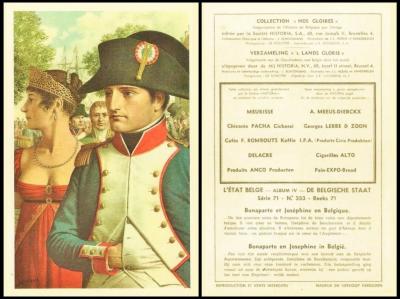
I promised you a link to yesterday`s card, and it was that Queen Astrid spent a lot of time whilst she was expecting her first child by reading a book about Empress Josephine, a character she found most inspiring.
In fact "Josephine" was not her real name, for when she was born on the 23rd of June, 1804, she was christened Marie Josephe Rose Tascher de la Pagerie. We do not know exactly where she was born, but we think it was in Saint Lucia.
Her aunt was the mistress, then later the second wife of the Governor of Martinique, Francoise de Beauharnais, and step mother to his son Alexandre. When the son came of age, and needed a bride, it was suggested that he married Marie Josephe. He thought she was a bit young, for she was only fifteen, so he was betrothed to someone else. Unfortunately before the wedding the someone else died, so he was offered her sister, who was thought unacceptable, being only eleven. Therefore he seems to have settled on Marie Josephe, and they were wed on the 13th of December 1779
This was not a happy marriage, though it produced a son and a daughter. Then the French Revolution came along and Alexandre was arrested, then put to death by guillotine on the 23rd of July 1794, along with his cousin. Marie Joseph was also arrested but before she could be executed the Reign of Terror was over and she was freed.
In 1795 she met Napoleon Bonaparte, in whom she saw a spark of promise, though he was six years younger than her. She became his mistress almost straight away, and it was he who called her Josephine. They were married in 1796, though both lied on their marriage certificate, adding eighteen months to his age and dropping four years from hers. His family were appalled, not just at the age gap, but at the fact she already had two children, and they also thought that she was stringing him along. They were right in that, as the same year she was openly seen in public with a handsome Hussar, who was also aide de camp to Napoleon`s brother in law. In order to stop this affair, Napoleon asked her to join him in Italy, and she did, but she brought her paramour along as well. In retaliation, he had an affair, with an officer`s wife. .
What changed this was an assassination attempt, in Paris, on Christmas Eve, 1800. Someone, to this day unknown, left a bomb in a cart and it exploded as her carriage was passing, Napoleon`s carriage having already gone by. That seems to have reawakened his ardour for her, and in 1804 the two of them were crowned Emperor and Empress of the French
Sadly, it was becoming evident that there was another problem, for after having been married for quite some time she had still not given him an heir. In fact it seems that our card, showing the pair in Belgium, relates to a trip they made to see his doctor in the hope that some solution could be found. Unfortunately that too failed, and he decided his only hope was to divorce her and marry someone who could give him children. It must be said at this point that he did have two children already, however they were not legally his heirs to the throne as he was not married to their mother(s), but it is not certain why he did not just marry one of them. All we know is that in 1810 he divorced his Josephine, and married Marie Louise, the sister of Alexander I, tsar of Russia, and she gave him four children.
Napoleon set Josephine up with a luxurious apartment at the Chateau de Malmaison, and gave her an annual allowance, but sadly she died, of pneumonia, on the 29th of May 1814, aged just fifty-one, whilst Napoleon was exiled on Elba. Reportedly he was most distressed at this, and as he lay dying, in 1821, he mentioned her name.
Now this set is often listed as being by "La Societe Arts Historia S.A" of Brussels, but though their name comes first, they only edited the text. If you look further down the back, it turns out that the series was issued by several companies, all of whom are listed in the thick bordered box – however, because all of the names are listed, there is no way to tell by which one of them any particular card was included.
The first name is Meurisse, and so we have gone for that as the issuer, rather than the others, who were
- Chicoree PACHA Cichorei
- Cafes F. ROMBOUTS Koffie
- DELACRE
- Produits ANCO Producten
- A MEEUS-DIERCKX
- Georges LEBBE & ZOON
- I.P.A. (Produites Cirio Produkten)
- Cigarillos ALTO
- Pain-EXPO-Brood
And did you pick up that one of these was a tobacco issue, Cigarillos Alto? Sadly they appear in neither the original nor the updated World Tobacco Issues Index, but I do know they were Dutch, and that they are usually listed under the name of "Verkoopkantoor N.V. Alto Sigarenfabrieken" - though "Verkoopkantoor" means sales office, and "N.V." is the Sutch way of denoting a limited company. I also know they were based at 25a, Kloveniersburgwaal, Amsterdam. They are mostly known these days for their collectable cigar bands, but that could well be because their name is so far down the list on the back that nobody notices it.
The other unsolved mystery is the true name of the set. The top line gives "Collection - Nos Gloires", which is French for "Collection - Our Glories". Then the next section tells us it is "Verzameling - Lands Glorie", and that is Dutch, and not so far off the French title, for it means "Collection - National Glory". However beneath the box with all the issuers there is a second title, "L`Etat Belge - de Belgische Staat". That means "The Belgian Nation", and it is the only title which has the album number (IV) the series number (71), and the card number (353). Therefore it seems that the real title of this set is that second one.
I have no idea of the date of issue though.
Thursday, 26th March 2026
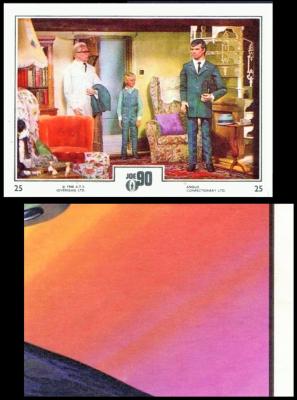
Here is another famous Joe who did not really exist, save in the head of Gerry and Sylvia Anderson. He was a simple schoolboy, called Joe McClaine, just nine years old, when his adoptive father, Ian "Mac" McClaine, a widowed computer whizz, invents a magical machine which can record knowledge and implant it in someone else`s brain. For some reason, he picks Joe as the guinea pig, and turns him into a spy, the "Most Special Agent" of the World Intelligence Network.
When you think about it, this was most of the appeal of the show for children, seeing someone of their age doing things they could only dream of. James Bond was okay, but he was an adult, and got involved with lots of women, things that wasted time which could be spent fighting the bad guys and playing with cool pieces of kit.
Joe 90 was first shown on ITV between 1968 and 1969, and it was the last series to be made entirely using the Supermarionation puppets. However Joe 90, and its predecessor, Captain Scarlet, paved the way for the next step in Gerry Anderson`s enterprises, for they used puppets of the same proportions as human beings, and, in this case, of human appearance too, of more than one size, for Joe was the size of a child and he mixed with adults who were taller. That is shown well on our card
Strangely, the set only uses a few cards of the actual puppets, most of the set shows artist`s impressions. The thirteen cards (out of sixty-six) which are of the actual Supermarionation puppets are :
- 3 - "Mac" in his office with a cup of tea
- 14 - Joe 90 in a red and black coat swamped by a big black chair
- 25 - "Mac", Shane Weston and Joe 90 at home with a spiral staircase
- 26 - Joe 90 in a grey jumper
- 31 - Joe 90 perched perilously on a railing with "Mac"
- 39 - "Mac" and Joe 90 looking at a machine on the wall
- 43 - "Mac", Shane Weston and Joe 90 at home with a fireplace
- 44 - Shane Weston, "Mac" and Joe 90 in a laboratory
- 49 - Joe 90 in a chair in the middle of an empty space
- 52 - Shane Weston in a pink shirt
- 54 - Joe 90 in the middle of the RAT TRAP globe
- 63 - Joe 90 in a red and black coat with a microscope
- 66 - the outside of "Mac"`s cottage
There is very little about this set in our British Trade Index part two, just this scant description :
- JOE 90. Lg. 89 x 64. Sectional back. Nd. (66) ... ANF-4
This is slightly expanded in our updated British Trade Index, but not by much, only to :
- JOE 90. 1968. 89 x 64. Nd. (66) Sectional back, forming one large picture. ... ANG-210
Friday, 27th March 2026
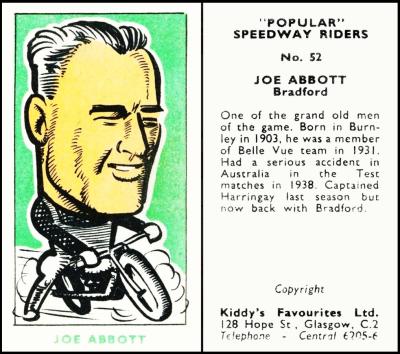
John Patrick Abbott was born on the twelfth of April 1902 in Burnley - though our card says 1903. Then we seem to know nothing about him until he turned up at the local track, Towneley Speedway. This is said to have been in 1928, but if so it could not have been at the Stadium as it was only opened in 1929. It seems that no expense was spared in its construction, including two covered grandstands, and even electric lights, but for some reason it continued to lose money and was sold to the great Percy Platt, of Rochdale. However not even he could take it beyond the end of 1929.
The same year he appeared as J.P. Abbott (Joe) on Pattreiouex`s "Dirt Track Riders", as card thirteen. That fills in some of the confusion about his racing origins, for it says he "first broadsided at Blackpool`s half mile track". Now that was also the greyhound stadium, but it appears that the original speedway track was at the Sports Ground on South Shore.
The Pattreiouex card also tells of how he "...Rode at the Rochdale track on a Standard Rudge, for some months riding to and from Burnley every meeting on the Rudge. Arriving at the meeting he would strip the bike, "do his stuff", equip the bike and ride back to Burnley. Real enthusiasm! Won honours during 1929 at Leeds, White City (Manchester), Belle Vue, Salford, Sheffield, Barnsley, Rochdale, Warrington, Hanley, Burnley, etc."
The closing of the Rochdale track dispersed the riders, and Joe Abbot moved to Preston. Then he was approached by the Belle Vue Aces, who had just joined the National League, and who would be the team to beat in the 1930s, winning the league title five times on the trot between 1933 and 1937, the year our man is shown in Belle Vue colours on card one of John Player`s "Speedway Riders".
In 1938 he seems to have gone to Australia, and was seriously injured, so much so that he was sent back to England with a warning, never to ride again. This is mentioned on our card. partially, as ""Had a serious accident in Australia in the Test Matches in 1938." Looking that up I can see it was a collision with the Australian Lionel Maurice Van Praag. The race was stopped, and then re-run, but our man was missing. The injury was to his spine, which takes a pummelling as the bikes bounce over the cinders, to say nothing of the continual leaning from side to side to skid round the corners. We don`t know if he told Belle Vue any of that, but three months after he returned to England he also returned to them.
In 1939 Belle Vue shared the title with the Wembley Lions, and looked forward to another run. Little did they know that no more competitions would take place until 1946 - which they also won outright. However by then our man was at Harringay, captain of the "Racers", though he did not stay long, moving to the Odsal Boomerangs in 1947. They are the team, for some reason, which are called "Bradford" on our card. However I`m not sure why it says he is "now back at Bradford", because he went there only after he left Harringay. More investigations, I think.
Anyway, on the twenty-first of June, still racing for Odsal, and live on television, he was involved in another accident at West Ham Stadium. What saved him was the attendance, that night, of a quantity of ambulancemen from Poplar Hospital, who raced down and saved his life.
This story then takes an even sadder turn, for, on the first of July 1950, in a National League Match, at Odsal, and again against the West Ham Hammers, his bike suddenly fell over and he was run over by another rider, too close to stop. Some say that he was killed instantly, and others that the bike fell because he had died whilst riding it. He was forty-eight years old. The most curious thing is that they did not stop the meeting, they continued, and it appears that his death was not broadcast until after the meeting had ended and the fans gone home.
That was a sad night for speedway, as his friend, and fellow rider, Jock Shead, who had even been born in the same street as him in Burnley, was also killed, at Norwich. And he was only twenty-four.
The home page for all the Kiddy`s Favourites sets can be found with that card, which was our Card of the Day for the 21st of October, 2023 - so here we will only record the details for this set, which appear in our original British Trade Index part II, RB.27, issued in 1969, as :
KIDDY`S FAVOURITES Ltd. Glasgow
Cards issued about 1948-52, as singles, joined pairs, or stapled in batches in booklet form. Premiums offered for complete sets. Small size, very variable, about 63-69 x 38-50 m/m
- "POPULAR" SPEEDWAY RIDERS. Sm. Nd. (52) See D.353 ... KHM-8
The D.353 reference takes you to the back of the British Trade Index part II, and might well make your heart skip a beat at the thought that they were also issued by another company, as is usual with a "D" code, but they were not, it is simply that they are known in an anonymous printing, having green borders and black captions. And it seems strange that only our set, and "Cricketers" were printed in that way, but more information may come to light.
There is an update in British Trade Index part III, rather confusingly telling us that the "Popular Speedway Riders captions are in (a) green (b) grey-black". This could just mean that the usual caption was green and the anonymous version grey-black, adding the information in from D.353, but if so then why not mention that this also applied to the "Cricketers"?
In our updated British Trade Index, there has been a change in both the order of the sets, and in the details of our set. The listing now reads :
- "POPULAR" SPEEDWAY RIDERS. 1950. Nd. (52) Captions in a) green b) grey-black. See HX-150. Back a) normal descriptive, b) . Buy `Yanky` Bubble Gum - it`s best". ... KID-200
Well, dear readers, I have to say that I did not think I would get all the days finished, but here they all are Thanks for that are entirely due to the fact that when it stopped raining i attempted to take nipper out for his late afternoon walk and he stood on the step, turned tail, and hopped up on the sofa, where I joined him and completed all this, before tea, at seven, too.
Tomorrow he is going out to the hairdressers, and hopefully it will be dry, though I will pack his coat in my bag simply because it is rather cold when you go in the salon as Cousin It and come out as Sean the Sheep....
Have a great weekend, and enjoy any trips you make to markets and fairs, but do remember to save some money for the Convention, where all kinds of rarities will be there to tempt you......