
Is it just me, or do your Saturdays come round with ever increasing speed too ? This year seems to be rocketing past at an extraordinary rate of knots...

website news :
this week, urged on by the fact that I am growing ever closer to indexing the newsletters of 2023, I cracked on with gusto, and added the cards from the 9th of March 2024, the 16th of March 2024. the 23rd of March 2024, the 30th of March 2024, the 6th of April 2024, the 13th of April 2024, the 20th of April 2024, the 27th of April, 2024, the 4th of May 2024 and the 11th of May 2024 - those ten newsletters adding seventy more diary date cards to the index. At that rate, if I can repeat it next week, I ought to be starting 2023 by the time of the convention, and perhaps have all of the diary date cards added to the index by the end of the year, as they only go back to October 2021.
this week`s meeting dates :
- Saturday the 18th of April - East Anglia - from 8.30 a.m. to 3.30 p.m., with auction at 11 p.m at Roydon Village Hall, High Road, Roydon, Diss, Norfolk IP22 5RB. East Anglia club members get free admission, but its £3 for visitors.
- Saturday the 25th and Sunday the 26th of April - Our Annual Convention hits King`s Lynn, again in Norfolk. The full address is Alive Lynnsport, Greenpark Avenue, Kings Lynn PE30 2NB. On Saturday CSGB members go in, for free, from 9.30 a.m. whilst non members have to wait until 10.30 and pay £5. The doors close at 5.30 p.m. On the Sunday there is no admission charge for anyone, and it is open from 10.00 a.m. until 4.00 p.m.
And now for our regular excursion into the anniversaries and awarenesses of the forthcoming seven days, to amuse and educate, and also to assist with social media...
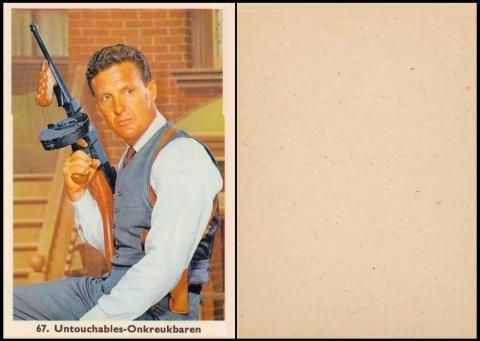
MONTY [trade : gum : O/S : Netherlands] "T.V. Stars" - set one (1966) 67/69
Today we are going to start with someone who a lot of people think is fiction, but he is not - though our card does not show him, it shows someone pretending to be him.
The actual person was called Eliot Ness, and he was born today in 1903, in Chicago, Illinois, to a Norwegian family who already had four children, and a bakery. However they made sure that their children had a good education, and our man ended up at the University of Chicago.
When he graduated, in 1925, he got a job, an odd one, investigating people who wanted credit. He found this interesting, and intriguing, but what he really liked was finding out that one of the people who had applied was not entirely, or not at all, being truthful.
In 1926 he met a lady called Edna Stahle, who had a brother, and he was working at the Bureau of Investigation He encouraged our man to quit checking credit and start chasing criminals, and, by the sound of it, the prospect was too good to turn down. He also married Miss Stahle, in 1929, by which time he was working at the U.S. Treasury, on prohibition cases. This led him, less than a year later, to join the squad who were out to get Alphonse Gabriel Capone, a "bootlegger", or smuggler of illegal alcohol. He was wanted for a few more things beside that, but it was thought this would be the best way to catch him.
That squad was six men strong, and they were heavily vetted to make sure that they were not corrupt in any way - and it was called "The Untouchables" because none of them had anything that could be used against them by way of leverage or blackmail; they also had to swear an oath that they would never be bribed. And in 1932, Eliot Ness was one of the men who guarded Al Capone as he went to jail in Atlanta, but not for bootlegging - for tax evasion
In 1932, Eliot Ness was promoted to Chief Investigator of the Prohibition Bureau, and he became the last one, for Prohibition ended in 1933. He then became involved with ensuring that people in Kentucky and neighbouring states paid due tax on their home made brews. Then in 1935 he moved to Cleveland, where he was put in charge of safety; and though that sounds a little tame, Cleveland, at the time, was a pretty heavy "mob" area.
In 1938 he got divorced, and went through a bit of a rough patch. That seemed to settle down when he met a new lady, who at the time was working in fashion, as a model and artist, and after they were divorced, in 1945, would become an illustrator, and actually quite a famous one, still calling herself Evaline Ness. He married again, not long after, to another artist, called Elisabeth Seaver, and they adopted a son, his only child.
Eliot Ness died on May the 16th, 1957, aged just fifty-four. He had been working on an autobiography, called "The Untouchables" which was published posthumously the same year. That means he never got to see the finished work, nor see it converted into a film, called "The Untouchables", released in 1987 with Kevin Costner as Eliot Ness, or a television series, also called "The Untouchables", which began in 1959.
That brings us to our card, and to Charles Langford Modini Stack, who played Mr. Ness in that television series, which went on until 1963, and for which he would win an Emmy.
He was born in Los Angeles in 1919. His mother chose his name which his father hated, and changed to Robert. When he was a year old they divorced, and his mother took him to live in Italy. They later came back, and his parents remarried, but his father died when "Robert" was ten.
At first our man was heavily into sport, and he wanted to make that his career, but he could not choose which one he wanted to specialise in. Then, when he was twenty, he visited Universal Studios and they offered him a screen test. That went well and he made his first film, "First Love", which was released in 1939, and hit the headlines by being the first film to show Deanna Durbin being kissed - by our man. He made a few more films with her later, but less controversially.
During the Second World War he was a gunnery instructor in the U.S. Navy. After the war he was much in demand, usually playing pilots or cowboys. He got married in 1956, to an actress and model, and the former Miss Tacoma and Miss Montana, called Rose Marie Bowe, who had appeared in several films, and modelled for Gil Elvgren. The role of Eliot Ness came along in 1959 and he freely admitted it was not one of his favourites, and he felt that the story was never really developed, so that every week it was more or less the same. In hindsight, that is the truth of even high profile crime fighting, it does take a lot of work to reach a result that will stand up in court, and, for that, the series was an honest portrayal, much more so than series in which a criminal is traced and captured in the space of a single episode. Perhaps to keep him on board, he was given 25% of the profits, which was a much better deal than he had imagined, because the show was syndicated worldwide and there have been many re-runs. And in 1968 he returned to a similar role, in "The Name of the Game", where he was a federal agent turned true crime journalist - but that only lasted until 1971.
In the late 1970s he took a part in a film he thought was simply a bit of fun. This was the anti-war war epic "1941", directed by Steven Spielberg. The audiences loved it, though, and it gave him a whole new career in comedy films. It also got him another role, as the presenter and narrator of a tv series called "Unsolved Mysteries", which ran from 1987 until 2002.
In the October of that year he was hospitalised for prostate cancer, and on May 14th 2003 he died, at his home, with his family, of heart failure. He was eighty-four years old. His wife outlived him, and only died on January the 20th, 2019, aged eighty-six
I am beginning to break my self-imposed rule, and allow newsletter cards to be home pages, especially if, as in our case, the set comes first of all, on Saturday.
This set was the first to be issued, and is the largest set of all, series 2, 3, 4, and 5 only being of fifty-five cards - but sadly none of them have any wording on the reverse, or any idea of which set they are from.
- Series 1, our set, was issued in 1966, and contains
cards 1 to 27 - "The Man from Uncle" (but named as "U.N.C.L.E." alone)
cards 28 to 42 - "Batman"
cards 43 to 65 - "Flipper"
cards 66 to 69 - "The Untouchables" (but named as "Untouchables-Onkreukbaren").
- Series 2 was also issued in 1966, and contains The Saint, Thunderbirds, Zorro, The Fugitive, Love on a Rooftop and Mission Impossible
- Series 3 was issued in 1967, and contains Daktari, The Monkees, Mannix, Time Tunnel, Voyage to the Bottom of the Sea, Peyton Place, Gentle Ben, The Avengers, High Chaparral, and Zorro
- Series 4 was issued in 1968 and we featured that in our newsletter of the 14th of March 2026 as the diary date for Wednesday the 18th of March.
- Series 5 was issued in 1970, using silver foil. It is quite scarce.
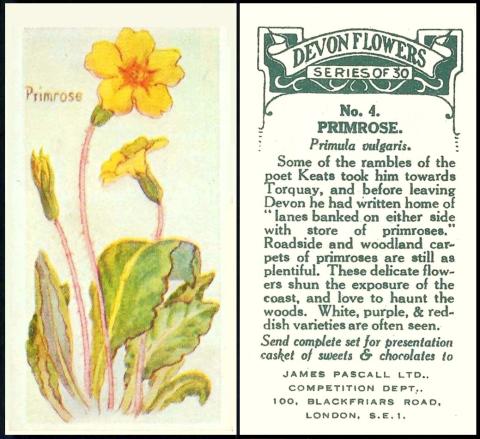
James PASCALL Ltd [trade : confectionery : UK - London] "Devon Flowers" - "complete set" only, no red square (1927) 4/30 - PAS-060.B.a : PBS-5.B.a
This is an odd day indeed, because I discovered it was Primrose Day, and though we have had a fair proportion of cards that were issued by Primrose Confectionery, we have not featured the jolly little flower that is so glorious to see amidst the countryside. And I presumed that today marked when they reached their peak, perhaps even that this was the day, in times gone by, that coach parties left the big smoky towns to go and see them.
It turned out to be nothing to do with any of that, for Primrose Day marks the passing of a Prime Minister, Benjamin Disraeli, who died today in 1881. Apparently it was his favourite flower, and after his burial, in Hughenden, every year, on the anniversary of his death, starting in 1882, people would flock there and leave primroses on his tomb. And they also left primroses on his statue, in Parliament Square, London - right until the 1920s, when it started slowing down, I suppose because less and less people remembered him.
In actual fact we are not entirely sure that he would have enjoyed the adulation, or even the primroses, for it was only Queen Victoria`s word that they were his favourite flower, she sent him bunches of them, especially after the death of his wife, and in couple of his thank you letters he reportedly said that he liked them, but I have not been able to find the word "favourite" ever uttered, or written, by him. However, she then sent a wreath of primroses to his funeral, and a note, which said "His favourite flowers from Osborne", and this was when the media of the time picked it up and ran with it.
Then, in 1882, Sir George Birdwood got involved. He wrote a letter to The Times Newspaper, saying how he had noticed a great rise in sales of primroses leading up to the anniversary, and that he hoped St. Stephen`s Club (a noted meeting place for conservative party members) would be similarly festooned. We are not sure either of these things were true, but by the following anniversary The Primrose League had been created.
The Primrose League aimed to continue Disraeli`s dreams and to make the public more aware of what the conservative party stood for. It was indeed hoped, but not openly stated, to attract more voters to their side as well. It allowed women to join too. Its motto was "Imperium et Libertas", which had two meanings, the obvious "Empire and Liberty" and the subtextual "Power and Freedom". Members were entitled to wear a badge, of a primrose, with the letters "PL". They turn up a lot in boxes of mixed badges, something I used to find surprising, but no longer will, since in writing this I discovered that by 1910 there were two million members, split between full members, generally richer folk, who had to pay half a crown a year, and associates, who paid what they could afford, sometimes as little as a few odd pennies.
The First World War was the turning point, for this did more to give women the vote than anything else, and it also allowed them to become full members of the conservative party, not just Primrose Leaguers. But the League did continue, right until December 2004, and it has since, just a couple of years ago, been re-registered at Companies House, as seemingly a separate entity, nothing to do with the conservative party, though we are not entirely sure why.
As far as the actual primrose, featured on our card, that bears the rather unfortunate name of Primula Vulgaris, or the common primrose. Though some prefer to call it the English Primrose. It is a perennial, which means it lives more than two years, and its flowers arise from a cushion of leaves.
It is a Spring flower, at least in the northern hemisphere, which is where we get the name of primula, from the Latin "primus", or first. The most usual colourway has yellow blooms, though you can get white and pink - and there is a sub species, in the Balkans and South West Asia which runs from light pink to purple.
Its earliest cartophilic appearance seems to have come in 1888, in America, in Duke`s "Fairest Flowers in the World", rather a play on words, because as well as the botanical "flower" there is a lady`s head, and the head on top of the primrose is Mrs. Langtry. I am rather surprised at this, for I would have thought someone ought to have given her a lily, after her own christian name, and even more so as only one lily is included in the set, the rather off-puttingly named "dragon lily", whose floriferous form is topped by the head of a Miss Engel. Now research failed to find Miss Engel, and my thought, that it may be the actress Jeanne Eagels was dashed when she turned out to have been born only in 1890.
The next two appearances of a cartophilic primrose also came from the other side of the world, and, once more, has a female head atop it. I say "they" but they are both the same card, at least on the front, and almost on the back, but they come from that curious time when the British American Tobacco was coming into prominence, and if you look closely you will discover the 1895 version is branded for the American Tobacco Company, whilst the 1903 one is branded for the British American Tobacco Co. Ltd. You have to look closely though, because the basic back design is otherwise identical. And both are known as "Flower Girls".
That leaves the honour of being the first card to simply show a primrose to go to W.D. & H.O. Wills, with its 1913 second series of "Old English Garden Flowers", in which it is card 19. It is also the first card with a description of a primrose, which reads as follows "PRIMROSE. Primula vulgaris. A low growing hardy herbaceous plant that is found wild in the hedge-rows and copses of Great Britain. Propagated by division of the plants as soon as they have finished flowering, or by seed sown in a frame in spring. Likes rather heavy damp soil and a shady position, There are a number of garden varieties, some with double flowers. Height 6 inches."
Our set comes along almost fifteen years later, and there are three versions, described in our original British Trade Index as :
- DEVON FLOWERS. Sm. 67 x 35. Nd. (30). ... PBS-5
A. Back "Send complete set, or 100 assorted cards ....."
B. Back "Send Complete set for presentation...."
(a) without
(b) with red square overprinted embodying letter "A".
Now this is rather confusing.
Firstly, there is not really any way to tell when these versions were issued. We could say that they said from the outset, as is implied by "A", that the presentation casket of chocolates would be sent for either a complete set, or 100 various cards,and then, when stocks ran low, only allowed the chocolates for a complete set of cards. But we could also say that at first they only allowed complete sets as the exchange and then got little interest, so widened the criterion, as is implied by "B".
As far as the red square, I have no idea, I have seen none and found nobody with one. It is possible that all the cards sent back with the casket of chocolates were marked, to prevent them being resubmitted, but what the "A" stood for in that case I cannot fathom.
By the time of our updated British Trade Index there had been a few discoveries, and that text reads :
- DEVON FLOWERS. 1927. 67 x 35. Nd. (30). ... PAS-060
Base of back
A. "Send complete set, or 100 assorted cards ....." (James Pascall 23 mm)
B. Back "Send Complete set for presentation...."
(a) with
(b) without letter "A" in red square overprinted. (James Pascall 22 mm)
No.19 is found with caption "Meadow Saffron - Colchicum Autumnale (a) normal (b) these words reversed
The strange thing here is that in the second, "B" grouping, the order of the with and without the letter A in have been transposed, bringing the "with" forward to B.a -which is the opposite of the earlier book.
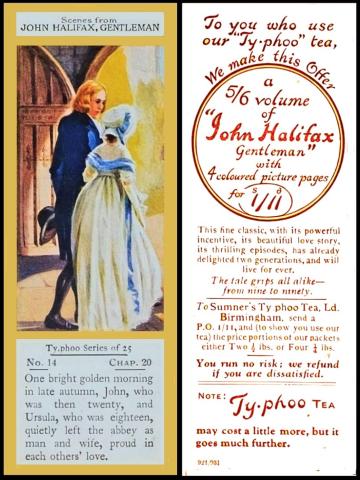
TYPHOO [trade : tea : UK] "Scenes From John Halifax, Gentleman" (1931) 14/25 - TYP-560 : SUM-14
Today marks the two hundredth birthday, not of our character, John Halifax, Gentleman, but of his creator, who was born at Stoke on Trent in 1826.
She, and indeed she was a lady, was christened Dinah Maria Mulock. Her father was a minister, and seems to have had periods of reasonably secure finances and times of great penury, which affected his health quite badly. By the time she was thirteen, she was living in London with her mother, writing the occasional poem and being delighted when they were published. However, just six years later, in 1845, her mother died. Her father did not want her back, and there is not a word of what happened to any of her siblings.
Probably because of that, she decided to stay in London. She had several friends, and through them she met a writer called Camilla Toulmin. All these afforded her great encouragement to continue with her own writing, and from 1846 she was being regularly published in magazines and periodicals, including "The New Monthly Belle Assemblee", a magazine which was primarily fashion news, but also published short stories. Some of these pieces were one offs, but some were expanded and made into other, longer novels
Her first novel is often said to be "The Ogilvies : A Novel", published in 1849. This is not strictly true, but it was her longest ever work. and ran to three volumes. Her first book was actually "Michael the Miner" written for the Religious Tract Society, in 1846, and she had just published a book called "Cola Monti", about a young Italian of that name who moves from his village to a large town and starts a journey towards becoming an artist.
Our book, "John Halifax, Gentleman", was first published in 1856. By then she was thirty years old, and living in Hampstead. The novel is set in Tewkesbury, Gloucestershire, an area she had visited but not lived in, and that led to some inaccuracies, though because of the fame the book brought to the area she has a memorial in Tewkesbury Abbey.
Card number 9 of John Player`s "Characters From Fiction", issued in 1933, tells us that "John Halifax, Gentleman, by Miss Mulock, afterwards Mrs. Craik (1826-1866), first appeared in 1857. This fine novel was planned in 1853 when the authoress was staying near Stroud, Gloucestershire; the town of Tewkesbury is the "Norton Bury" of the book."
It is a simple tale, set in the Industrial Revolution, about an orphan, who is kind of adopted by a Quaker tanner, Abel Fletcher, of Norton Bury after helping his invalid son, Phineas, who is the narrator of the book. John Halifax teaches himself to read, write, and do mathematics, and is given a job as a clerk in the tannery. Eventually our man becomes Abel Fletcher`s apprentice, and accompanies him on a brief stay in the country, where he meets a man called Mr. March, who has a daughter, Ursula, with whom John Halifax falls in love, though it is hopeless, for she is only to marry a gentleman. When Mr. March dies, it becomes ever more hopeless for the two lovers to meet, in fact he thinks of emigrating, but somehow the two get together and everything goes wrong; she has a child, who is born blind, the tannery fails, a rival diverts the stream that powers the mill. However this act of vengeance proves his salvation, for he finds a way to run the mill with steam. He prospers, moves to a big house, and becomes a magistrate, treating less fortunate people with kindness and understanding. And both he and Ursula die together, quite peacefully at the end of the book.
In 1865, when she was thirty-nine years old, Dinah Mulock was married, to George Lillie Craik, the nephew of the famous Scottish writer and literary critic. Soon after their wedding he was asked if he would like to become a partner in Macmillan and company, the publishers, and he agreed.
Four years after this, as they had no children, they offered to adopt a small child that was found abandoned in their locality, and they were accepted. They christened her Dorothy, and she went on to marry twice, the first time in 1887, to an Alexander Pilkington. Sadly Dinah Craik did not live to see the wedding, as she died, of heart failure, shortly before it was due to take place. The wedding also ended sadly, in divorce in 1911, though it did produce a son, named John Mulock Pilkington. Some time later, Dorothy married again, to a Captain Richards, who lived at Macmine Castle in Ireland.
As for John Halifax, Gentleman, it was made into a silent movie in 1915, with Fred Paul as the leading man and Peggy Hyland playing Ursula. It was remade in 1938, but only titled as "John Halifax". The stars this time were John Warwick and Nancy Burne; the most exciting thing about it was that it was one of the first performances of Roderick Andrew Anthony Jude McDowall, who would later keep his surname and shorten his forename to Roddy.
Our set was issued in 1931, which, like the John Player card, is right between these two films, but surely too far between either to have had any bearing on the decision to convert it into cards. However the back of our card tells us that if you were a Ty-phoo user, you could send away for a 5/6 volume of the book, with four coloured picture pages, for just 1/11, plus proof of purchase, which was to cut out the price from the cardboard box, either two proofs from half pound packets, or four from quarter pound packets.
Now in our original British Trade Index this issuer is listed as Sumner`s Typhoo Tea, hence the "S" code. It is catalogued as :
- SCENES FROM JOHN HALIFAX, GENTLEMAN. Back inscribed "921/931". Nd. (25). ... SUM-14
However in our updated British Trade Index there has been some changes. I looked back in the other three volumes of the original Trade Index set and it was not recorded in any of those, but suddenly the text in the updated volume reads :
- SCENES FROM JOHN HALIFAX, GENTLEMAN. 1932. 102 x 36. Nd. (25). Vari-backed, 12 backs, as listed at HT-123, plus "Ty-phoo TEA is the genuine ... small ground tea" ... TYP-560
That HT-123 reference is confusing at first for it refers to another set, but if you read on it actually says : "This listing also applies to the set "Homes of Famous Gentlemen", (TYP-390) and 11 to "Scenes from John Halifax, Gentleman", less Nos. 1,3,6 and 7." It did not take too much effort to extract them, though I ended up with twelve, not eleven), and here they are :
- Common tea causes indigestion. `Ty-phoo` TEA, by medical ... not do so. (on cards 11, 16, and 21)
- `Ty-phoo` TEA is grown in the mountains of Ceylon (on cards 8, 13, 18, and 23)
- `Ty-phoo` TEA is so pure that it cannot harm the weakest nerves (on cards 5, 10, 15, 20 and 25)
- `Ty-phoo` TEA is the TEA so different!. Note its mildness, ... blandness (on cards 8, 13, 18, and 23)
- `Ty-phoo` TEA is the TEA so rich ... far again (on cards 4, 9, 14, 19, and 24)
- `Ty-phoo` TEA is the TEA that doctors prescribe ... digestions (on cards 5, 10, 15, 20 and 25)
- `Ty-phoo` TEA is the TEA with that nice nutty taste (on cards 2, 12, 17, and 22)
- `Ty-phoo` TEA may cost a little more ... further (on cards 11, 18 and 21)
- `Ty-phoo` TEA one quality, THE BEST, and one price only (on cards 4, 9 , 14, 19, and 24)
- `Ty-phoo` TEA relieves indigestion ... recommend it (on cards 4, 9 , 14, 19, and 24)
- `Ty-phoo` TEA. There is real economy ... its brew (on cards 8, 13, 18, and 23)
- `Ty-phoo` TEA will save you money, and please you too. (on cards 2, 12, 17, and 22)
Now that was all very well, but when I started hunting out the cards to complete the missing bits, I found it did not tally, and there were slogans that did not appear above. Therefore this is a list that I made myself, by looking at the cards.
- NOTE : Common tea causes indigestion. Ty-phoo TEA, by medical testimony, does not do so." (also on card 5)
- NOTE : Ty-phoo TEA is the TEA so rich in natural juices that it goes "just half as far again"
- NOTE : Ty-phoo TEA is grown in the mountains of Ceylon.
- NOTE : Ty-phoo TEA. There is real economy in the richness of its brew. (also on card 8)
- NOTE : Common tea causes indigestion. Ty-phoo TEA, by medical testimony, does not do so." (also on card 1)
- NOTE : Ty-phoo TEA. There is real economy in the richness of its brew. (also on card 4)
- NOTE : Ty-phoo TEA may cost a little more, but it goes much further
- NOTE : Ty-phoo TEA is so pure it cannot harm the nerves. (also on card 20)
- NOTE : Ty-phoo TEA one quality, the best, and one price only
- NOTE : Ty-phoo TEA is the TEA that doctors prescribe for weak digestions (also on card 22)
- NOTE : Ty-phoo TEA will save you money and please you too.
- NOTE : Ty-phoo Tea is the genuine leaf-edge Tea - not small ground tea.
- NOTE: Ty-phoo TEA relieves indigestion, for which the doctors recommend it.
- NOTE : Ty-phoo TEA is so pure it cannot harm the nerves. (also on card 12)
- NOTE : Ty-phoo TEA is the TEA that doctors prescribe for weak digestions (also on card 14)
- "NOTE : Ty-phoo TEA is the genuine leaf-edge TEA - not small ground tea.
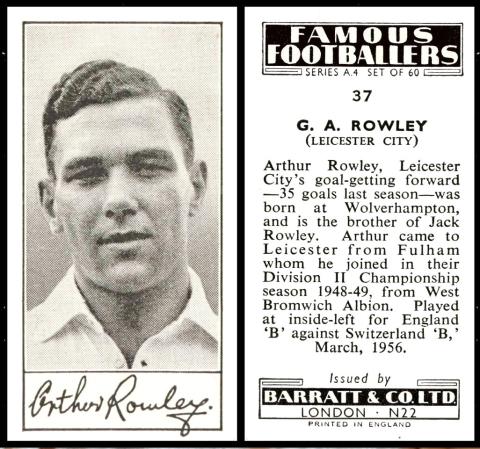
BARRATT & Co. Ltd [trade : confectionery : UK - London, England] "Famous Footballers" - Series A.4 (1956) 37/60 - BAR-325 / BAR-72.4
Our next subject is George Arthur Rowley, Junior, who was born today in 1926, one hundred years ago, and is therefore our first centenary of the week.
He was born in Wolverhampton, the third son of a semi-professional goalkeeper in a nearby local league, and his early talent was encouraged, so much so that he was selected to play for England`s schoolboys team, but he never played, because the Second World War broke out. Instead he stayed at school.
In 1940 he left school and found employment at a sheet metal factory, making war equipment, and we know not what, yet. However his older brother, John Frederick, who had been old enough to go to war, and fight in Normandy, got him a trial at Manchester United, and that secured him a place on their team, as well as a match, just four days after he turned fifteen, making him, to this day, the youngest ever player for that team. And, as you must be wondering, because I was, apparently the youngest ever player in a senior level match was Eric Godpower of Liberia, who made his debut aged just ten years and eleven months!
By the way looking for John Frederick Rowley got me absolutely nowhere, because he played as Jack. He was born in 1918 and his first card was the extraordinarily rare Football Snaps` "Famous Footballers", a set of 96 cards, in which he was number nine. And he appears on thirty one other cards, whilst our man appears on only seven.
Arthur Rowley went on to play several more times for Manchester United but was then moved on to Wolverhampton Wanderers, as a guest player, and then to West Bromwich Albion, where he turned professional in 1944. But four years later he was sold to Fulham, and after just one season he was on the move again, to Leicester City.
This is when he made his first appearance on a card, our card, number 37 of Barratt`s "Famous Footballers Series A.4", but not until 1956, the year that he represented England on the "B Team" against Switzerland. The same photo also appears on card 44 of their 1957 set, "Famous Footballers A.5", but the text is slightly different, removing any mention of his brother, Jack, and adding the facts that "Last Season Leicester City won promotion into the First Division", and our man "scored 44 goals - the highest in Div II"
His next cartophilic commemorations were also in 1957. The first of these, at least in alphabetical order, was Cadet Sweets` "Footballers", though this is actually two sets, for one version has a number, his being number 10, and the other does not. However it is not a simple case that the numbers were omitted, as though the text is the same on both versions, it has been enlarged to fill the gap that the number had occupied. The third card was card 47 of a set called "Football Stars", issued by D.C. Thomson with "Adventure", the boy`s magazine. We do not know which of these came first, in date order but we might, when I have added all the newsletter cards to the index and start working on adding the text from the magazines, because that information could be in the New Issues Reports....
He struggled initially at Leicester City, simply because he replaced Jack Lee, a very popular player who had just moved on to Derby County. But our man was a likeable guy, and a great footballer, so slowly the crowd got behind him, so much so that when he was sold in 1958 there was much grumbling, and many calls to sack the manager, so many that the manager did indeed get the sack. In fact this was rather a shame, as our man had wanted to leave, for he had been offered the job of player-manager at Shrewsbury Town. He then moved on to manage Southend and several other non-league clubs, before retiring for good in the mid 1970s.
Just after that he must have been thrilled to see himself remembered as card 317 of the Sun newspaper`s "Soccercards", and with quite a pleasing portrait too. Here he is part of the "All Time Greats" section, and the text tells us he was a "Burly centre-forward who holds the aggregate goal-scoring record with 434 League goals. In a career that started in the first post-war season and ended as player-manager of Shrewsbury Town in 1965, Rowley holds the highest scorer in a season record for Leicester with 44 in 1956-7 and at Shrewsbury holds both the aggregate record and top scorer in a season record."
There is one thing slightly wrong in that description, for he actually stayed on as just manager, not player, of Shrewsbury Town until 1969.
Something you may not know is that he was also a keen cricketer, and represented Shropshire at county level. And I tried to find a cricket card to throw you off the scent, but I could not.
He died on the 18th of December, 2002, aged seventy-six - four years after his brother, who had died on the 28th of June, 1998, aged seventy-nine
Now this set makes its first appearance in our original British Trade Index part two, but rather buried amidst the listing for sets A.1 to A.15, which are catalogued as a group.
FAMOUS FOOTBALLERS - "Series A.1" to "Series A.15
4. Series A.4. 1956. Small. Black. (60). No. 25 (J. Jauld) is found with team (a) Everton (b) Charlton.
This is actually a typo, as the player`s name was Jimmy Gauld. And actually the (a) and (b) are in the wrong order, because the first version to be issued reads :
"25. J. GAULD (CHARLTON ATHLETIC) Inside-forward Jimmy Gauld of Charlton Athletic formerly played for Waterford. During the 1954-55 season he was chosen for two International League games, playing at inside-right for the League of Ireland against the Football League and against the Irish League. During his first season with Charlton (1955-56) he scored 18 goals."
The second version reads as follows, definitely proving it came after the first :
"25. J. GAULD (EVERTON) Inside-forward Jimmy Gauld joined Everton, October, 1956, from Charlton Athletic for £10,000. He had previously played for Waterford.. During the 1954-55 season he was chosen for two Inter-League games, playing at inside-right for the League of Ireland against the Football League and against the Irish League."
This naming error was not picked up in any of the original British Trade Indexes, nor in our updated volume, where the entry for our set reads :
- FAMOUS FOOTBALLERS SERIES, A4. 1956-7. 65 x 35. Black. Nd. (60). No.23, text, next to last line, a) scorer, b) scorers, and No.25 is found with team a) Everton, b) Charlton ... BAR-325
Card 23 shows John Charles, of Leeds United, and it is just that one word which changes, converting the final section from "Was top of the League Goal scorer, 1953-54 season, with 42 goals." to "Was top of the League Goal scorers, 1953-54 season, with 42 goals."
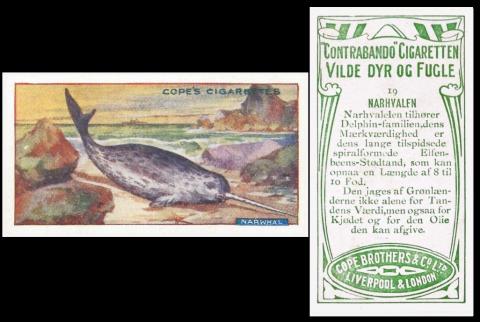
COPE Brothers & Co. Ltd [tobacco : UK - Liverpool and London] "Vilde Dyr og Fugel" / wild animals & birds (1907) 19/25 - C798-390 : C132-45
An odd one now, for today is #NationalNarwhalDay.
The narwhal is a seldom seen, ancient beast, with a spiralled horn akin to a unicorn. Their home is in the Arctic, Canada, Greenland, and Russia, many fathoms below the ice, and they migrate, en masse in the summer, for breeding purposes.
They were first catalogued by Carl Linnaeus in 1758, using a term from old Norse, Narhval, which is actually why we picked this card, for the title on it is Narhavalen. The word means the corpse-whale, for two reasons; firstly its grey, shroud-like colour, which whitens as they age, and secondly, its summer practise of laying completely motionless atop the waters to get the sun on its skin.
The technical name for them is Monodon monoceros, which means, in Greek, that it has one tooth and one horn. It seems to have no living relatives, but is similar to the beluga whale - so similar that they are known to interbreed, successfully - and it seems that at one time these two were one species, which somehow split off, perhaps when the land masses changed, for they are that old, possibly as many as eleven million years old. In fact the beluga whale is also known as the white whale, another link to their original closeness.
As for its unicorn "one horn", that is mainly seen in the males, which is probably how its purpose has come to be regarded as a weapon. Some males grow two. And some lady narwhals also grow them, though they are much smaller. The "one tooth" is also not strictly correct, as they have two, but they are very small and often joined together, it is easy to see how Mr. Linneaus was mistaken there.
As for cartophilic narwhals, most people seem to think they only began with a most curious spotted creature which was shown as part of Liebig`s "Strange Animals" in 1912. However our card predates that by five years. It was also issued twice, once with a back in English and once, as we show here with a back in Scandinavian. The English version is the same set, and size.
This is not the only Scandinavian set, either, there were five, all exact copies of the English sets, save one, which was specific to that country and is a set of Scandinavian actors and actresses, in black and white, with plain backs.
Today`s set is recorded in our original World Tobacco Issues Index with the following header :
2.B. THE `CONTRABANDO" ISSUES. Danish language issues. Except for set C132-42, the series have the same fronts as the equivalent English Set in 2.A above, with backs reprinted in Danish.
- VILDE DYR OG FUGLE (Wild Animals and Birds). Sm. 68 x 36. Nd. (25) C132-45
And the entry in the updated World Tobacco Issues Index is exactly the same, save a new card code, of C798-390
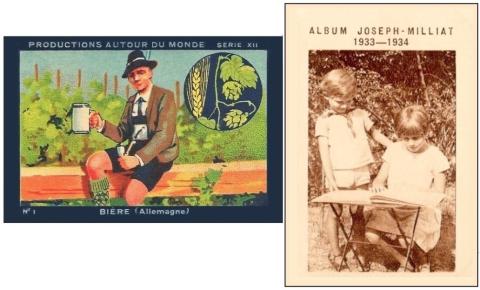
Joseph MILLIAT [trade : food : O/S - Lyons, France] "Productions Autour du Monde" / products round the world (1934) 1/12
Drink up, for we are almost half way to closing time. And, in honour of today, you had better make it a Krombacher, a Warsteiner, or a Beck, for today, and every April the 23rd, is #GermanBeerDay.
There is very good reason for this event, and it dates right back to 1516, when something called the Reinheitsegebot was introduced across Germany by Duke Wilhelm IV. This was a law, which had been effective in several regions of Germany, and it basically forced brewers to only use pure ingredients, at the time just water, barley, and hops, and nothing else. There seems to have been two reasons for this, firstly because there had been a rash of beer corrupting, when all manner of items were added to the brew, some of which were actually toxic, and secondly because at that time beer was often enhanced with wheat or rye. Now that was also used for making bread, the price of which had been continually rising, due to brewers buying up the wheat and rye.
Now we have to stress at this point that there is a difference between beer and lager, and also between what we now know as wheat beer, because today, although the Reinheitsgebot was never repealed, wheat is again allowed into beer, so long as it is labelled as being a weizenbier or a weissbier.
Yeast is also allowed, not because of any change to the law, more to the fact that when the law was passed the advantage to adding yeast to beer was still to be discovered. Those advantages were only discovered in 1857, by Louis Pasteur, at which point it was simply pencilled in to the Reinheitsgebot.
It was not until 1993 that the law was legally revised to say that German beer is only to consist of water, malted grains, hops, and yeast.
Now Joseph Milliat made all kinds of food, and we know that the film stars were issued with pasta.
This set is really well coloured, but there is a problem, most usually, which our card has escaped, and that was the fact that they could be redeemed for prizes, and though the cards were returned, they had a pattern of punched holes in them, which is rather annoying.
We do have a list, as follows :
- Biere (Allemagne)
- Choucroute (Alsace)
- Tulipe (Hollande)
- Pasteque (Orient)
- Orange (Algerie)
- Datte (Maroc)
- Grenade (Espagne)
- Cacao (Mexique)
- Vanille (Antilles)
- Banane (Gabon)
- The (Japon)
- Riz (Chine)
Thanks to a reader, we know that there were twenty series, each of twelve cards, that fitted into a paperback album, one set on each page. And that though the company retailed many foodstuffs, these cards were issued in 1934 with pasta. They are also not the same style of card throughout, the first ones being black/green/blue and white with white borders, the coloured cards coming later, starting with the birds, as Serie VI - and often having different coloured, or white, borders, not always square ones, just to make it to all the more confusing.
The full list of series are :
- Serie I - Compositeurs de Musique / musical composers (B&W)
- Serie II - Artistes Cinema (Femmes) / female film stars (B&W)
- Serie III - Artistes Cinema (Hommes) / male film stars (B&W)
- Serie IV - Les Champions / champions (B&W)
- Serie V - Peintres / painters (B&W)
- Serie VI - Les Oiseaux / birds (colour)
- Serie VII - Animaux Sauvages / wild animals (colour)
- Serie VIII - Sports Modernes / modern sports (colour)
- Serie IX - Gymnastique Scolaire / school gymnastics (colour)
- Serie X - Habitations ? / dwellings
- Serie XI - Jeux d`Enfants / childrens games (colour)
- Serie XII - Productions Autour du Monde / products round the world (colour)
- Serie XIII - Les races / human races (colour)
- Serie XIV - Fleurs d`Europe / flowers of Europe (colour)
- Serie XV - Costumes d`enfants / childrens costume through the ages (colour)
- Serie XVI - Bateaux - boats (colour)
- Serie XVII - Moyens de Locomotion / means of transport (colour)
- Serie XVIII - Chiens / dogs (colour)
- Serie XIX - Arbres du Foret ? / forest trees
- Serie XX - Scenes de Cirque / scenes from the circus (colour)
The only two sets left to check the French title I have made up is correct, and whether they are, as I suspect, coloured cards, are serie X (Habitations / Dwellings) and serie XIX (Arbres du Foret / Forest Trees)
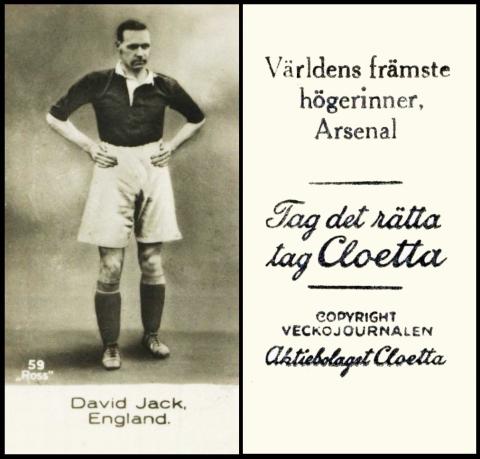
CLOETTA [trade : confectionery and nuts : O/S - Sweden] "Sportsmen" (1933) 59/158
As our parting shot, we close with another centenary, and that is of the 1926 F.A. Cup Final, which brought together 1923`s winning side, Bolton Wanderers, and newbies to Wembley, Manchester City, though they had actually played in a Cup Final before, way back in 1904, when it was held at Crystal Palace.
In fact, now I look it up, that 1904 Cup Final was Bolton Wanderers vs Manchester City, and Manchester City had won, by a single goal.
I can also tell you that the first appearance of Bolton Wanderers was in 1894, when they lost to Notts County by four goals to one, at Goodison Park.
In 1926 the semi finals saw Manchester City beat Manchester United by three goals to nil, and Bolton Wanderers beat Swansea Town by the same result.
That brought Manchester City and Bolton Wanderers to the final, which started well for Bolton, as they were favourites, and they won the traditional coin toss. All but one of their field had also played at Wembley before, in the 1923 Cup Final, and won; the newbie being Harry Greenhalgh.
By all intents and purposes it was a good match, and there was no time that a clear winner could be judged, but luck came just fourteen minutes from the end, when David Jack scored what would be the only goal. That meant that Bolton Wanderers won the cup, and the honour of being the only club to win at Wembley for a second time.
As for the goal scorer, David Bone Nightingale Jack, he was born on April the third, 1898, in Bolton, son of another famous footballer, Bob Jack, player with many teams and manager of Plymouth Argyle You may think it curious, then, that his career began at Plymouth Argyle, at least according to his "rookie" card - number fifteen of Magnet Library`s "Real Photos of Famous Footballers", issued in 1922. However his next appearance on a card, the same year, in D.C. Thomson`s "Cricketers and Footballers", tells us that he was brought up in Plymouth, and that is explained by the fact that his father became Plymouth Argyle`s first ever professional player in 1903. That card also adds another team to his career, for it says he "Assisted Chelsea during the War".
It was almost certainly his father`s influence that got our man a trial with Plymouth Argyle in 1919, shortly after which he joined the team. He was then aged twenty-one, quite late in life, and that is explained by the fact that he had served his country during the First World War, in the Royal Navy. Now if he was able to "assist Chelsea" he must have been based within London, rather than out at sea, so I will have to do a bit more digging, though he has quite a common name, it may take some excavation...
Now we have to say, at this point, that there seem to be no cards of him at Plymouth Argyle, they all show him after his move to Bolton Wanderers, where his father had also played, which took place in 1920. He played most of his career there, almost three hundred matches over eight seasons. And in his first appearance at a F.A. Cup Final, in 1923, he had also scored a goal, becoming the first player to ever score one at Wembley.
That probably caused his call up to the England Squad, in 1924, and he remained a stalwart until 1932, appearing in nine matches, captaining four, and scoring three goals. But in 1928 he left Bolton Wanderers and moved to Arsenal; it appears he did not want to, but he was a valuable player, probably their most valuable, and Bolton was in a bit of a monetary crisis, so accepted the offer, by Arsenal, of what, at that time, was a record fee - ten thousand, six hundred and forty seven pounds, and ten shillings. The reason for the high figure was not so much his playing ability, though, it was more that Charlie Buchan had retired and Arsenal were having great difficulty filling his shoes.
Now after a lot of research, at least on the part of one of my football contacts, they have come up with the certain knowledge that his Arsenal "rookie" card is not, as usually reported Major Drapkin`s "Sporting Celebrities in Action", dating from 1930, but Barratt & Co.s "Football Stars", those curious cartoon caricatures on jet black backgrounds, issued in 1928/29, as two series - the first version of which sees him named for Bolton Wanderers and without any colour on the card but black and white, and the second version of which has him named for Arsenal, with the shirt coloured in red.
He stayed with Arsenal until he retired, in May 1934, after winning his third League Championship medal. But he did not hang up his boots, as he went on to manage Southend United, Middlesborough, and Shelbourne, in Ireland, leaving them only in April 1955. And, sadly he did not live long after that, dying at the age of sixty, on the tenth of September 1958.
As for Cloetta, they were once a family firm, founded in 1862, in Copenhagen, Denmark, by three brothers, Bernard, Christophe and Nutin. The original name reflected this, for it was Brodrene Cloetta. The three brothers then relocated the manufacturing across the border to Sweden, and it seems that Nutin started a subsidiary in Malmo, which opened in 1873. We also think he was also responsible for another subsidiary, in Oslo, which opened in 1896.
In 1917, the Svenfelt family somehow acquired a majority shareholding in Cloetta, though they kept hold of it, and still have major ownership interests at time of typing.
The wording on this card, "varldens framste hogerinner" is kind of odd, because in Swedish and Norwegian it translates to "the world's leading ladies" and in Finnish to "the world`s leading high school student". I agree with the world`s leading, but am seriously stumped by the "hogerinner" bit....
This week's Cards of the Day...
saw us off on a road trip, with a difference, as we celebrated both Pan-American Day, on Tuesday the 14th of April and Pan-American Week, which started on Sunday.
The idea of that celebration is a remembrance of the 1890 conference that established the International Union of American Republics, in order to bring peace, harmony friendship, and co-operation throughout the continent of America, a landmass which extends from Murchison Promontory, Nunavut, in Canada. through North America , squeezing through the narrowness of Central America, and then going all the way down to Aguila Islet, part of the Diego Ramirez Islands, in Chile.
We have taken a bit of a liberty with this, and decided to travel the Pan-America Highway, which, technically, is a road that runs all the way down that continent, some nineteen thousand miles, but only goes to prove that manufacturing any form of unity, whilst an applaudable dream, is very unlikely to ever happen....
And so to this week`s clue cards.
Saturday, 11th April 2026
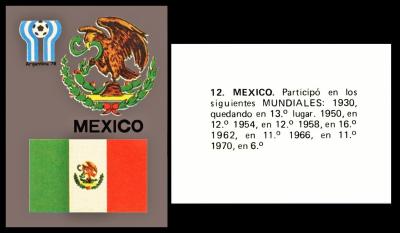
Our week, and our journey, started in Mexico, and with several good reasons.
Firstly, after the 1923 International Conference, that saw the Pan-American Highway gain a lot more acceptance, and the next one, in 1928, that saw the scheme approved, the route started in Mexico and ended in Buenos Aires.
Secondly, the first construction to begin on the road began in Mexico.
Thirdly, though our long and winding road technically starts at Prudhoe Bay, within the North American state of Alaska, it is not officially designated as part of the Pan-American Highway, it is titled as the Alaska Highway. It also changes name several times as it passes through the Yukon and into into British Columbia. When the road hits the border into North America this strange state of affairs continues, as though it was way back in 1966 that the Federal Highway Administration openly stated that the interstate highway system was part of the Pan-American Highway, they never bothered to change the signs, or anything else, and to this day you will find no written proof on any maps or plans. However if a driver, or anyone, come to that, was to look at the roadway system from Alaska downwards, it is pretty obvious to see that this long and fairly straight highway route is there for the taking.
And so, officially, our road only becomes the Pan-American Highway after it has waved goodbye to the entire continent of North America, at a place called Laredo, on the Texas border, and entered Mexico, at a place called Nuevo Laredo. Strangely, this section of the Pan-American Highway is very similar to that long and winding road from Prudhoe Bay, and it also changes name several times as it passes through Mexico, but it is still known as the Pan-American Highway, which makes it even odder that North America and Canada does not. Though we must say that Mexico does not always call it that, preferring the more honest term of the Inter-American Highway, simply because it is the road that takes them up into America.
It extends right down to Guatemala, crossing the border at Cuidad Cuauhtemoc - which was the finishing line of the first ever Carrera Panamerica race in 1950, a race which began at Ciuadad Juarez, just below the border with America, some 2096 miles away. This was a race designed to celebrate the delight at the completion of this section of the roadway, and it was a huge event, even though it took six days to complete, entered by world-wide racers from every form of motor sport, a bit like a giant gumball rally, but it also allowed for members of the public to take part, including women, nine of whom drove in it
The race would go on every year until 1954, though the start and finish line differed. In 1951 it was run the other way ending at the American border, to suit the American drivers and fans. It was eventually cancelled due to the fact it was a very dangerous race, and twenty-seven fatalities, of drivers, crew, and spectators, had occurred over those few years, giving it the unwelcome statistic of having the highest death rate per event of any form of motor sport past or present.
It did leave us one lasting legacy, and that was the reason why there is a Porsche called a Carrera. You see though the first Porsche cars to drive in the race, in 1952, had been privately owned, this suggested to Porsche that it would be a good idea if the factory entered a team in 1953. This was duly done, using a pair of the latest Spyders, but they failed to finish, the only two which did again being privateers. But in 1954 the works team not only came home third and fourth in the main race, they were first and second in their class.
However that may have been the final race, but it was not the end for the Carrera Panamericana, and it was revived in 1998, as a week long event on only certain parts of the former course, splitting the entrants into ten classes in order to compensate for the speed and power differences which caused many of the accidents in the original version. And most of the entries nowadays are from drivers of 1950s and 1960s cars, making it more of a tribute than a no holds barred speed fest.
Our sticker today comes from a set that covered the Spanish League Championships and the World Cup in Argentina. However that World Cup was not a good one for Mexico, and it is chiefly remembered for its biggest ever defeat, being beaten by six goals to nil by West Germany, though they beat the other teams in their group, Tunisia and Poland, with a score of three goals to one in each match.
The first sixteen cards in this set are like ours, relating to the World Cup, all being silver backgrounds with the blue and white World Cup logo for that year, which, in itself was controversial, being based on a popular gesture by Juan Peron, who had been deposed two years before the tournament actually took place. The two other things on each sticker differed, for they were the emblem of the country, and its flag. The countries were :
- Argentina
- Alemania Federal (West Germany)
- Austria
- Brasil (Brazil)
- Espana (Spain)
- Escocia (Scotland)
- Francia (France)
- Holanda (Holland)
- Hungria (Hungary)
- Italia (Italy)
- Iran
- Mexico
- Peru
- Polonia (Poland)
- Suecia (Sweden)
- Túnez (Tunisia)
All of those cards had a text back about the country, and ours tells us that Mexico has taken part in the World Cup right since 1930, which was held in Uruguay. Unfortunately they went out in group one, after losing against Argentina, Chile, and France. However one of those teams, Argentina, made it all the way to the final, where they were beaten four goals to two by Uruguay, the host country.
Now if you came across that part of the set and looked for more, you would be unlucky, and you would probably think it a set of just sixteen cards. That is not the case though, it was simply the fact that the set changed the back after these cards to a pink design of circles with flowers inside (and we will use one of those some time so you can tell them apart more easily). These pink backed stickers showed players from the following Spanish League clubs, and in this order :
- Real Madrid
- F.C. Barcelona
- R.C.D. Espanyol de Barcelona
- Atletico Madrid
- Valencia C.F.
- Athletica Bilbao
- Sevilla C.F.
- Racing de Santander
- Seleccion Espanola
- Rayo Vallecano
- Burgos C.F.
- Real Sociedad
- U.D. Las Palmas
- C.R. Huelva
- R.C. Celta de Vigo
- Hercules C.F.
- Sporting de Gijon
- U.D. Salamanca
- Real Zaragoza
So let us now have a chat about the issuer, MAGA. This was founded in 1951, by Manuel Gago, and it takes its name from the first two letters of its founders forename and surname.
Senor Gago had previously worked for another, similar company, called Editorial Valencia, which had been founded in 1932, and its output was a mix of Spanish language melodramatic novelas, and what is called theatre scripts, but seems more to have been novelisations of those plots. It stopped all its printing when the Spanish Civil War started, and we are not entirely sure if the founder, Juan Bautista Puerto Belda survived that, because in 1940 it reopened, under the control of another person, Juan Manuel Puerto.
Now he is a very important person because he produced a book of stickers, "Deporte e Instruccion" (Sports and how to play them). However, he seems not to have made any more, moving instead into children`s comic books.
In 1950, Manuel Gago, whilst working for Editorial Valencia, decided to test the waters as to going it alone, so he founded a sideline business, Editorial Garga, with his father and his two brothers, Gago and Pablo. It seemed to be working so in 1951 he started another business, called MAGA. They specialised in adventure stories, mostly tales of yore, and it went so well that he left Editorial Valencia in 1954. For a while they continued to thrive, but the 1960s saw a world where entertainment was primarily supplied by television, not print, and in 1966 they stopped publishing the comics entirely.
All was not lost, as in 1965 they had decided to move into stickers and albums, which they did, very successfully, for another twenty years.
But in 1986 they closed, forever.
Sunday, 12th April 2026
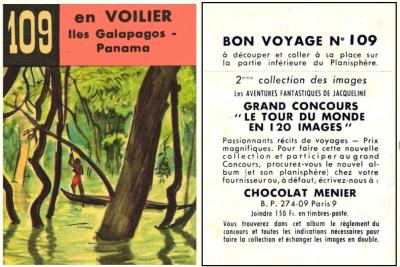
After leaving Mexico, we motored on down through Guatemala, El Salvador, Honduras, Nicaragua, and Costa Rica.
The stretch of road from Costa Rica was slightly different as it was constructed by the American Army Corps of Engineers, who were suddenly worried about access to the Panama Canal should war affect that region. It was started in 1941, just after America had joined the hostilities.
Then we carried on into Panama, and hit a big problem, for the Pan-American Highway ends, abruptly. At one time it was even shorter, ending at Canita, but it now ends at a town founded in 1638 by Spanish missionaries as San Jerónimo de Yaviza, rather a lawless area at that time, even a fort, constructed in 1760, only lasted for twenty years before it was overrun by the indigenous population. However, this extra construction of the road became more and more awkward, and the men were forced to give up, in fact for many years the Pan-American Highway petered out as a dirt track, and abruptly ended in the middle of nowhere. However more recently this has been upgraded and it is not such a strange ending for such a mighty road.
There was another reason why they stopped, though, and that is something known as the Darien Gap. Now this card is not named as the Darien Gap, but it has many of its characteristics, for the area is remote, impassable, except by canoe, as it is a system of deep waterways and dense rainforests. It is also very dangerous, for it not only marks the border between Panama and Colombia, but the border between North and South America, and because of that it is one of the most likely places that migrants attempt to get through, or are convinced by a trafficker that it is possible to do such a thing. We do not know, and will probably never know, how many people attempt this journey, or how many people make it, but we are fairly sure that those who make it are very much less that those who start out, and are never seen again.
This set is a far cry from the early chromolithographs that we usually associate with Chocolat Menier.
Now if you are trying to complete it, do bear in mind that it is known by several titles - "Bon Voyage", which appears at the very top of the reverse, and simply means have a good trip - "Grand Concours "Le Tour du Monde" en 120 images", which is the large text right in the centre of the reverse, and which means the grand around the world competition - and "Les Aventures Fantastiques de Jacqueline", which is in tiny text just above that, and means the fantastic adventures of Jacqueline, though I have no idea who Jacqueline was and have yet to spot her on a card.
The one we picked is simply because there was a map/wallchart, drawn by J.B. Jannot, and that was entitled "Le Tour du Monde - en 120 images - Grand Concours du Chocolat Menier".
Now if you find one of these, and they are not particularly rare, you may be wondering why there are spaces for only the first three cards, number one just above Karachi, number two slightly above and to the right, and number three just above La Paz. However, most of the wallcharts you will find have something missing, that being a panel right across the bottom below the map, which is split into 120 little boxes, in which you were supposed to write the location on those numbered cards, and then presumably, detach the panel and return it. And as for the three "cards" on the map, they relate to questions that were on those cards, for there is a place to write them in too, along with a third part, where you had to write down "parmi tous les lieux ou est passee Jacqueline, quels sont les 5 lieux ou vous aimeriez aller?" - or among all the places she has been what are the places you would like to visit? There was also a section for you to write a slogan, in under ten words, - which I have not fathomed out yet.
Another thing that I was told is that you had to stick the cards in these little boxes, not write in the names - this was something I discounted, as it would have been too unwieldy, and also how could you stick one in between two others already there, when each is but a small box? But this may be partially correct, as if you look at the reverse of our card it is perforated, at a point which corresponds, on the front, with being below the large number in the black box and the pink oblong with the wording. The map was 29.5" x 43", so, as these are quite small cards, would have been a possibility.
And whilst fathoming that out from a variety of sources, I found Jacqueline, who turns out to be a small, sweet, little girl, who was used in their advertising as a kind of mascot, and whose first appearance came in 1893, when she was depicted writing on a wall with a piece of chocolate.
As for a list, well I can start, with
- en AVION Paris-Le Caire
- en TRAIN
- en AVION Le Caire-Stanleyville
- en AUTO de Stanleyville a Banalia et dans la Foret Vierge
- en AUTO dans le Foret Vierge jusqu`a Beni
- en AUTO Routshourou - Kysengi
- en AUTO Kysengi - Costermansville
9 and 10 make a scene together, half on each card - en BATEAU Kigoma - Albertville
- en TRAIN Livingstone - Johannesburg
- en AVION Johannesburg - Nairobi
- en TRAIN Tel Aviv - Jerusalem
- en AUTO Jerusalem - Bethleem
- en AUTO visite a le Mer Morte et ou Jourdain
- en AUTO Jerusalem - Baghdad
- en AUTO Bagdad - Babylone
26 and 27 make a scene together, half on each card - en AUTO Babylone - Ur
this may show Jacqueline, surprised by a snake - en AUTO Kournah - Bassarah
- en AUTO Bassarah - Karatschi
- en AUTO Karatschi - Bombay
- en AUTO Bombay - Peshawar
- en AUTO Peshawar - Kaboul
- en AUTO - de Kaboul a ? (Enigme No.1)
- en AUTO Kaboul - Peshawar
- en AUTO - ? (Enigme No.1) a Kaboul
- en AUTO Peshawar-Delhi
- en AUTO Delhi - Indore
- en AUTO Indore - Oudaipour
- en AUTO du palais du Radjah a Agra
- en AUTO Goudiraknayapura - Colombo
- en BATEAU Jong-Kong - Canton
- en BATEAU Canton - Hong Kong
- a PIED l`ascension du Fuji-Yama
- en TRAIN Tokyo - Yamada
- en TRAIN Yamada - Tokyo
- en AVION Tokyo - Formose
- en AVION Formosa - Manille
- en AUTO Manille - Baguio
- en AVION Manille - Zamboanga
- en BATEAU Zamboanga - Badjermassim
- en AUTO visite de l`Ile du Bali
- en TRAIN Sydney - Rockhampton
- en BATEAU Rockhampton - Port-Moresby
- en GOELETTE Iles Gilbert - Iles Fidji
- en AVION Papeete - San Francisco
- en AVION San Francisco - Santa Fe
- en AVION La Nouvelle-Orleans - Miami
- en AVION Fort Churchill - Mexico
- en TRAINEAU un tour dans le Grand Nord
- en AVION Miami - Fort Churchill
- en AUTO Mexico - Pahuatlan at retour
- en BATEAU excursion aux Iles San Blas
- en BATEAU un tour dans le Panama
- en VOILIER Panama - Iles Galapagos
- en VOILIER Iles Galapagos - Panama
- en AVION Panama - Quito
- en AVION Quito - Manaos
- en AVION Manaos - Quito
- en AUTO Quito Santa Helena ou retour a Quito
- en AVION Lima Cuzco
- en AUTO Cuzco - ? (enigme No.3) et La Paz
115 and 116 make a scene together, half on each card - en TRAIN Santiago - Buenos-Aires
Monday, 13th April 2026
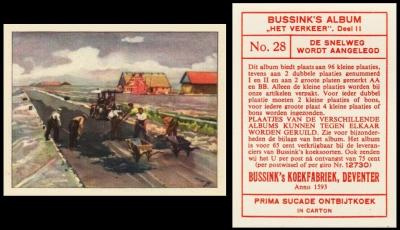
Now those two cards saw us off on our journey but they did not provide the road, so our third card showed just that, being carved through what was formerly open land, for if you look closely there is but a farm, whose lands are now lost forever, and whose peace and quiet will never be the same.
And in this you can see, and sympathise with, the indigenous peoples of the Darien Gap, whose world would be forever altered if a road came crashing through.First of all, "Het Verkeer" is Dutch for "The Traffic". And as we see here, that is not just the vehicles that travel, it is the roads they ride upon. And, sadly, though there is no descriptive text, there is a title "De Snelweg Wordt Aanglego", which means, in English, the highway is being constructed. It`s just a shame that there is not any word of which highway, where.
This was the second collection by Bussink, after ten volumes of "Mijn Land" (or my homeland), and it retained the same team of author, G. J. Nijland, and illustrators, Wubbo de Jonge and J. Pander.
Our card is actually from the second series of "Het Verkeer", which was issued in 1939, and is divided into three chapters, covering land, water, and air. It is easy to tell the first series, with its blue back, from our second, with a red back. There was also a third series, but not until 1948.
The album, which cost sixty-five cents if it was bought at a supplier, or seventy-five cents if you sent away for it by post, was almost identical to Volume one in the way it looked, but it was in vertical format rather than horizontal. That was a good idea as far as layout was concerned, as it took into account that the second series had only ninety-six standard pictures, with two longer ones, and also two large plates - but it did mean that they did not fit so well on a shelf.
The album gives a date of February 1940, but though the cards were still being issued for a short time after that, the progress of the Second World War stopped them.
Tuesday, 14th April 2026
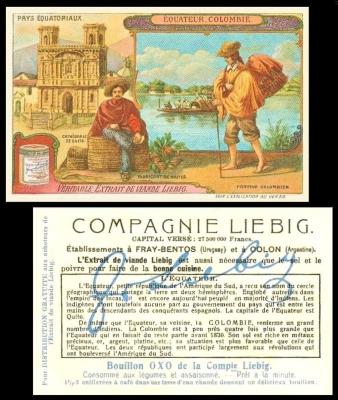
Now there are ways to bypass the Darien Gap. The easiest and quickest is to take an aeroplane from Panama City to Medellin in Colombia, but people who are driving the route most usually take a ferry, from Colon in Panama to Cartagena in Colombia.
The first section of the Pan American Highway after the Darien Gap actually starts in a place called Turbo, in Colombia, which is almost six hours by road from Medellin Airport. However Cartagena is even further away, eleven hours drive.
Most of the Colombia section is a toll road, with several tolls, and frequent places where one road becomes two and you are not quite sure which one to take. And when it crosses the border into Ecuador tolls are also still levied. However in Ecuador there is much confusion, because the road is called Troncal de la Sierra (or road to the highlands) it is only called La Panamericana by locals, and is seldom recorded as so on any signs.
This card was chosen because it shows both Colombia and Ecuador, though in reverse order. The set was issued in Dutch and French, and the cards, in the French version, are
- Afrique Anglaise
- Borneo
- Bresil [Brazil]
- Congo
- Equateur, Colombie [Ecuador, Colombia]
- Sumatra
Many of these countries are the same name in the French and Dutch versions, the exceptions probably being our card, of Ecuador and Colombia, which are the same in Dutch but different in French, and Brasil, which in Dutch is Brazilie. However without seeing the cards I cannot be sure.
There is also a question about the set title for in the Dutch version that may be Betaalt Equatoriaal. Again, maybe you can let us know if this is right.
The most interesting card of the six is the first one on the list, Afrique Anglaise, or English Africa, because this was not a single region, it included countries in the west of the continent (Gambia, the Gold Coast, Nigeria and Sierra Leone), some in the east (British East Africa) and others in the south (Rhodesia and South Africa). However, the card shows a Masai warrior, Lake Victoria, and Mount Kenya, which actually ties it down to British East Africa, later to become known as Kenya. So as this card was issued in 1912, it ought to have been titled for British East Africa, or, at that time, Afrique Orientale Britannique.
Wednesday, 15th April 2026
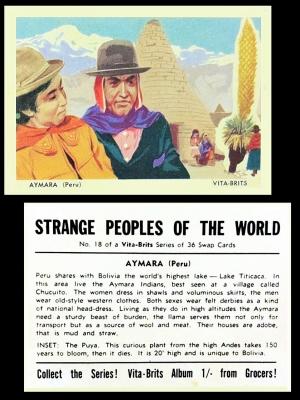
If we stayed on our road into Peru we would find it instantly renamed to the Ruta Nacionale, or PE-1, and, under those names, it takes us the whole length of the country, more or less along the coastline, some 2,661 kilometres - though it is split into PE-1N and PE-1S, those letters standing for North and South. Again it is sometimes tolled, and moves from two lane to four lane highways, sometimes seemingly at random.
Most of its traffic is commercial and industrial freight but the road is sold to drivers, especially those from overseas, as a way of boosting tourism.
Building this section came quite quickly after the 1923 Pan-American Conference in Chile, thanks to a far-sighted President, Augusto Leguia, who realised that a large road would increase trade with its neighbouring countries and also lead to modernisation of his own. And it also helped with unemployment, for the road was a manual task that required a huge workforce. After him, the road was more or less abandoned; it was only the military leadership of the 1970s and 80s that realised the road was key to their defences, and they started a radical programme of upgrades and new sections, both in length and width. And the next real improvements to the road did not come for another twenty years, after the disastrous Pisco earthquake, and its associated aftershocks, which led to much rebuilding with more stringent earthquake protection systems, many of which were severely tested, and even broached by a succession of devastating El Ninos.
Our card shows two Peruvians outside their adobe dwelling, who probably had little to do with our road, and whose mode of transport was almost certainly the llama. The back tells us that these are Aymara Indians, and that the house is in a village called Chucuito. That is some distance from the Pan-American Highway. It is believed that the Aymara people could date back to the late Mesolithic period, and are largely unaltered. In fact, we also know that they were one of the few peoples who fought back against colonisation by the Incas, though this led to savage punishment. And under the Spanish rule which followed they almost disappeared.
As for their headwear, yes, it is a bowler hat. Apparently this started in the 1920s, when a shipment of these hats was sent out for European railway workers to wear in order to protect their heads from the sun. These hats then became part of local costume, but there are many theories as to why. Some say that any which were too small for the workers were given to local children, whilst others believe that one Aymaran managed to get hold of one of the hats and sported it with gusto, then acquired more for anyone that wanted one for themselves, and they became a bit of a fashion.
Another question revolves around the issuer of this set.
Some say it was Cereal Foods, and other put it under the Nabisco brand. The answer depends on the date, for in the early 1920s a company called Cereal Foods Ltd. was created purely to compete with Sanitarium, it was founded by selling shares, at one dollar each. However in the mid 1930s it was liqudated, and arose once more in November 1935 as Cereal Foods Pty. Ltd. That then acquired the assets of the former Cereal Foods Ltd, which included their best selling brand, Vita-Brits. The brand was later sold to Purina and in 1960, when Purina was bought out by Nabisco, they acquired it. Nabisco suddenly stopped selling in Australia in the late 1980s, and they sold the brand to ICM Australia Pty. Ltd. Shortly after that the Vita Brits brand became attached to one of their subsidiaries, "Uncle Toby`s". That was bought out by Nestle in 2006, but in 2020 they decided to stop production of Vita Brits and contract it out. This cannot have worked too well, as in 2025 Nestle sold the Vita Brits brand to Sanitarium.
The only problem is that I have not been able to find out the year that Purina bought the Vita Brits brand from Cereal Foods Ltd, so, in 1958, when this set was issued, it might have been either of them.
Thursday, 16th April 2026
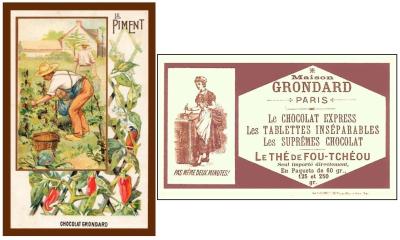
This is a bit of a red herring, or a red chilli anyway. For it brings us to almost the final leg of the Pan-American Highway, the stretch into Chile. and we have to say that chillies are not only not named after the country, but seldom eaten, as Chileans are not that keen on spicy foods.
As for the Pan-American Highway, it goes along what is known locally as Chile Route 5, at least until it almost reaches Santiago, where it bifurcates. After that, one side eventually becomes the Carretera Austral, or the Augusto Pinochet highway, depending on your politics, and remains unfinished, though the dream remains to take it further, right down into Magallanes, and almost to the Antarctic. The other side, which is technically the proper continuation, takes you beneath the Andes, in a long tunnel, and, at some point, right in the middle of the tunnel, you have changed country and are in Argentina.
The main problem with driving this part of the route is the weather, for the road, and definitely the tunnel, are often closed at short notice between the months of May and September. So if you fancy driving the route you have to bear that in mind. The reason for this is not immediately apparent if you are driving up from Argentina, but the entrance from Chile is far more difficult, and the only way to construct the road was to make it a long series of small curving roads that gradually descend into the mountains, and are extremely treacherous in snow and ice, to say nothing of the rather sharp, and often blind, bends. However the Argentine side is also subject to bad weather, and notably, as recent as September 2013, the roads and tunnel were closed for ten hours, due to a sudden fall of half a metre of snow. And this situation is made worse by the fact that this remains the only tunnel.
As far as our card, we just fancied something different from flags and geography. This is from a very well used set, with lots of other issuers, just a quick look online brought it up for
- C BERIOT Chicoree Belle Jardiniere
- Henri FACQ - coffee
- Chocolat GRONDARD
- L. FOURNERAULT Chocolat du Negrillon
- Chocolat IBLED
- Chocolat Cacao Francois MEUNIER - Paris
- Chocolat PAYRAUD
- Chocolat POULAIN
- THIERY et Sigrand, clothing, Lyon
- Chicoree WILLIOT
That meant that we were able to add more cards and over the weekend I will look at each of those individual names and see if I can add some more. But at the moment we know of :
- Le Cafe
- Le Canne a Sucre
- La Capre
- Le Gingember
- Le Laurier Sauce
- Le Mais
- La Menthe Poivree
- L`Olivier
- Le Piment
- Le Riz
- La Vanille
The one thing I don`t know is the title of the set. Maybe you do, and can tell us - along with the identities of any other cards or issuers.
As far as our issuer, Maison Grondard, they are rather a tangled web. Most sources say they were founded in 1853 with a shop located between Rue M. le Prince and Rue de l'Odéon. However there are a couple of sources which give the founding date as 1841. Now we could just discount that, except for one fact, the address, which is 17 Rue de l`Odeon.
Anyway what made their name was that they got a Royal Warrant, or the French equivalent of one, anyway, from Her Majesty, the Empress of France. This led to their expansion, and they relocated, opening two shops, one at 129 Boulevard Saint-Germain, and another at 53 Boulevard Malesherbes as well as the factory at 1, Rue de l`Odeon in Arcueil.
That factory proved too small, and moved to Grand-Montrouge, at 93-95 Route d'Orléans. Now the date of the opening of that factory is a bit sketchy, but we think it was about 1905. By this time it appears to have changed its name to Grondard et Fils, or Grondard and Sons.
They closed in 1922, and further research has proved that for some reason they went bankrupt. And it also appears that they had already sold half of that large factory, as the bankruptcy judgement quotes only number 95, not 93-95.
Friday, 17th April 2026

We close our week with an item that may not be entirely cartophilic but actually mentions the Pan-American Highway, and I could find nothing else that did.
This set contained two hundred and eighty eight pogs but they were not all of one subject, nor one series.The one we show today comes from series two, which was numbered from 265 to 288, but contained subsets of Sailing Adventures (265-269) Pan-American Highway (270-279), and American Highways (280-288). All of these were available with two different backs, but both are the same colour, off white with a mauvey purple text, the only alteration being the fact that this text either says "Slammer Whammers" or "Slammer Jammers". For some reason the ones that say "Slammer Jammers" are much rarer, and I have no idea why.
Out of all the Pan-American Highway ones, this got selected because it shows a Gaucho, and they are, for the most part, from Argentina. And Argentina brings our journey to a close, right down in Ushuaia, in the province of Tierra del Fuego, which is a noted jump off point for travellers to Antarctica.
However the road conditions do vary, quite dramatically, and some places are very remote indeed. But if you started your trip in Alaska, by now you are used to that. It is estimated that this leg of the journey takes two weeks in good weather with no mechanical failures - and up to a month in bad weather. Some people actually stop in Chile, especially if their are running very late on their schedules, and take a ferry across the Strait of Magellan, which definitely cuts the road journey down, but perhaps is a bit of a cop-out.
There have been plans, for some time, to take the Pan-American Highway yet further, to the West Indies. However it would never be able to be done by a single road, or even on land, it would require lots of stops and trips on ferry boats. It would also mean a new road would have to be carved across the country to Florida, from where you would have to sail to Cuba. But once you got to Cuba the road would take in the island of Haiti, the Dominican Republic, and Puerto Rica. Another possible route could be easier, and involve the current road, with a ferry from Yucatan, Mexico, across to Cuba, and this was well researched in 1947, but has not happened yet.
And so, dear readers, we must part for another week. This is your final week to sort out your wants and wants lists and decide if anything from your collection can be bartered or sold, because next Saturday is, as I reminded you at the start, our Annual Card Convention.
But if you can add any of the backs to the Typhoo "John Halifax, Gentleman", do let us know, because I am stuck there!
Thanks for tuning in. And now off you go, to bed.